Last updated: June 13, 2026
The Short Version: A B2B podcast generates leads two ways. Listeners find you, build trust over multiple episodes, and reach out when they’re ready to buy. And the guests you invite? That’s your prospect list. You get a real conversation with an ideal client AND a content asset from the same 30 minutes. Film it on Riverside so every recording becomes a YouTube video, a podcast episode, social clips, and a blog post. Two platforms, 10+ pieces of content per session.
A B2B podcast generates leads through listener trust and guest relationships, producing content that compounds across YouTube, social, email, and search.
If you’re building a content workflow for B2B, a podcast slots right into the middle of it. Not as a vanity project. As the engine.
Here’s the thing nobody tells you about B2B podcasts. The download number doesn’t matter. I know that sounds wrong. Every podcast guide you’ve read probably told you to obsess over downloads. But 77% of marketers now rank podcasts among the most effective content formats for lead generation, and the ones seeing those results aren’t measuring downloads. They’re measuring conversations started, relationships built, and content produced per hour of effort.
A podcast is the only format where you can simultaneously build inbound trust with listeners AND have a direct conversation with a prospect you hand-picked. Cold email rarely breaks single digits on response rate. A podcast invitation? Completely different story.
This post breaks down exactly how to set one up, what equipment you actually need, how to turn every episode into 10+ pieces of content, and why you should absolutely be filming it.
Why Should a B2B Company Start a Podcast in 2026?
Because it does three things at once that no other single channel can.
First, it’s a content engine. One 30-minute recording produces a podcast episode, a YouTube video, a blog post, 3 to 5 social clips, a newsletter segment, and pull quotes for LinkedIn. That’s not a theory. That’s the content repurposing system I actually run.
Second, it’s a relationship builder. Your guest list IS your prospect list. When you invite someone onto your show, you’re not cold pitching. You’re offering them a stage. That changes the dynamic completely.
Third, it compounds. Blog posts decay. Paid ads stop the second you stop spending. A podcast episode from six months ago still ranks on YouTube, still shows up in search, still gets recommended by Spotify’s algorithm. Podcast-engaged prospects close 23% faster than non-engaged ones, according to Content Allies’ 2026 data. The math keeps getting better the longer you run it.
And the audience is there. 67% of Americans now listen to podcasts monthly, up from 62% in 2025. That’s not a niche audience anymore. That’s the majority of the country.
Why Should You Film Your Podcast?
Film it. Every time. This isn’t optional anymore.
If you’re recording audio anyway, adding video costs you almost nothing extra in time or money. But it doubles your distribution surface. You get a podcast AND a YouTube channel from the same recording session. YouTube is the second-largest search engine in the world, and it now has over 1 billion monthly active podcast viewers.
Think about what that means for discoverability. Your podcast episode sits on Spotify and Apple, where people find it if they’re already searching for your topic. Your YouTube video sits in Google search results, YouTube search results, and gets recommended by the algorithm to people who’ve never heard of you. Two completely different discovery paths from the same 30 minutes of work.
The Edison Research Podcast Consumer 2026 study confirmed that video is reshaping how people consume podcasts. Two-thirds of weekly podcast consumers now engage with content at home, and they’re watching on smart TVs and desktop monitors. Audio-only podcasts aren’t dead, but video podcasts have a discovery advantage that’s hard to ignore.
I use Riverside for this. It records each participant’s video and audio locally on their own device, which means quality doesn’t depend on your internet connection. You get separate tracks for each person, up to 4K video, and the whole thing runs in a browser. No software to install. Your guest clicks a link and they’re in.
Riverside also handles the export side. Magic Clips pulls short-form clips automatically. You can publish directly to Spotify, Apple Podcasts, and YouTube from the same platform. For $24 a month on the Pro plan, that’s a lot of infrastructure in one place.
What Equipment Do You Actually Need?
Less than you think. Under $200 gets you started.
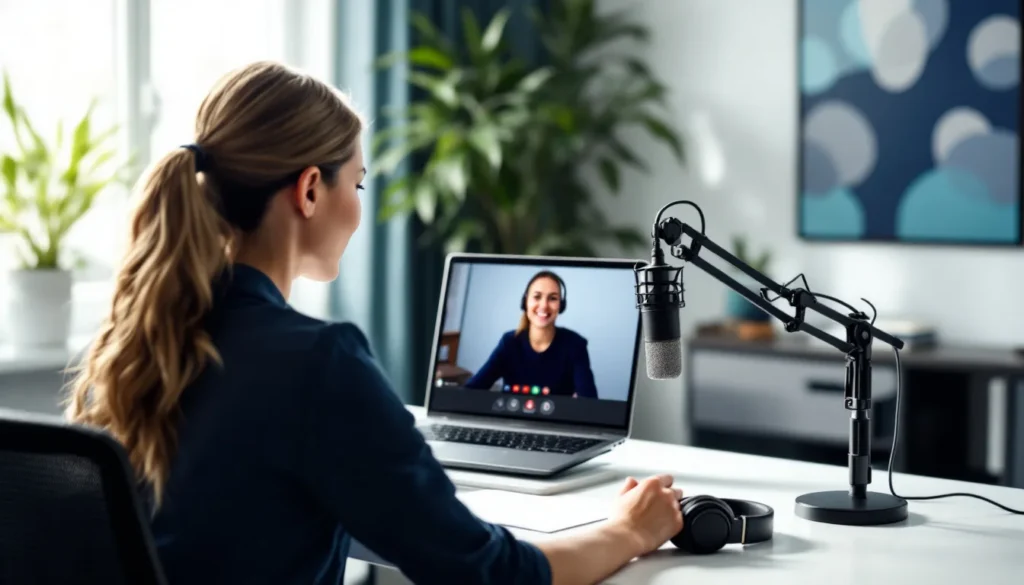
Here’s the actual setup, not the aspirational one. A USB microphone, a pair of closed-back headphones, a boom arm, and Riverside for recording. That’s it.
For the mic, I recommend Shure. The Shure MV7 is the sweet spot for podcasters who want professional audio without a complicated setup. It’s USB and XLR, so you can plug it directly into your laptop now and upgrade to an audio interface later if you want. The Rode PodMic is another solid option at a lower price point, and Rode also makes a Mini that works well if you want something more compact. Get a boom arm to mount it on. Keeps the mic at the right distance from your face and off your desk so you’re not picking up keyboard noise and vibrations.
For video, your iPhone works. Prop it on a small tripod and you’ve got a better camera than most webcams. If you’d rather use your computer, a Logitech C920 or any higher-end built-in camera handles it fine. Don’t buy a camera until you’ve recorded at least 10 episodes and know you’re committed.
| Equipment | What to Get | Approximate Cost |
|---|---|---|
| Microphone | Shure MV7 (USB/XLR) or Rode PodMic | $99-250 |
| Boom arm | Any desktop boom arm | ~$25-40 |
| Headphones | Audio-Technica ATH-M20x or similar closed-back | ~$40 |
| Pop filter / windscreen | Foam windscreen | ~$8 |
| Recording platform | Riverside (free plan to start) | $0-24/mo |
| Camera | iPhone on tripod or laptop webcam | $0 |
The biggest mistake is waiting until the setup is perfect. Teams stall because they’re chasing the perfect mic and the perfect edit instead of just recording episode one. Get the content out. Upgrade later.
How Does the Podcast-as-Lead-Gen Model Work?
Two paths. Inbound and outbound. Running simultaneously.
The inbound path works like any trust-building content channel, but with one difference. Podcast listeners are among the most engaged audiences in any medium. 47% of podcast listeners have purchased a product after hearing a recommendation on a show. That’s not a casual scroll-past. That’s someone who spent 30 minutes listening to you talk, decided you know what you’re talking about, and then went and bought something you mentioned.
Compare that to Instagram. Or a banner ad. Different universe.
The inbound flywheel looks like this. Someone finds your episode on YouTube or through search. They listen. They subscribe. Over a few episodes, they start to trust your perspective. When they have a problem you solve, they reach out. You didn’t chase them. They came to you already pre-sold on your expertise.
The outbound path is where it gets interesting. Your guest list IS your prospect list.
Say you sell marketing services to SaaS companies between $2M and $20M in revenue. Your ideal guest is a VP of Marketing or a founder at one of those companies. You reach out on LinkedIn with a simple message. “I’d love to feature you on our podcast. We talk about [topic they care about]. Interested?”
That message gets a response rate that would make your sales team cry. One agency reported a 60% response rate on LinkedIn podcast guest invitations using Sales Navigator. Compare that to cold email, which rarely breaks single digits, and the math is obvious.
You record the episode. You have a genuine 30-minute conversation. You build a real relationship. And then, after the episode airs, you follow up. Not with a pitch. With the finished episode, a thank you, and maybe a question about something they mentioned. The sales conversation happens naturally from there.
I’m not saying every guest becomes a client. They won’t. But some will. And the ones who don’t? They refer you. They share the episode. They remember you six months later when the timing is right.
What’s the Right Format for B2B?
Interview format. One host, one guest. 25 to 35 minutes.
Don’t overthink this. Solo monologue shows are harder to sustain and don’t give you the relationship-building benefit. Panel shows are a production headache and the conversation quality drops when you split attention across three or four people. The interview format is easier to produce, better for guest relationships, and it creates more focused, searchable content.
Keep episodes in the 25 to 35 minute range. Long enough to go deep on one topic. Short enough that people finish them. 72% of podcast listeners finish episodes in their entirety when the length is right, which is the highest completion rate of any media format.
Name the show after the topic, not your company. “Revenue Systems for B2B” is searchable. “[Your Company Name] Podcast” is not. Unless you’re already a known brand, the show name should describe what listeners get, not who’s behind it.
What’s the Recording-to-Distribution Workflow?
One recording. Two platforms. 10+ content pieces. Here’s the sequence.
Record on Riverside. Export the video file for YouTube. Strip the audio for your podcast feed. That’s the base. Everything else is distribution.
What one episode turns into:
- A full YouTube video (with optimized title, description, chapters, and thumbnail)
- A podcast episode on Spotify and Apple
- A full blog post written from the transcript (this is how I produce a lot of my written content, and it’s one of the reasons a podcast fits so well into a B2B content workflow)
- 3 to 5 short-form video clips for LinkedIn, YouTube Shorts, Instagram Reels, and TikTok. Use Riverside’s Magic Clips or Opus Clips to pull these automatically
- 2 to 4 LinkedIn text posts from the best quotes and takeaways
- A newsletter teaser or full segment for Beehiiv
- Pull quotes and audiograms for social
- Threads, carousels, or infographics derived from the key points
- Secondary articles that go deeper on subtopics the episode touched on
That’s 12 to 15 assets from one conversation. Schedule them across the week using Publer and you’ve got a full content calendar from a single 30-minute recording.
The workflow in practice:
- Day 1 (Recording day, 45 min total including prep): Record the episode on Riverside. Let AI generate clips, transcript, and show notes.
- Day 2 (Distribution day, 90 min to 2 hours): Upload video to YouTube with SEO metadata. Publish audio to podcast feed. Write the blog post from the transcript using Claude. Draft LinkedIn posts. Pull clips. Queue newsletter teaser. Schedule everything.
If you’ve read the content repurposing system post, this plugs straight into it. The podcast becomes the source recording. Everything else flows downstream. Blog content, social content, email content, even ideas for standalone articles all come from the same conversation.
Two days of work. A few hours total. Content for an entire week across every channel that matters for B2B marketing.
How Do You Get Guests Who Are Actually Your Ideal Clients?
LinkedIn. That’s it. That’s the sourcing channel.
Build a list of 50 people who match your ICP. Go to LinkedIn Sales Navigator if you have it, or just use LinkedIn search filtered by title, industry, and company size. Look for people who are already posting, already speaking at events, or already showing up on other podcasts. They’re comfortable on camera and they’ll say yes faster.
Your outreach message doesn’t need to be long. Something like:
“Hey [Name], I host [Show Name] where we talk about [topic]. I’ve been following your work on [specific thing they posted about] and I think our audience would get a lot from hearing your take. Would you be up for a 30-minute conversation?”
Short. Specific. About them, not you.
A few things that increase your response rate:
- Engage with their content for a week before reaching out. Comment on 2 to 3 posts. They’ll recognize your name when the DM lands.
- Reference something specific they’ve said or written. Generic invitations get ignored.
- Make the time commitment clear. “30 minutes” removes the “how long is this going to take” objection before they even think it.
Don’t pitch on the podcast. Seriously. The episode should be genuinely useful to listeners. If you spend the whole time steering toward your product, your guest will feel it and your listeners will too. The relationship does the selling. Not the episode.
Already want to be on OTHER people’s podcasts too? That’s a different playbook entirely. I wrote the whole thing here: how to get booked on podcasts.
Where Should You Host and Distribute Your Podcast?
Three channels. Spotify, Apple Podcasts, and YouTube.
Your podcast hosting platform generates an RSS feed that automatically distributes to Spotify and Apple. YouTube is a manual upload, but it’s also where you’ll get the most organic discovery, so don’t skip it.
For hosting, you have a few options. Riverside now includes built-in podcast hosting on Pro plans, so if you’re already recording there, you can publish directly to Spotify and Apple without a separate hosting account. Buzzsprout and Transistor are solid standalone alternatives if you want more granular analytics.
Spotify and Apple are both investing heavily in video podcasts. Apple launched HLS video support in early 2026, and Spotify adopted the same technology in May 2026. The platforms are converging around video. Starting with video now means you’re already positioned for where distribution is heading.
YouTube requires more manual work (custom thumbnails, SEO-optimized titles, descriptions, chapters) but it’s worth it. YouTube videos rank in Google search results. Podcast episodes on Spotify don’t. If someone searches “how to build an outbound sales system” and your YouTube podcast episode covers that topic, you can show up in Google AND YouTube results. That’s two organic placements from one recording.
What Are the Biggest B2B Podcast Mistakes?
I’ve seen these kill shows faster than bad audio quality.
Measuring downloads instead of relationships. Downloads tell you how many people pressed play. They don’t tell you how many conversations started, how many guests became clients, or how many listeners eventually reached out. Track the metrics that matter to your business, not the metrics that make you feel good about a chart.
Going audio-only in 2026 is leaving half the distribution on the table. YouTube has over a billion monthly podcast viewers. Your audio-only episode can’t reach any of them.
No guest strategy. Random guests make random content. Build your guest list from your ICP. Every episode should feature someone your ideal listener would want to hear from, and ideally someone who could become a client or referral source.
What about consistency? Publishing three episodes in week one and then going dark for a month tells the algorithm (and your listeners) that you’re not serious. Pick a cadence you can actually maintain. Weekly is ideal. Biweekly is fine. Monthly is too infrequent to build momentum.
A 90-second intro with music, sound effects, and a narrator reading your company bio is a skip button magnet. Get to the content in under 15 seconds.
And for the love of your own time, repurpose. Publishing an episode and moving on wastes 80% of the value. Every episode should produce clips, a blog post, social content, and a newsletter segment. If you’re not doing that, you’re working too hard for too little return.
The Bottom Line
A B2B podcast is a prospecting tool, a content engine, and a trust-building machine packed into one format. It works on the inbound side because listeners who hear you talk for 30 minutes a week start to trust you in ways that blog posts and ads can’t replicate. It works on the outbound side because “I’d love to have you on my podcast” opens doors that cold emails never will.
Film it. Use Riverside so you’re recording video and audio from day one. Publish to YouTube AND your podcast feed. Repurpose every episode into 10+ pieces of content. Invite guests from your ICP.
You don’t need a studio. You don’t need a production team. You need a microphone, a quiet room, and a list of 50 people you want to talk to.
If you want help building the marketing system around it, or you want someone to build the strategy and run it with you, that’s what I do.
What B2B Founders Ask About Podcasting
How long before a B2B podcast actually generates leads?
Six months is the realistic timeline for inbound. The guest-as-prospect model produces results faster because you’re building direct relationships from episode one, but listener-driven leads take time to compound. Between months 6 and 12 is when the inbound flywheel starts producing consistently. Don’t expect pipeline in the first 90 days.
Do I need to be a great interviewer?
Nope. You need to be a good listener and genuinely curious about your guest’s work. Prepare 5 to 7 questions in advance. Let the conversation go wherever it goes. The best B2B podcast episodes feel like two people who know their stuff talking shop, not a scripted interview.
What if I don’t have time to edit episodes?
Riverside’s built-in editor handles the basics (trimming, removing silences, auto-leveling audio). For anything beyond that, a freelance podcast editor on Fiverr runs $30 to $75 per episode. Or hire it out to a fractional resource. Editing shouldn’t be the founder’s job.
Is a podcast worth it if I only have a small audience?
200 of the right listeners beats 20,000 random downloads. In B2B, audience size matters less than audience quality. If your listeners are VPs at your target accounts, that’s worth more than a massive general audience. And the guest strategy works regardless of audience size because the value to the guest is the conversation and the content, not your download numbers.
Should I monetize my podcast with ads and sponsors?
For B2B, probably not. At least not initially. Your podcast monetizes through the pipeline it creates, not through $25 CPM ad spots. Sponsorship revenue is a distraction for a show with under 5,000 downloads per episode. Focus on using the podcast to drive business outcomes first. Ads can come later if the audience grows large enough to justify it.
Can I start a podcast solo or do I need a team?
Start solo. Record on Riverside, edit with the built-in tools, publish from the same platform. Add a freelance editor after 10 episodes if you want to free up time. Add a VA for scheduling and guest outreach after 20 episodes. You can run a professional weekly podcast with about 2 to 3 hours of total work per week once you’ve got the workflow dialed in.