A listicle is a blog post structured as a numbered or bulleted list, where each item delivers a standalone point. To write one that ranks and gets cited by AI, combine long-tail keyword research, EEAT signals, and self-contained list items with specific evidence.
The Short Version
Listicles aren’t lazy content. They’re the format AI search engines reach for when someone types “best,” “top,” or “ways to” into a search bar. But a ranked listicle in 2026 looks nothing like the BuzzFeed era. It needs real research, first-hand experience, structured data, and evidence that holds up under Google’s EEAT framework. This post breaks down the entire production process I use across client accounts every week.
If You Think Listicles Are Dead, You’re Writing Them Wrong
I’ll say the quiet part out loud. You’re reading a listicle about how to write listicles. Meta? Sure. But there’s a reason I picked this format.
I oversee listicle production across multiple B2B client accounts. Every week, I watch numbered-list posts outperform long-form essays in organic search. And in Q1 2026, list-style pages showed up in AI Overviews for “best,” “top,” and “ways to” queries at a rate that made me rethink my entire B2B SEO strategy.
The difference between a listicle that ranks on page one and one that dies on page four isn’t the format. It’s the production quality behind it. So here’s how I build them.
What Is a Listicle?
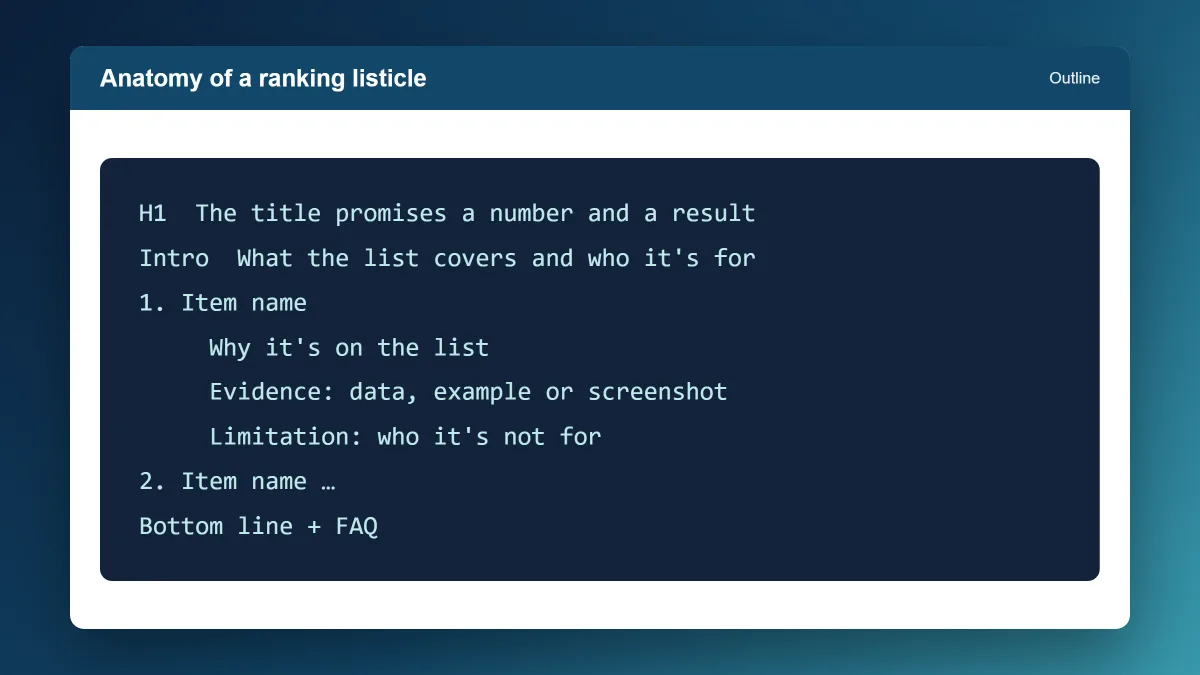
Short answer. A listicle is an article organized as a list, where each item includes its own heading, explanation, and supporting detail. The format works for “best of” roundups, how-to steps, tip collections, and comparison posts.
There are a few common types, and each serves a different search intent.
| Listicle Type | Example | Search Intent |
|---|---|---|
| Best-of roundup | “7 Best CRMs for Small Businesses” | Commercial investigation |
| How-to steps | “How to Set Up Google Analytics in 5 Steps” | Informational |
| Tips collection | “12 LinkedIn Profile Tips for B2B Sales” | Informational |
| Comparison list | “HubSpot vs. Salesforce vs. Zoho” | Commercial investigation |
| Resource roundup | “15 Free SEO Tools Worth Using” | Informational/transactional |
The format itself isn’t the strategy. A listicle without a clear angle is just a numbered list of generic advice. The posts that rank have a specific premise baked into the title. Not “10 Content Marketing Tips.” More like “10 Content Marketing Fixes That Take Less Than an Hour.”
Why Listicles Still Work in 2026
Short answer. Listicles match how both humans and AI parse information. Numbered items with descriptive subheads are easy for Google to feature in snippets and for AI models to cite in generated answers.
Here’s what’s changed. AI search engines don’t just read your content. They extract from it. When Gemini or ChatGPT answers a “best tools for X” query, it pulls from list-style pages because each item is self-contained. The AI can grab item #4 without needing context from items #1 through #3.
That’s the AEO (Answer Engine Optimization) advantage of listicles. Each list item functions as its own answer unit. And if you’re building a generative engine optimization strategy, this format is table stakes.
On the traditional SEO side, listicles still dominate for featured snippets. Google likes pulling numbered lists into position zero. And readers like scanning them. Nobody argues with a format that has built-in scannability.
Start with Long-Tail Keyword Research
Short answer. Target long-tail keyword variations with clear intent instead of broad head terms. Use a tool like Semrush to find phrases where the SERP isn’t dominated by massive authority sites.
The biggest mistake I see is writers picking a keyword and then deciding the format. Flip that. Start with keyword research and let the SERP tell you whether a listicle is the right call.
For every listicle I produce, the keyword research phase looks like this.
- Pull the primary keyword into Semrush’s Keyword Magic Tool and filter for questions and long-tail variations
- Look at search volume, but weight keyword difficulty more heavily for newer sites
- Check “People Also Ask” boxes for related questions that become FAQ entries or H2s
- Identify the intent behind each keyword variation. Commercial investigation keywords (“best X for Y”) need comparison listicles. Informational keywords (“how to X”) need step-based lists
- Cross-reference with Moz Pro’s keyword explorer for a second opinion on difficulty scores
Long-tail keywords are where the opportunity lives. “Best CRM” is a war you won’t win against HubSpot and G2. “Best CRM for HVAC companies under 50 employees” is a fight you can take. If you’re still learning the fundamentals of how search works, start there before building a listicle calendar.
Check the SERP Before You Commit to List Format
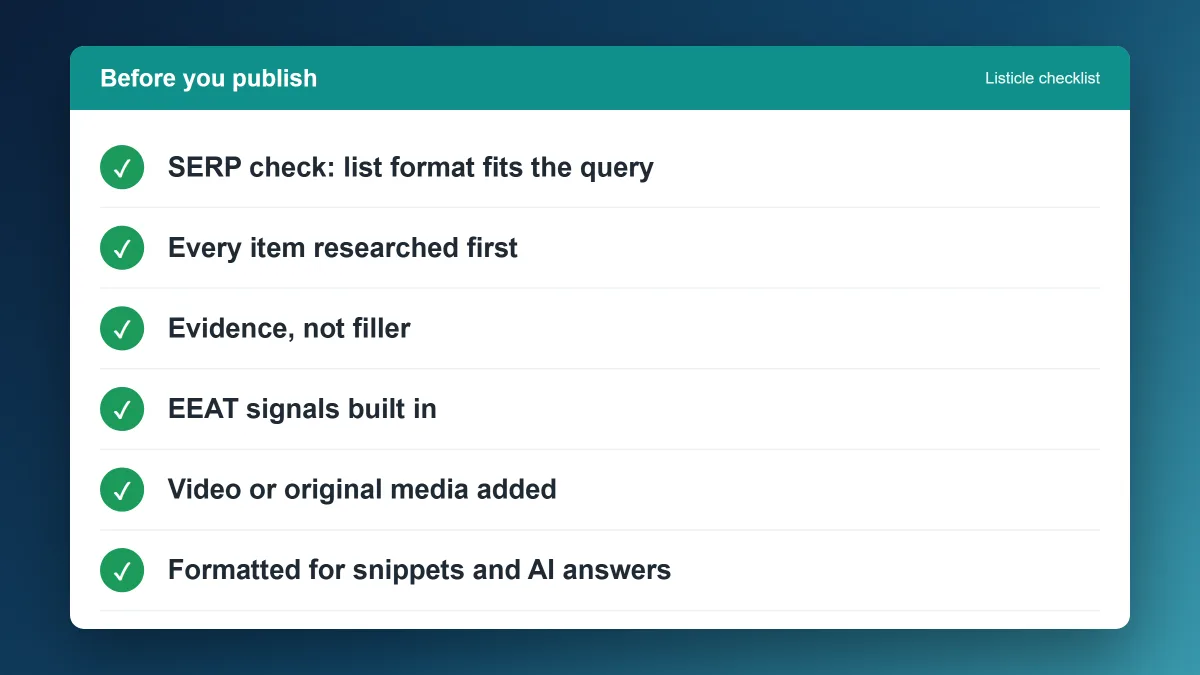
Short answer. Search your target keyword and look at what’s ranking. If the top five results are listicles, write a better listicle. If they’re long-form guides, a listicle might not be the right format for that query.
This takes two minutes and saves hours of wasted writing. Google has already told you what format it prefers for a given keyword. You just have to look.
Open an incognito window. Search the exact keyword. Study the top ten results.
- Are the top results numbered lists? Match the format.
- Are they long-form guides with no list structure? A listicle may not be what Google wants here.
- Is there an AI Overview at the top? Look at where it’s pulling from. If it’s citing list items, that’s your signal.
- How many items do the top-ranking listicles include? If every competitor has 15+ items, your 5-item list won’t compete.
I’ve killed more listicle drafts at this stage than any other. It’s not a failure. It’s smart resource allocation.
Research Every Item Before You Write
Short answer. Every list item needs to demonstrate first-hand knowledge or thorough research. Google’s EEAT framework rewards content where the author has real experience with the subject matter.
Here’s where the amateur listicles fall apart. They list ten tools the writer has never used. They describe features pulled from a pricing page. They include no original observation, no practical context, no evidence of hands-on experience.
Google’s EEAT quality framework evaluates Experience, Expertise, Authoritativeness, and Trustworthiness. Trust is the foundation. And in 2026, Google evaluates EEAT through patterns across your entire site, not isolated pages.
That means your listicle about “best project management tools” needs to show that you’ve actually used the tools. Not just listed their features.
For every list item I write, I follow this checklist.
- Have I used this tool, visited this place, or tested this method myself?
- Can I include a specific observation that wouldn’t appear on the product’s own marketing page?
- Am I including details that only someone with hands-on experience would know?
- If I haven’t used it myself, am I transparent about how I gathered this information?
This is the Experience signal that separates ranked listicles from content that Google ignores. It’s also what makes your content citable by AI. When an AI search engine is choosing between two listicles covering the same topic, the one with specific, first-hand observations wins.
Structure for Scannability and AI Extraction
Short answer. Use descriptive H2 or H3 subheads for each list item, keep items self-contained, and front-load the key takeaway in the first sentence of each section.
Structure isn’t decoration. It’s how search engines parse your content. And in 2026, it’s how AI models decide which pieces of your post to cite.
Self-contained list items are the single biggest structural factor for AI citation extraction. If an AI can understand item #6 without reading items #1 through #5, you’ve built it right.
Here’s the structural framework I use across client listicles.
- Descriptive subheads, not clever ones. “Semrush” as an H3 is weaker than “Semrush for Competitive Keyword Research.” The subhead should tell Google and AI models exactly what this section covers.
- Front-load the verdict. Start each list item with your assessment. Don’t bury the lead under three sentences of feature descriptions.
- Keep items parallel. If item #1 covers pricing, features, and a recommendation, every item should follow that pattern.
- Use the same HTML structure for every item. Consistent heading hierarchy (H2 for sections, H3 for individual list items) gives search engines a clean content tree to parse.
This structure also supports content repurposing. A well-structured listicle can be broken into individual social posts, email snippets, or comparison tables without rewriting.
Add Evidence, Not Filler
Short answer. Replace vague claims with specific dates, sourced data, and named examples. AI search engines favor content with verifiable specifics over generic assertions.
Here’s a test I apply to every draft. If you can delete a sentence and the post doesn’t lose information, that sentence is filler. Cut it.
Evidence means specifics.
| Weak (Filler) | Strong (Evidence) |
|---|---|
| “This tool has been gaining popularity recently” | “Ahrefs added a content audit feature in March 2026” |
| “Businesses are increasingly adopting AI tools” | “Gartner’s February 2026 survey found 67% of marketing teams use at least one AI writing tool” [VERIFY] |
| “This is a great option for small teams” | “The free tier supports up to 3 users and 1,000 contacts, which covers a team under 5 people” |
| “It integrates with popular platforms” | “Native integrations with HubSpot, Salesforce, Slack, and Google Workspace. No Zapier workaround needed.” |
Specific dates beat vague language for AI search. “In March 2026” is stronger than “recently” because an AI model can verify the date and cite your content with confidence. This is a small change that makes a measurable difference in whether your content gets referenced in AI-generated answers.
Build EEAT Signals Into the Post
Short answer. Add author bylines with credentials, link to relevant author pages, include original screenshots or media, and reference first-hand experience throughout the content.
EEAT isn’t a checklist you complete at the end. It’s woven into every section of the post. But there are specific signals you can build in that make a difference.
In early 2026, Google added an “Authors” section to its Search Central documentation. Author credibility is now more explicit in how Google evaluates content quality. That means your listicle needs a real author with verifiable expertise, not “Admin” or “Content Team.”
Here’s what I build into every listicle.
- Author byline with credentials. Name, title, relevant experience. Link to an author page or LinkedIn profile.
- First-person experience references. “I tested this across three client accounts” carries more weight than “users report that.”
- Original screenshots. A screenshot you took of a tool’s dashboard is an Experience signal that stock photos can never replicate.
- Publication and update dates. Always visible. AI models and Google both weight content freshness.
- Linked sources. When you cite data, link to the primary source. Not a blog post that cited a blog post that cited the original study.
Trust is the center of EEAT. Everything else supports it. If your content can’t be trusted, the experience and expertise behind it don’t matter.
Add Video and Original Media
Short answer. Embed original video walkthroughs, custom graphics, or annotated screenshots to increase dwell time and signal first-hand experience to Google.
Video embedded in a listicle does two things. It increases time on page, which is a user engagement signal. And it demonstrates Experience under Google’s EEAT framework in a way that text alone can’t.
A 90-second screen recording of you using a tool is worth more than 500 words describing its interface. The recording proves you’ve actually touched the product. No amount of well-written copy replicates that.
For B2B listicles, I recommend these media types.
- Screen recordings. Walk through the feature you’re discussing. Keep it under 2 minutes per tool.
- Annotated screenshots. Highlight the specific element you’re referencing. A red arrow and a callout box take 30 seconds in any screenshot tool.
- Comparison graphics. Side-by-side feature tables as images work for social sharing and Pinterest indexing.
- YouTube embeds. If you have a longer review video, embed the full version and timestamp the relevant section.
Original media is also harder for competitors to replicate than text. Anyone can rewrite your paragraphs. Nobody can recreate your screen recording of a specific workflow in a specific tool. That’s a defensible moat in SEO.
Format for Featured Snippets and AI Overviews
Short answer. Format your content so Google can pull it directly into featured snippets and AI Overviews. Use numbered lists, answer questions in under 40 words, and structure H2s as complete questions when targeting PAA boxes.
Featured snippets and AI Overviews pull from content that’s already formatted for extraction. You don’t format for them after writing. You build the structure during writing.
The AI tools reshaping B2B marketing are also reshaping how content gets surfaced. If your listicle isn’t structured for extraction, it won’t get cited. Period.
Here’s my snippet optimization checklist.
- Lead with a 30-40 word definition or answer right after the H2. This is snippet bait. Make it complete enough to stand alone.
- Use HTML ordered lists where appropriate. Google pulls numbered lists into snippet boxes more readily than paragraph text.
- Match PAA question format in H2s. If “People Also Ask” shows “What is the best CRM for small businesses?” use that exact phrasing as your H2, then answer it in the first sentence.
- Include the target keyword in the first 100 words of the post and in at least 2-3 H2s naturally.
- Add FAQ schema markup. Structured data won’t guarantee a snippet, but it gives Google explicit question-answer pairs to work with.
For AI Overviews specifically, the pattern I’ve observed in 2026 is that AI models prefer citing content with specific, verifiable claims over content with generalized advice. A list item that says “Semrush’s Site Audit tool checks 140+ technical SEO issues” is more citable than “Semrush has a comprehensive site audit feature.”
If you want to see how this connects to a broader Semrush review and workflow, I’ve covered that separately.
Common Listicle Mistakes That Kill Rankings
I’ve audited hundreds of listicles across client accounts. The same mistakes keep showing up. Here are the ones that do the damage.
- No angle. “10 Marketing Tips” isn’t a premise. It’s a category. Every listicle needs a specific point of view or constraint that makes it different from the 50 other posts targeting the same keyword.
- Thin list items. If your list item is two sentences and a bullet point, you haven’t said anything worth ranking. Each item needs enough depth to stand as its own mini-article.
- No original experience. Rewriting product descriptions from vendor websites isn’t content. It’s aggregation. Google can tell the difference, and so can AI models looking for sources to cite.
- Identical structure to competitors. If your listicle has the same 10 items in the same order as the top-ranking post, you’ve written a copy, not a competitor. Reorder. Add items they missed. Remove items that don’t belong.
- Missing internal links. A listicle that doesn’t link to your pillar content, related posts, or service pages is a dead end. Every listicle should connect to at least 3-5 other pages on your site.
- No update schedule. A listicle published in January and never touched again will lose rankings to fresher content by summer. Build a quarterly review into your content calendar.
- Keyword stuffing in subheads. “Best CRM for Small Businesses” as every H3 prefix is obvious and counterproductive. Vary your subhead language while keeping the semantic connection clear.
What Content Marketers Ask About Listicles
How many items should a listicle have?
There’s no universal number. Check what’s ranking for your keyword. If the top results have 10-15 items, aim for that range or slightly higher. A 5-item list won’t compete against 20-item posts for competitive keywords, but a focused 7-item list can outrank a bloated 30-item list that’s thin on depth.
Are listicles considered low-quality content by Google?
Not inherently. Google’s quality guidelines evaluate depth, accuracy, and usefulness regardless of format. A well-researched listicle with original insights and EEAT signals can outrank a poorly written 5,000-word guide. The format isn’t the problem. Lazy execution is.
Should I number my list items or use bullets?
Numbered lists outperform bullets for featured snippets and AI Overviews because they imply rank or sequence, which search engines find easier to extract. Use numbers when items have a logical order, ranking, or progression. Bullets work for unordered collections where no item is more important than another.
How often should I update published listicles?
Quarterly is the minimum for competitive keywords. Tools change pricing, companies get acquired, features launch and sunset. I flag every listicle in our content calendar for a 90-day review. The update doesn’t have to be a rewrite. Sometimes it’s adding one new item, removing a discontinued product, and updating a price.
Can a listicle rank for multiple keywords?
Absolutely. A well-structured listicle with descriptive subheads can rank for the primary keyword, several long-tail variations, and individual item names. Each list item with its own H3 is essentially a mini landing page for that subtopic. This is why structure matters as much as the writing itself.
What’s the difference between a listicle and a regular list post?
A listicle gives each item substantial coverage. Context, evaluation, pros and cons, practical advice. A regular list post just names items with minimal explanation. Think of the difference between a restaurant review that covers atmosphere, food quality, and price range versus a list of restaurant names with star ratings. The depth is the distinction.
The Bottom Line
Listicles aren’t the format of lazy marketers. They’re the format AI search engines reach for when answering “best,” “top,” and “how to” queries in 2026. But the bar for what ranks has changed.
A ranked listicle in 2026 requires real keyword research, SERP analysis before you commit to the format, first-hand experience with every item you include, structural precision for AI extraction, and verifiable evidence in place of vague claims.
I write these every week across client accounts. The ones that rank follow the process above. The ones that don’t almost always skipped the research phase or treated the format as a shortcut instead of a framework.
The listicle format isn’t going anywhere. But the standard for what makes one worth reading, ranking, and citing by AI just keeps going up. Meet that standard, and this format will be one of the highest-performing content types in your SEO strategy.