

Note: Some links in this post are affiliate links. I only recommend tools I actually use. Never at any extra cost to you.
Last updated: April 2026
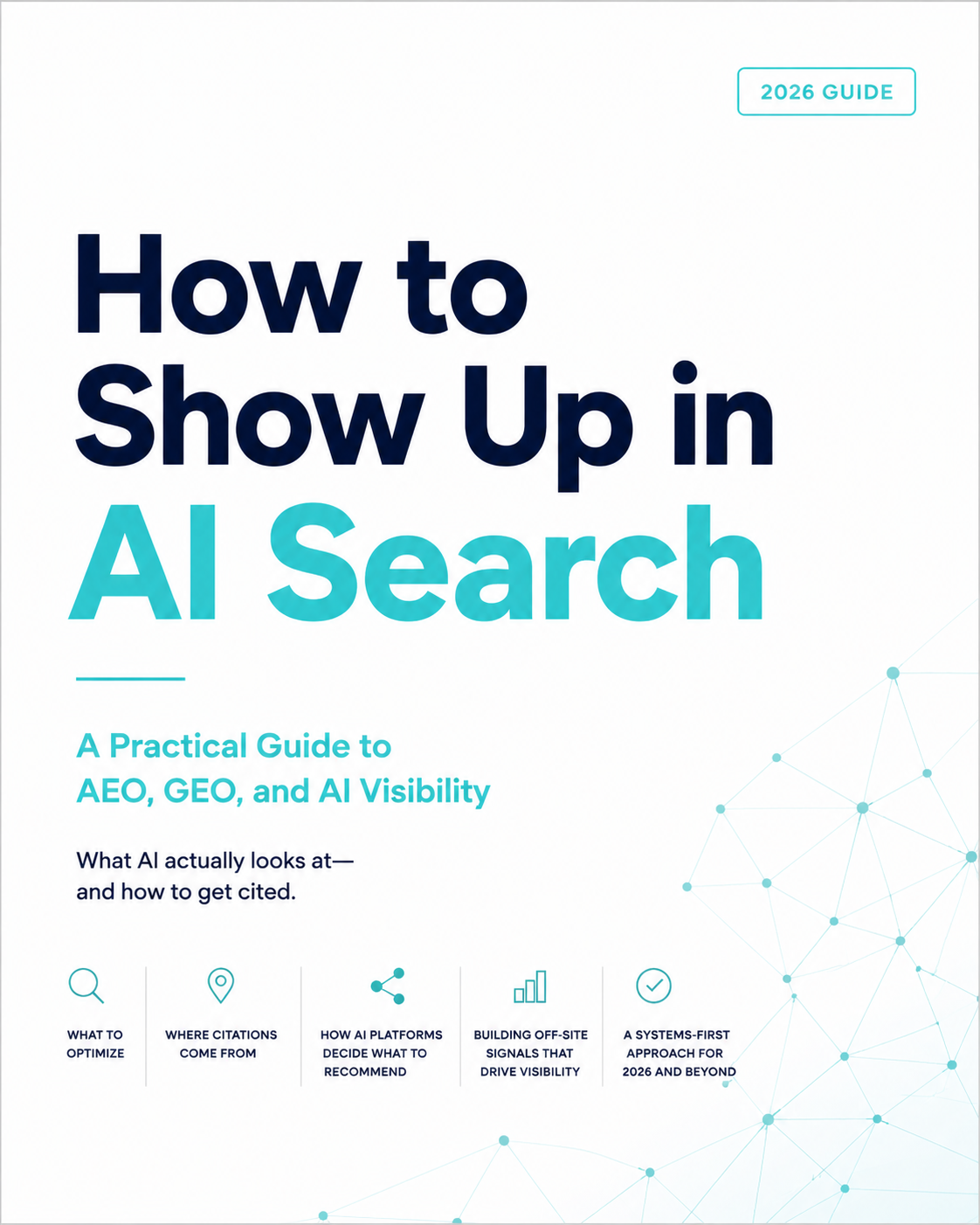
The Short Version: AI search doesn’t work like traditional search. ChatGPT, Perplexity, and Google AI pull short passages from trusted, well-structured sources across the web. Your site alone accounts for only 15% of AI citations. This post covers the full AEO + GEO + AIO system for B2B, including how to format content for extraction, build third-party authority, run a distribution workflow that scales, and a checklist you can start this week.
- Why Isn't Your B2B Company Showing Up in AI Search?
- How Does AI Decide What Content to Cite?
- What Should You Change on Your Website First?
- Why Your Website Alone Won't Get You Into AI Search
- Where Should Your Brand Actually Exist Beyond Your Website?
- What Does This Look Like When It's Actually Working?
- How Do You Execute This Without a 10-Person Team?
- The AI Visibility Checklist (Start Here This Week)
- What Comes Next
- What B2B Operators Keep Asking About AI Search (FAQ)
To show up in AI search, B2B companies need answer-first content formatting, structured data, multi-surface authority signals across YouTube, LinkedIn, reviews, and PR, plus consistent entity presence that AI systems can find, extract, and trust. Most companies are doing one of these. The ones showing up in ChatGPT are doing all four simultaneously.
Here’s a pattern I keep seeing across the B2B companies I work with.
Someone on the leadership team asks why they’re not showing up when people search in ChatGPT. The marketing team points to the blog, the SEO work, the content calendar, and all the effort they’ve been putting in for the last 18 months. Solid work, probably. But it doesn’t matter if AI systems can’t find you, can’t extract your content, and don’t have enough third-party evidence to trust you. If you’re building a marketing tool stack for B2B in 2026, this has to be part of it.
I made a video walking through this entire system. It’s embedded later in this post. But this goes deeper, with the full checklist and every tool I recommend for executing it.
Because search changed. The rules are different now. And most B2B companies are playing by the old ones.
Why Isn’t Your B2B Company Showing Up in AI Search?

Search has fragmented across at least seven surfaces. Traditional Google. Google AI Overviews. ChatGPT. Perplexity. Claude. Copilot. Gemini. Each one pulls information differently. Each one has its own idea of what makes a source worth citing.
Most B2B companies are optimizing for one of these. Google. And ignoring the other six.
Right there. That’s the gap.
It’s not just a “do more SEO” problem either. There are actually four distinct things you need to be doing at the same time, and the B2B companies I see winning in AI search are the ones treating these as parallel workstreams running simultaneously, not a checklist they’ll get to when the current SEO project finishes.
| Discipline | What It Does | What “Winning” Looks Like |
|---|---|---|
| SEO | Ranks your pages in search engines | Page 1 positions, organic traffic |
| AEO (Answer Engine Optimization) | Gets your content extracted as the answer | Cited in AI Overviews, featured snippets |
| GEO (Generative Engine Optimization) | Gets you recommended by generative AI | Named in ChatGPT, Perplexity, Gemini answers |
| AIO (AI Optimization) | Gets you understood accurately as a brand | AI describes you correctly, in the right category |
SEO is still the foundation. Nothing here replaces it. But if you’re only doing SEO, you’re optimizing for one surface out of seven. And the other six are where your buyers are increasingly starting their research.
A Forrester survey found that 69% of B2B marketers now say AI visibility is a top CMO or CEO priority for 2026. And G2’s research showed that 87% of B2B software buyers say AI chatbots have changed how they research, with half starting their research in a chatbot before they ever open Google.
Not a trend to watch. A behavior shift that already happened.
When you start building a real marketing system, all four of these disciplines need to be running together. Not sequentially. Simultaneously.
How Does AI Decide What Content to Cite?
AI cites content that’s short, direct, well-sourced, and backed by consistent signals across multiple platforms. Answer blocks under 40 words get extracted at 2.7x the rate of longer passages. That’s from GenOptima’s Q1 2026 data across 449 citations on 6 AI platforms.
And there’s a front-loading effect that most companies miss entirely. According to Growth Memo’s research, 44% of all LLM citations come from the first 30% of your text. The intro. The opening paragraphs. The first answer under your first H2.
So if your content opens with three paragraphs of context-setting before you get to the actual answer, you’re invisible to the machine even if a human reader would eventually find value in it.
This isn’t how most B2B content is written. Blog posts build up to the answer, provide context, frame the problem, tell a story, and by the time the actual answer arrives the AI has already moved on to whatever competitor structured their content in a way the machine could grab in under three seconds.
AI doesn’t read stories. It extracts passages.
What ties all of this together is a concept called content-answer fit, which essentially means writing the way an AI assistant would answer the question if it were responding directly to a buyer sitting across the table from it. Direct. Structured. Concise. Useful on the first read. That’s the primary citation driver across every platform.
Forget word count. Forget backlink profile. Forget domain authority on its own. Whether your content actually answers the question in a format a machine can grab is what determines citation.
What Should You Change on Your Website First?

Restructure your top pages with question-based H2s, direct 40-word answers, comparison tables, and FAQ blocks. Add schema markup. Check your page speed. Update anything older than 90 days. These are the fastest wins.
The specific technique I use across every client is what I call an answer-first block. The structure is simple.
- H2 = a question a real person would ask
- First 40 to 60 words = direct answer. No buildup. No preamble. Just the answer.
- Then expand with context, data, examples
80 to 90% of your sections should follow this pattern. And the good news? You can retrofit existing content. You don’t need to rewrite everything from scratch. Go into your top-performing pages, restructure the H2s as questions, and move the answer to the top of each section. That’s one of the fastest visibility gains I’ve seen.
If you want a tool that shows you which pages have the most to gain from this kind of restructure, Semrush is what I use. It’ll show you impressions without clicks, pages ranking in positions 4 through 20, and content that’s decaying. All of those are retrofit candidates.
Schema, llms.txt, and the Technical Stuff Your Dev Team Needs to Know
Schema markup is where most B2B companies leave the most points on the table, and what makes it frustrating is that it’s not even complicated once you understand the basic types, it’s just that nobody prioritizes it because it’s invisible to human visitors and lives in the code.
Schema tells machines exactly what your page is. FAQPage. Article. Organization. Service. VideoObject. It’s not just for rich results in Google. It’s machine-readable identity. If your pages don’t have it, you’re harder to extract and harder to recommend.
Here’s what to add by page type.
- Every blog post needs Article or BlogPosting schema, plus Person schema for the author
- Every page with FAQs needs FAQPage schema
- Every page with embedded video needs VideoObject schema
- Your site needs Organization schema (once, sitewide)
- Service pages need Service schema with areaServed if you’re location-relevant
Then there’s llms.txt. It’s a simple, machine-readable file that summarizes your brand, your offer, your context for AI systems. Think of it like a robots.txt, but for AI agents. Easy to implement. Almost nobody in B2B is doing it yet. Which means doing it now is a real differentiator.
Check your robots.txt while you’re at it, because if GPTBot, ClaudeBot, or PerplexityBot are blocked (and this happens more than you’d think, often through default Cloudflare settings that nobody on the team remembers configuring), AI systems can’t crawl your content at all. Fix it before anything else.
Why Page Speed and Freshness Are Now Citation Signals
This one surprises people.
Pages with a First Contentful Paint under 0.4 seconds average 6.7 AI citations, which is more than triple the 2.1 citations that pages slower than 1.13 seconds receive, according to SE Ranking’s November 2025 study. That gap alone should be enough to make page speed a priority conversation with your dev team this week.
Freshness matters more than it ever has, and the numbers back it up with zero ambiguity. Pages that go more than 3 months without an update are 3x more likely to lose AI visibility. Over 70% of pages cited by AI have been updated within the past 12 months. AirOps found that for commercial queries specifically, 83% of AI citations came from pages updated within 12 months, with 60%+ refreshed in the last six.
That’s a publishing consistency argument, not just a quality argument. You can’t publish once and expect to stay visible. AI rewards the sites that keep showing up.
Why Your Website Alone Won’t Get You Into AI Search
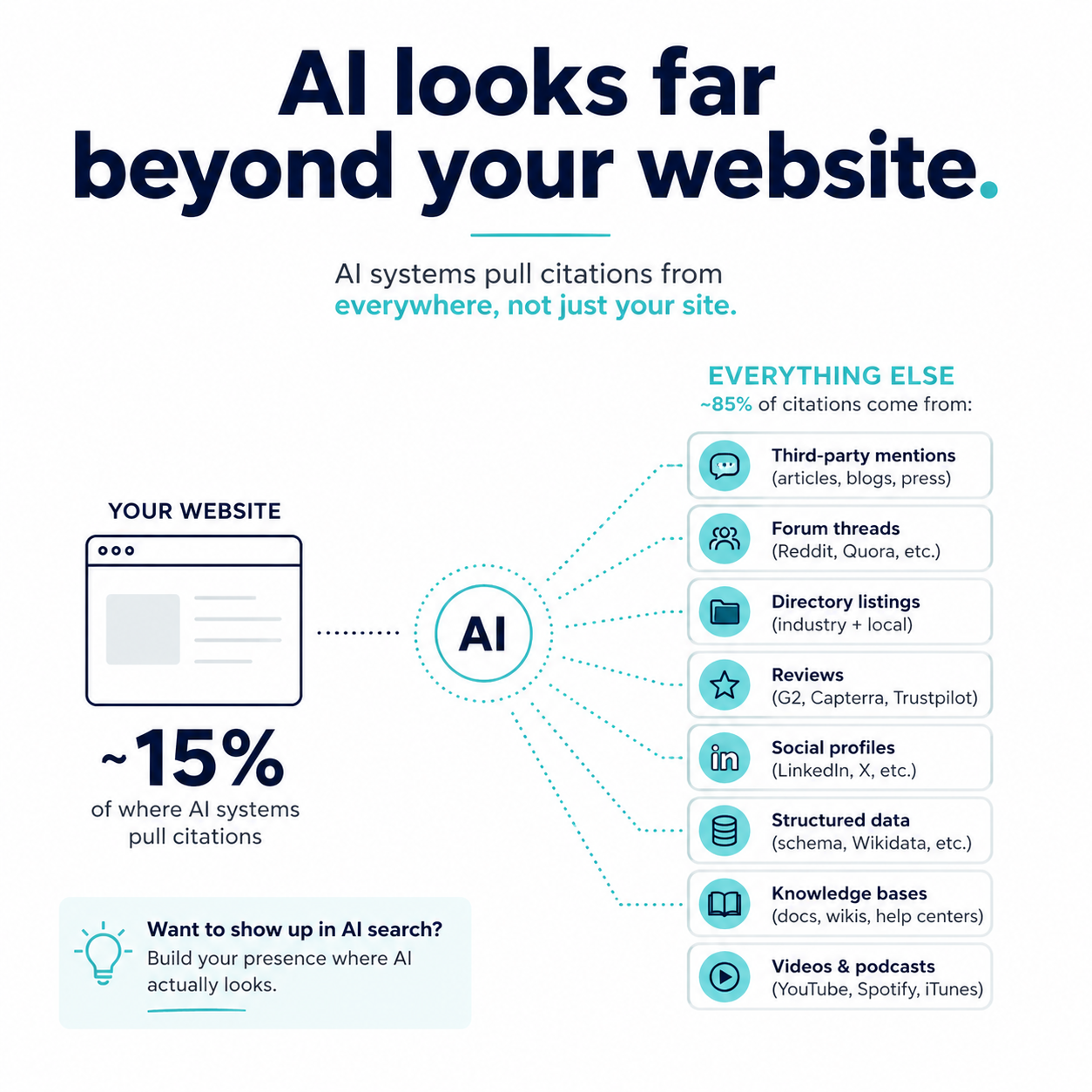
Only 15% of AI citations go directly to a brand’s owned content. The rest come through trade press, LinkedIn posts, podcast transcripts, forums, and syndicated research. AirOps analyzed 21,311 brand mentions across ChatGPT, Claude, and Perplexity and found that brands are 6.5x more likely to be cited by AI through third-party sources than through their own website.
Let that land for a second. Your site alone isn’t the answer.
And the gap gets wider. Stacker’s December 2025 research found that distributing content to a wider range of publications increases AI citations by up to 325% compared to publishing only on your own site.
For the past 15 years, the authority model was straightforward, and every SEO playbook reinforced it. Backlinks equal authority. More links, higher ranking.
That model isn’t dead. But it’s one signal in a stack of about twelve now, and the new ones carry more weight than most B2B marketers realize.
| Signal | Old Model (SEO Only) | 2026 Model (SEO + AEO + GEO + AIO) |
|---|---|---|
| Backlinks | Primary authority signal | Still matters, but one of many |
| Brand mentions | Nice to have | Correlation of 0.664 with AI visibility (SE Ranking) |
| Reviews (G2, Capterra, Trustpilot) | Conversion signal | 3x higher ChatGPT citation chance (SE Ranking) |
| Referring domains | Important for DR | 32,000+ = 3.5x more likely cited by ChatGPT (SE Ranking) |
| Third-party mentions | PR metric | 6.5x more citation-driving than owned content (AirOps) |
| Distribution breadth | Optional | Up to 325% more AI citations (Stacker, 2025) |
Authority in 2026 is consensus across the internet. Not a link count.
Reviews teach AI your use case, your strengths, and who you’re for. They’re not just star ratings anymore. They’re training data. If you don’t have a system for generating them consistently, GoHighLevel is what I use to automate review campaigns. And Testimonial.to is how I collect video testimonials and social proof that lives on the site and reinforces the brand signal.
For managing citation consistency across directories (same name, same description, same positioning everywhere), Moz Local handles it. Entity inconsistency is a trust gap that AI systems notice immediately.
Where Should Your Brand Actually Exist Beyond Your Website?

YouTube. LinkedIn. Reddit. Review platforms. Podcasts. PR placements. Listicles. Directories. Each surface is a citation input. The more places a consistent version of your brand exists in a format AI can crawl, the more it trusts you.
Here’s where each one matters.
YouTube Is GEO Infrastructure, Not a Nice-to-Have
YouTube is the #2 most-cited source in both Gemini and Perplexity, and #3 in Google AI Mode. 75% of YouTube citations come from non-branded queries. People aren’t searching for you specifically. They’re searching for how something works. And if your video is there with a clean transcript and relevant content, you get cited.
Video is GEO infrastructure. Not a content nice-to-have.
But here’s where it falls apart for most B2B companies, and I’ve watched this happen across nearly every client I’ve worked with over the past two years. Recording takes time. Editing takes time. It’s always the thing that gets pushed to next week, and then the week after that, until three months have passed and the YouTube channel has two videos on it.
That’s the bottleneck AI avatar tools remove. You record yourself once for about two minutes. The tool builds an avatar with your face, your voice, your expressions. After that, you generate video from a script without sitting in front of a camera again. Script goes in, video comes out, published to YouTube, transcript indexed. Another surface covered.
I use HeyGen for this. If you’re evaluating options, check out the full breakdown on the best AI video generators. For enterprise training content and multilingual needs, Synthesia is the alternative worth looking at. And if you want to repurpose longer recordings into short-form clips for social, InVideo handles that workflow well.
Reddit, Quora, and Community Presence as Citation Inputs
Perplexity references community platforms in more than 90% of its answers. Reddit appears in roughly 1 in 5 AI answers across platforms.
Not because Reddit is authoritative in the traditional sense, but because AI systems treat community discussions as real-world signal, with real people asking genuine questions about real problems and getting unfiltered, experience-based answers that carry weight precisely because they weren’t written by a marketing team.
Show up and answer real questions. Contribute something useful. Be present where your buyers actually go. That’s a citation input now. Not a social media tactic.
LinkedIn matters too, and not just for company page posts. Publishing real opinions and commentary on LinkedIn contributes to brand mention density. It’s one of the most-cited domains in AI answers alongside Reddit, Wikipedia, and YouTube. If you haven’t built a real LinkedIn strategy for B2B, that’s a gap worth closing. Taplio is the tool I use to schedule LinkedIn content, track what’s performing, and stay consistent without living inside the platform all day.
PR also makes a difference here, and frankly it’s one of the most underused authority levers in B2B. Podcast appearances, listicle inclusions, “best of” roundups. A feature in a relevant trade publication carries more weight for AI citation than most other tactics, because it generates backlinks, brand mentions, and transcripts that AI systems index and weigh as independent validation.
For finding and pitching podcast opportunities, PodPitch works well for outbound discovery. Talks.co is what I use for inbound podcast booking. For recording remote podcast interviews with clean audio and separate tracks, Riverside is what I recommend. And for pushing content across all of these platforms consistently, Publer is my go-to distribution tool. One piece of content, multiple surfaces, scheduled and tracked.
What Does This Look Like When It’s Actually Working?
When a B2B company is running all four disciplines, and doing it with enough consistency that the signals compound instead of resetting every quarter, here’s what you see.
Answer-first formatting on every important page. Schema markup on every page type. Fast load times. AI bots allowed. Internal links working. External citations sourced and linked.
YouTube is publishing consistently. Topics aligned to what buyers search. Transcripts indexable.
LinkedIn has native content. Not just link drops. Real commentary. Real engagement on relevant threads.
PR and podcast appearances are generating editorial mentions and backlinks on a regular cadence. Not occasionally. Regularly.
The company shows up in relevant listicles and category roundups. Entity information is consistent everywhere. Same name. Same description. Same positioning.
Reviews are coming in with volume, recency, and specificity. Community contributions are happening in the places buyers actually go.
llms.txt file exists too, giving AI agents a clean, machine-readable summary of what the business does, who it serves, and why it’s different from the twelve other companies in the same category.
Now here’s why this isn’t just a visibility play. According to Semrush’s 2026 data, AI-driven visitors convert at 4.4x higher than standard organic visitors. Superprompt’s analysis of 12 million website visits found that AI search traffic converts at 14.2% compared to Google’s 2.8%. That’s roughly 5x more valuable per session.
But here’s the uncomfortable part. CommonMind’s 2026 survey of 169 marketers found that 93% know AI visibility matters. Only 14% have a strategy for it. And while 89% of brands appear in AI citations at least once, only 14% of marketers track what those citations actually say.
Visible but blind.
You can show up in ChatGPT and have no idea how you’re being positioned, whether the AI is recommending you or dismissing you, or whether it’s describing your company in a way that would make your sales team cringe if they saw it.
Measurement is part of the system, not an afterthought, and the companies that skip it end up six months into an AI visibility strategy with no idea whether it’s working or whether ChatGPT is actively recommending their competitor instead.
I have a deeper take on using AI to clone yourself and remove execution bottlenecks if you’re thinking about how to actually sustain this kind of output with a small team.
[Replace this line with the bare YouTube URL once the video is live. WordPress oEmbed will handle the embed automatically.]
How Do You Execute This Without a 10-Person Team?
One piece of content becomes many surfaces. Blog post becomes a LinkedIn post, a YouTube script, a newsletter angle, a community answer, a social post. One input. Multiple outputs. That’s the distribution model.
Companies doing this well aren’t doing it manually, because the math on distributing one blog post to seven surfaces by hand doesn’t work when you’re also running pipeline, managing clients, and doing the other 47 things on the marketing to-do list. They’ve built workflows.
Most B2B companies don’t stall because they lack strategy. They stall because they can’t execute consistently, and the gap between “we know what to do” and “we’re actually doing it every week” is where most AI visibility strategies quietly die without anyone noticing until the quarterly review.
Systems problem. Not a knowledge problem.
For the video piece specifically, this is where HeyGen removes the biggest bottleneck. One recording session builds the avatar. Everything after that is a script. No camera. No studio. No scheduling conflicts. Script goes in, video comes out.
When it comes to distributing that content across platforms, Publer keeps everything organized and scheduled. It’s the tool I use most for making sure one piece of content actually reaches all the surfaces it should.
To organize the whole workflow (briefs, drafts, distribution tasks, refresh schedules), ClickUp is what holds it together. Without a task system, this falls apart by week three. I’ve watched it happen with clients who had the strategy right and the execution loose.
AI amplifies systems. It doesn’t replace thinking. But it does remove the execution gaps that stop good strategy from actually running.
The AI Visibility Checklist (Start Here This Week)
This is the framework I walk through with every B2B client when we’re building their AI search visibility from scratch. Five categories. Specific actions. Not theory.
1. Content Audit
- Pull your top 5 pages by traffic or impressions
- Check each for answer-first formatting (H2 = question, first 40 words = direct answer)
- Look for comparison tables, FAQ blocks, and definition paragraphs. If they’re missing, add them
- Confirm your primary keyword appears in the H1, first paragraph, and 2 to 3 H2s
- Use Semrush to identify pages with high impressions and low clicks. Those are your retrofit priorities
2. Technical Quick-Wins
- Add schema markup to every page type (Article, FAQPage, Organization, VideoObject, Service)
- Create an llms.txt file summarizing your brand, services, and audience
- Check robots.txt. Confirm GPTBot, ClaudeBot, PerplexityBot, anthropic-ai, and Google-Extended are NOT blocked
- Test page speed. Target FCP under 0.4 seconds on your most important pages
- Add a visible “Last updated” date to every important page
3. Citation and Authority Check
- Map everywhere your brand currently exists outside your own website (PR, podcasts, listicles, directories, reviews, LinkedIn, YouTube, Reddit, Quora)
- If the honest answer is “mostly just our site,” pick one surface and fix that this month
- Check your review profiles on G2, Capterra, and Trustpilot. Volume, recency, and specificity all matter
- Audit entity consistency. Same company name, same description, same positioning everywhere
- Use Moz Local to manage directory citation consistency
4. Distribution and Surface Expansion
- Build a workflow where one blog post becomes a LinkedIn post, YouTube script, newsletter, community answer, and social post
- Start or restart YouTube with a consistent topic cadence aligned to buyer questions
- Publish native LinkedIn content (not just link drops) at least 2 to 3 times per week
- Identify 3 relevant podcast opportunities and pitch them this month
- Answer 2 to 3 questions per week on Reddit or Quora where your expertise is directly relevant
- Use Publer to schedule and track distribution across channels
5. Measurement Setup
- Test your brand name across ChatGPT, Perplexity, Google AI, and Gemini right now. Document what you see
- Test your top 3 category queries (“best [your category] for [your audience]”) and record who gets cited
- Do this monthly. Track whether you’re cited, how you’re described, and who shows up instead of you
- Set up AI-referred traffic tracking in GA4
- Use Semrush for ongoing AI visibility tracking and share of voice monitoring
You won’t do all of this in a week. That’s fine. Start with the content audit and technical quick-wins. Those are the highest-impact moves with the fastest payback. Layer in the authority and distribution work over the next 30 to 60 days.
The diagnostic question worth sitting with is this. How many surfaces does a consistent version of your brand actually exist on, in a format that AI can find, extract, and trust?
Not how good is your SEO. How many places does your brand show up in a form that machines can use?
That’s the real gap for most B2B companies right now.
What Comes Next
AI search visibility for B2B isn’t complicated. But it does require a system.
Three things to take away from this.
First, this is a multi-surface problem, not an SEO problem. Four disciplines. Running together. SEO, AEO, GEO, and AIO aren’t sequential phases. They’re parallel workstreams.
Second, your owned site accounts for 15% of AI citations, which means the other 85% comes from trade press, podcasts, LinkedIn, reviews, directories, forums, and every other place on the internet where your brand either shows up consistently or doesn’t show up at all.
Third, the system is buildable. Start with content formatting. Layer authority signals. Build distribution. The checklist above is week one.
If you want to build out the full tool stack for this, I put together a breakdown of the top marketing tools for B2B in 2026 that covers everything from SEO to distribution to automation. Start there.
Not complicated. But not optional anymore either.
If you’re looking for done for you AEO/GEO or marekting help in general, reach out here.
What B2B Operators Keep Asking About AI Search (FAQ)
So what exactly is the difference between AEO, GEO, and AIO?
Three different goals, same system. AEO (Answer Engine Optimization) is about getting your content extracted as the direct answer. GEO (Generative Engine Optimization) is about getting recommended when AI generates a response. AIO (AI Optimization) is about being understood correctly as a brand. A company can be extracted (AEO) but described wrong (AIO failure). Or described correctly but never recommended (GEO gap). You need all three working together. The table earlier in this post breaks down the signals for each.
Can I retrofit existing blog posts or do I need to rewrite everything?
Retrofit first. Go into your top 10 pages by traffic, restructure the H2s as questions, move the direct answer to the first 40 words under each heading, add a comparison table if one doesn’t exist, drop an FAQ block at the bottom, and add schema to the page. You can do this in an afternoon per page, and the citation impact starts showing up within weeks on platforms like Perplexity that favor recency.
Realistically, how fast will I start showing up in ChatGPT?
Depends on the platform. Perplexity has a strong recency bias, so new or freshly updated content can get cited within 1 to 2 weeks. ChatGPT’s knowledge base updates less frequently, so you’re looking at 6 to 12 weeks. Google AI Overviews pulls from its existing index, so improvements to indexed content show faster. The third-party authority signals (reviews, PR, mentions) take longer to compound. Expect 3 to 6 months for the full system to really click in.
Does this matter for a $3M B2B company or is it only for big brands?
Smaller companies actually have an advantage here. AI platforms don’t inherently favor large brands. They favor content quality, structure, and relevance. A small B2B company publishing well-structured, authoritative content in a specific niche can outperform a Fortune 500 competitor that’s publishing generic, unfocused content. Niche specificity is your edge. The companies I’ve seen win fastest are the ones with deep expertise in a narrow space who just needed to make it extractable.
Which AI platform should I focus on first?
ChatGPT. 47% of B2B buyers in G2’s survey named it their preferred AI tool, roughly 3x more than any other. It handles over 2 billion queries per day. If you’re going to test and monitor one platform, start there. Then add Perplexity (fast-growing, strong recency bias) and Google AI Overviews (because it sits on top of the search engine your buyers already use).
Do I really need YouTube to make this work?
You can make progress without it. But you’re leaving one of the highest-citation surfaces uncovered. YouTube is the #2 most-cited source in Gemini and Perplexity. And 75% of those citations come from non-branded queries, meaning people searching for how things work, not for you specifically. If the reason you’re not doing video is the production bottleneck, look at AI avatar tools like HeyGen. One recording session, then everything after that is just a script.
How do I know if my competitors are already doing this?
Open ChatGPT right now. Ask it to recommend the best [your category] for [your buyer type]. See who shows up. Then do the same in Perplexity and Google AI. If your competitors are named and you’re not, they’re ahead of you on the authority and distribution side. If nobody in your category shows up well, that’s your window. First mover advantage in AI citations is real, and it compounds.