

B2B marketing costs range from 5% to 10% of gross revenue, with small businesses under $5M typically spending 7-8% and actual dollar amounts varying from $3,500/month to $80,000+/month depending on company size, channels, and execution model.
The Short Version
B2B companies spend between 5% and 10% of revenue on marketing. For a $1M company, that’s $5,800 to $8,700/month. The real question isn’t how much to spend. It’s where the money goes. In-house teams cost more than you think. Agencies charge retainers that stack up fast. And a fractional CMO with the right systems can deliver full-scale marketing for a fraction of either. This post breaks down every cost so you can stop guessing and start budgeting.
What Does B2B Marketing Actually Cost?
Every B2B marketing budget conversation starts the same way. A business owner pulls up their bank statement, points at a line item called “marketing,” and asks me if the number is right.
It never is. Either they’re overspending with nothing to show for it, or they’ve been winging it and wondering why their pipeline is empty. Both are fixable. But first you need to know what things actually cost.
The frustrating part? There’s no single answer. B2B marketing costs depend on your revenue, your industry, your growth targets, and whether you’re building in-house, outsourcing, or doing some hybrid. But there are real benchmarks, and I’m going to lay them all out so you can stop guessing.
The baseline. The SBA recommends businesses with revenue under $5M allocate 7-8% of gross revenue to marketing. That’s the floor for companies that want to grow. Not the ceiling.
Cross-industry, the numbers back this up. Gartner’s 2026 CMO Spend Survey puts the average at 7.8% of revenue. The CMO Survey from Duke, Deloitte, and the AMA pegs it at 9.0% overall, with B2B services companies spending 10.1%.
But here’s what those benchmarks don’t tell you. 66.3% of small business owners spend less than $1,000 per year on marketing. And 26% plan to spend $0 in 2026. Zero. That’s not a budget decision. That’s a growth death sentence.
B2B Marketing Budgets by Business Size
The answer. A $500K company should budget $4,350/month. A $2M company, around $13,200/month. The exact number depends on your revenue tier and growth goals.
The SBA’s 7-8% guideline works for businesses under $5M. Above that, the percentage drops because the dollar amount is already significant. Below is what 2026 SMB data from Stealth Agents shows by revenue tier, translated into real monthly numbers.
| Annual Revenue | Median % of Revenue | Annual Marketing Budget | Monthly Budget |
|---|---|---|---|
| Under $500K | 10.4% | $26,000 – $52,000 | $2,200 – $4,350 |
| $500K – $2M | 8.7% | $43,500 – $174,000 | $3,625 – $14,500 |
| $2M – $10M | 7.9% | $158,000 – $790,000 | $13,200 – $65,800 |
| $10M – $50M | 5.8% | $580,000 – $2.9M | $48,300 – $241,700 |
Notice the percentage goes down as revenue goes up. That’s because a $10M company spending 5.8% still drops $580K a year on marketing. The percentages scale. The pain doesn’t.
For a company at $1M in revenue, 8.7% means roughly $87,000/year or $7,250/month. That’s a real number. And it needs to cover strategy, content, tools, and distribution. If you’re spending less than that and wondering why your pipeline is dry, there’s your answer.
Need help figuring out where that money should go? Start with a documented B2B marketing strategy before you spend a dollar.
How Budget Benchmarks Differ by Company Type
The answer. B2B services companies spend 44% more on marketing as a percentage of revenue than B2B product companies. SaaS falls somewhere in between but skews higher during growth phases.
Not all B2B companies are built the same. A managed services provider has different unit economics than a manufacturer. The 2026 CMO Survey breaks this out clearly.
| Company Type | Marketing as % of Revenue | Budget at $2M Revenue | Budget at $5M Revenue |
|---|---|---|---|
| B2B Product | 7.0% | $140,000/yr ($11,700/mo) | $350,000/yr ($29,200/mo) |
| B2B Services | 10.1% | $202,000/yr ($16,800/mo) | $505,000/yr ($42,100/mo) |
| Overall Average | 9.0% | $180,000/yr ($15,000/mo) | $450,000/yr ($37,500/mo) |
Services companies spend more because their product is harder to differentiate. When you sell a physical thing, the thing speaks for itself. When you sell expertise, marketing has to do the talking. That’s why MSPs, IT consultancies, and professional services firms consistently land at the top of the spend range.
Gartner also reports that paid media takes 31.4% of total marketing budgets across industries. If your budget is $10K/month and you’re putting $5K into ads with no organic engine behind it, you’re upside down.
What Each Marketing Channel Costs
The answer. Individual channels run anywhere from $500/month for email to $30K+/month for full content programs. Here’s what agencies and tools actually charge in 2026.
Knowing your total budget is step one. Knowing what each channel costs is how you build a marketing system that actually works.
SEO
Agency retainers for SEO run $1,500 to $10,000/month, with the average B2B engagement landing between $3,000 and $7,500/month. That typically covers technical audits, on-page work, content strategy, and link building. If you’re handling SEO in-house, a tool like Semrush or Moz Pro costs $100-$400/month and gives you the data you need to execute a B2B SEO strategy without paying agency markup.
Content Marketing
Content agencies charge $2,300 to $30,000/month depending on volume and complexity. The average sits around $5,000/month for a B2B program producing 8-12 pieces. That includes blog posts, landing pages, and sometimes gated assets. The spread is wide because “content” can mean a founder writing LinkedIn posts or a 10-person team producing whitepapers, case studies, and video scripts.
At the lower end, you might get four blog posts per month and some light editing. At $10K+/month, you’re getting a full editorial calendar, SEO-driven topic clusters, original research, and distribution planning. The question is what your funnel actually needs, not what a content agency wants to sell you.
Paid Advertising (PPC)
PPC management fees run $1,000 to $10,000/month, plus your actual ad spend on top. Google Ads for B2B keywords can cost $5-$50+ per click depending on the vertical. LinkedIn ads are even more expensive, often $8-$12 per click for sponsored content. The management fee is just the labor to run the campaigns.
Here’s the trap with paid. A $3,000/month management fee plus $5,000/month in ad spend puts you at $8,000/month. If your close rate on paid leads is 5% and your average deal is $10,000, you need 16 leads from paid just to break even. Know your numbers before you write the check.
Email Marketing
Email marketing services range from $500 to $13,000/month. The low end covers a freelancer managing your sequences and newsletters. The high end is a full agency handling strategy, copywriting, automation builds, segmentation, and deliverability monitoring. A tool like GoHighLevel or Instantly handles the sending for $97-$200/month. The expensive part is always the strategy and copy.
Social Media
B2B social media management runs $1,000 to $5,000/month for agency-managed programs. For LinkedIn-focused outreach, tools like HeyReach and Apollo let you automate prospecting at a fraction of the cost. The real question for B2B is whether you need a social agency or just a system. Check the best AI tools for B2B marketing for options that reduce this line item significantly.
Full-Service Agency
Full-service B2B agency retainers for demand generation land between $2,500 and $15,000/month at the SMB level. Mid-market companies pay $10,000 to $25,000/month for agencies covering strategy, content, paid media, marketing ops, and reporting. That’s before ad spend. Before tools. Before the internal time you still spend managing the relationship.
The Stack Underneath
Every channel above needs tools. A solid B2B marketing stack runs $500 to $2,000/month for CRM, email, analytics, SEO tools, project management (something like ClickUp helps here), and hosting. Hostinger keeps your website hosting costs low without sacrificing speed. These costs are easy to ignore until you add them up at the end of the quarter.
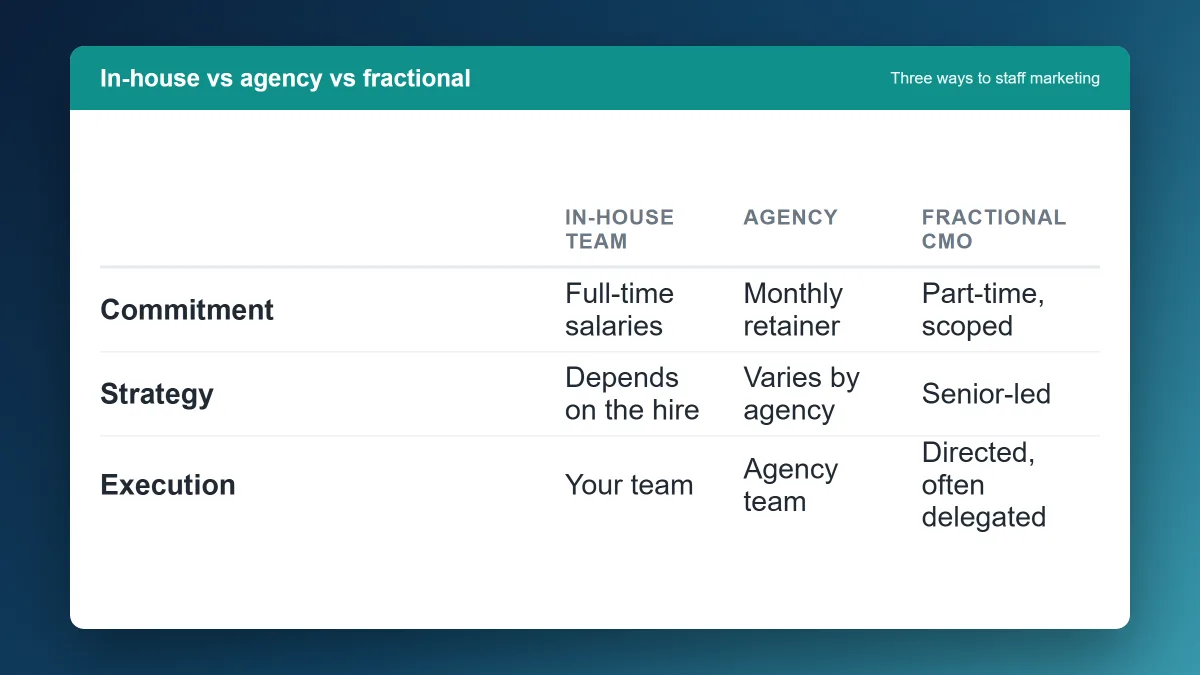
The Real Math on In-House vs Agency vs Fractional CMO
The answer. A full-time CMO costs $275K-$500K+ loaded. A marketing manager costs $210K/year. A fractional CMO costs $3K-$15K/month. The math isn’t close.
This is where the real budget conversation happens. Not “how much should I spend on SEO” but “who is going to do all of this?”
Full-Time CMO
Average salary for a full-time Chief Marketing Officer sits between $225,000 and $374,000. Add benefits, payroll taxes, equity, and bonuses and you’re looking at $275,000 to $500,000+ in loaded cost per year. That’s $23,000 to $42,000/month before they spend a dollar on actual marketing. And that marketing budget still needs to be funded separately. The CMO’s salary is the cost of the strategist alone.
It gets worse. The failure rate for new CMO hires is 42% within 18 months. Nearly half. And the ramp time is 3-6 months before they’re even fully productive. So you’re paying top dollar for someone who might not work out, and you won’t know for a year and a half.
In-House Marketing Manager
The Bureau of Labor Statistics puts the median marketing manager salary at $161,030. Loaded with benefits, that’s approximately $210,000/year or $17,500/month. That gets you one person. One person who still needs tools, possibly contractors, probably an agency for specialized work, and definitely a strategy to follow.
Agency Retainers
For mid-market B2B companies, a full-scope agency retainer covering strategy, content, paid, ops, and reporting runs $10,000 to $25,000/month. You’re buying a team. But you’re also buying their other clients’ priorities, their account manager’s interpretation of your brand, and their quarterly upsell pitches. The work often gets handed to junior staff while the senior people showed up for the pitch. If you’ve worked with an agency, you know exactly what I’m describing.
Fractional CMO
A fractional CMO charges $3,000 to $15,000/month. That’s 40-70% less than the loaded cost of a full-time CMO. Time to value is 30-45 days, not 3-6 months. And the average engagement runs 71 months, which tells you something about whether the model works.
You get a senior marketing leader setting strategy, managing vendors, building systems, and reporting on results. Without the $400K salary. Without the 42% chance they wash out. Without the six-month wait to see if they were the right hire.
Here’s a quick comparison of the real monthly costs side by side.
| Execution Model | Monthly Cost | Ramp Time | Risk Factor |
|---|---|---|---|
| Full-Time CMO | $23,000 – $42,000 | 3-6 months | 42% failure rate in 18 months |
| In-House Marketing Manager | $17,500 (+ tools/agencies) | 1-3 months | Limited scope, still needs outside help |
| Full-Service Agency | $10,000 – $25,000 | 30-60 days | Split attention, misaligned incentives |
| Fractional CMO | $3,000 – $15,000 | 30-45 days | 71-month avg engagement |
The Case for Leaner Teams
Here’s where I’ll be direct, because this is what I do for a living.
The numbers above paint a clear picture. In-house is expensive, slow to ramp, and risky. Agencies are expensive, hard to manage, and built to bill hours. A full-time CMO might be the right move at $10M+ in revenue, but below that line, you’re overpaying for a title.
The model that works for B2B companies between $1M and $10M looks like this.
- Fractional CMO ($5,000-$10,000/month) for strategy, oversight, and accountability
- Offshore/nearshore execution team ($1,000-$2,000/month) for content production, design, and technical implementation
- AI tools and automation ($500-$1,000/month) for research, drafting, SEO analysis, and workflow management
- Specialist agencies on-demand (variable) for PPC, PR, or technical SEO when you need deep expertise
Total cost for a full marketing operation. $7,000 to $13,000/month.
Compare that to a single in-house marketing manager at $17,500/month who still needs tools, training, management, and outside help for anything specialized.
This isn’t theory. I’ve built this model for multiple B2B clients. The fractional CMO sets the strategy and manages a stack built on AI that handles the repetitive work. The offshore team handles execution at a fraction of US labor costs. And AI fills the gaps that used to require three more hires. I wrote about the exact setup in how to build an offshore marketing team for $2K/month and how one operator can run marketing with AI.
The key isn’t spending less for the sake of spending less. It’s knowing where US-based expertise matters (strategy, brand voice, client communication), where trained offshore talent delivers the same quality at lower cost (design, content production, data entry, technical SEO implementation), and where AI handles the work entirely (research, first drafts, reporting, scheduling). When you stack those three layers under a fractional CMO who knows how to manage all of it, you get output that looks like a 5-person team for the price of one full-time hire.
The companies that figure this out spend less, move faster, and get better results than their competitors still debating whether to hire a marketing director or sign an agency retainer.
Where Small Businesses Waste Marketing Budget
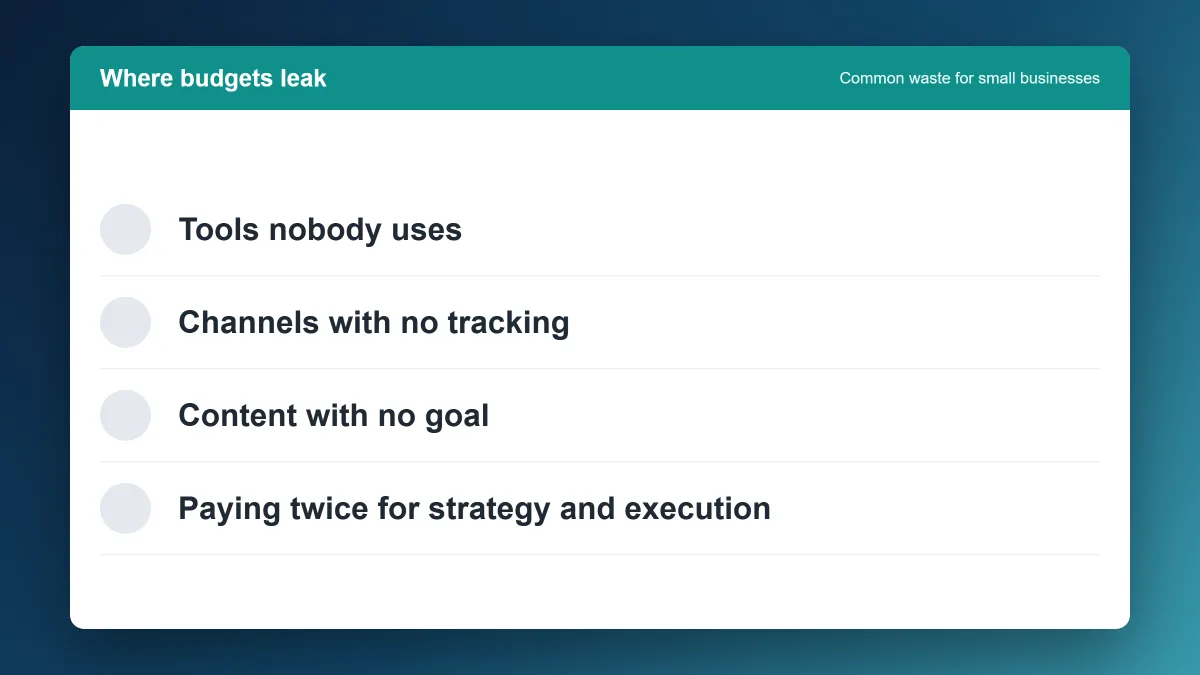
Before we talk about where to spend, let’s talk about where not to. I’ve audited enough marketing budgets to spot the same mistakes on repeat. Here’s where B2B companies burn cash.
- Paying for strategy and execution from the same agency. Your agency makes more money when you do more. That’s a conflict of interest baked into the business model. Separate the strategist from the executors.
- Running paid ads before building an organic engine. Paid traffic is rented attention. The moment you stop paying, it disappears. SEO, content, and email build compounding assets. Do those first.
- Hiring generalists who can’t go deep. A “social media and content and email and events” person does none of those things well. Hire specialists or buy specialist tools.
- Buying tools before building a process. A $500/month CRM does nothing if nobody follows the sales process inside it. Map the workflow first. Then buy the tool that fits it.
- Redesigning the website every two years instead of publishing content. Your website isn’t a brochure. It’s a publishing platform. A $30K redesign with no content strategy behind it is a fancy billboard on an empty highway.
- Ignoring the data. If you can’t tell me which channel produces your best leads, you’re guessing. Guessing is expensive. Set up attribution before you scale spend.
- Chasing tactics without a strategy. Posting on social, running a webinar, trying ABM, and launching a podcast all in the same quarter isn’t a strategy. It’s a spray pattern. Pick a B2B marketing strategy, commit to it for six months, and measure the results before you pivot.
Every dollar wasted on the wrong activity is a dollar that could have gone toward something that compounds. SEO compounds. Email lists compound. Content libraries compound. Scattered spending doesn’t.
What B2B Companies Ask About Marketing Costs
How much should a small B2B company spend on marketing per month?
The SBA recommends 7-8% of gross revenue for businesses under $5M. For a company doing $1M in annual revenue, that translates to $5,800 to $6,700/month. If you’re growing aggressively, plan for 10%+. If you’re maintaining, 5-7% can hold the line. The important thing is that the number exists and is tracked, not that it hits a perfect percentage.
Is a fractional CMO cheaper than hiring a full-time marketing director?
Significantly. A fractional CMO costs $3,000 to $15,000/month depending on scope. A full-time marketing director costs $140,000 to $180,000 in salary alone, plus benefits, tools, and management overhead. That’s $15,000 to $20,000/month loaded, and they still need agencies and tools on top. The fractional model gives you a senior strategist at 40-70% of the cost with a 30-45 day ramp instead of 3-6 months.
What’s the minimum marketing budget that actually produces results?
For B2B, $3,000/month is the floor where you can run a focused program. That covers a few core tools, a narrow content strategy, and basic SEO. Below $3,000/month, you’re spreading too thin to move any needle. At $5,000-$7,000/month you can start layering in paid, email sequences, and consistent content production. Don’t try to do everything at once. Pick two channels and fund them properly.
Why do 26% of small businesses plan to spend nothing on marketing?
Because they’re either living on referrals, don’t understand what marketing does, or got burned by a bad agency and swore it off entirely. Referrals are great until they slow down. And they always slow down. A 2026 UENI survey found that more than a quarter of small business owners plan to spend $0 on marketing this year. Those businesses aren’t saving money. They’re borrowing against future pipeline.
Should I hire an agency or build an in-house team?
It depends on your revenue. Under $2M, neither is the best move. An agency charges $5K-$15K/month and you’re one of many clients. An in-house hire costs $15K-$20K/month loaded and still needs help. The better path is a fractional CMO with a lean team and the right tools. Between $2M and $10M, a hybrid model works. Over $10M, you can afford to start building in-house with an agency supporting specialized channels.
How much do B2B companies spend on SEO specifically?
Agency-managed SEO retainers for B2B companies run $1,500 to $10,000/month, with the sweet spot around $3,000 to $7,500/month. That covers technical audits, keyword strategy, content planning, on-page work, and link building. If you handle it in-house using tools like Semrush, your hard cost drops to $100-$400/month for the tooling. The labor is what gets expensive.
What percentage of marketing budget should go to paid ads?
Gartner’s 2026 data shows paid media takes 31.4% of total marketing budgets on average. For B2B, I’d argue it should be lower in the early stages. Build your organic foundation first. Then layer in paid to accelerate what’s already working. If you’re spending more than 40% on paid with no organic engine, you’re building on rented ground.
The Bottom Line
B2B marketing costs real money. The benchmarks say 7-10% of revenue. The channel costs add up fast. And the execution model you choose determines whether that money builds something or just burns.
Here’s what the data tells us. A B2B services company doing $2M in revenue should be spending roughly $16,800/month on marketing. An in-house marketing manager alone costs $17,500/month and still needs tools and agencies. A lean model with a fractional CMO, offshore execution, and the right AI tools delivers a complete marketing operation for $7,000 to $13,000/month.
The question isn’t whether you can afford to invest in marketing. If you’re a B2B company that wants to grow, the question is whether you can afford not to.
I build lean marketing operations for B2B companies between $1M and $10M in revenue. Fractional CMO leadership, AI-driven systems, and teams that are right-sized for the budget. If the numbers in this post look familiar and you’re not sure where to start, let’s talk about what your marketing should actually look like.