

A founder content strategy is a system where a founder spends focused time capturing insight, and ideally, the marketing team turns that input into content distributed across multiple other channels. The goal of this is to protect the founder’s time.
If you’re a founder and content feels like a second job, this is for you.
Content becomes exhausting for founders for one simple reason. It asks for constant presence instead of leverage. Post every day. Be visible everywhere. React in real time. That model breaks founders. Or it quietly gets abandoned.
The alternative is not posting less. It’s building a source layer that everything else draws from. This system can be done in one hour per week.
(Disclosure: Some links are affiliate links. I only recommend tools I personally use, at no extra cost to you.)
Founder content is the source layer, not a social tactic
Founder content should sit at the center of your marketing ecosystem. SEO. YouTube. LinkedIn. Newsletters. Podcasts. PR. Sales enablement. All of it should pull from founder input. Founder content does not compete with company content. It amplifies it. For a deeper look at how this integrates into a full LinkedIn marketing strategy for B2B, that guide covers how to connect the two systems.
Lock the founder’s public identity before you create anything
This is where most teams fail. Before topics. Before calendars. Before tools. Every founder needs a locked public identity. One sentence.
In the mind of the market, this founder is the person who believes ___ and is building ___.
That sentence becomes a filter. If a piece of content does not reinforce it, it is not founder content. This is how you stop sounding scattered and start sounding intentional.
The four founder content lanes
Once identity is locked, you define lanes. Each founder gets four. No more. These aren’t formats. They’re angles.
Lane one — contrarian beliefs
What you believe the market gets wrong. This creates positioning and memorability.
Lane two — building and doing
What you’re actively working on right now. Not polished case studies. Real decisions. Real tradeoffs. This builds trust through transparency.
Lane three — leadership and decision making
How you think when making hard calls. Constraints. Accountability. Ownership. This signals operator maturity.
Lane four — industry expertise
Patterns you see across customers and prospects. Not opinions. Earned perspective.
Every founder post fits one lane only. If it fits two, split it. If it fits none, it does not get published. This is what keeps the signal clean, repeatable, and scalable.
Founder content lives inside an ecosystem, not a feed
Founder content doesn’t exist in isolation. It sits at the intersection of three inputs.
Founder input — Lived experience, prospect calls, customer calls, wins, failures, hard decisions. This is what humanizes the business.
Marketing team input — SEO priorities, YouTube strategy, campaigns, offers, product launches. This ensures content supports growth.
Ecosystem input — Industry conversations, peers, competitors, trends. This keeps content relevant.
High-leverage founder content connects at least two of these inputs. The strongest content hits all three. This framework prevents founder content from becoming random, reactive, or disconnected from revenue.
How founder content fits into the calendar
The team builds the base content calendar first. SEO blogs. YouTube topics. Campaign-driven content. Product priorities. That fills roughly 60 to 70 percent of the calendar. A proper content workflow for B2B marketing is what makes sure nothing falls through the cracks when the founder hands off their input.
The remaining 30 to 40 percent is reserved specifically for founder lanes. This space is protected. It can’t be backfilled with generic content. If you don’t protect founder signal, it disappears.
The founder capture system is where the hour goes
Founder content starts with capture. Every founder needs a running capture system. Slack. Notion. OneNote. Voice notes. The tool doesn’t matter. Consistency does. The founder drops in raw thoughts from prospect calls, customer calls, team issues, wins, failures, and industry observations. No polishing. No structuring. Just reality. The marketing team reviews this weekly. This is where leverage begins.
The recording workflow that removes execution risk
Once recording is on the calendar, execution risk drops. The founders I work with all use Riverside to record easily from a computer or iPhone. This makes it easy for the marketing team to access the recordings and edit all in one tool, without having to send over video files.
Recording sessions in Riverside follow the same structure every time. First half: marketing-driven topics, scripts provided in advance, aligned with SEO, YouTube, and campaigns. Second half: founder-driven topics, pulled directly from capture, unscripted. This is where the strongest content comes from.
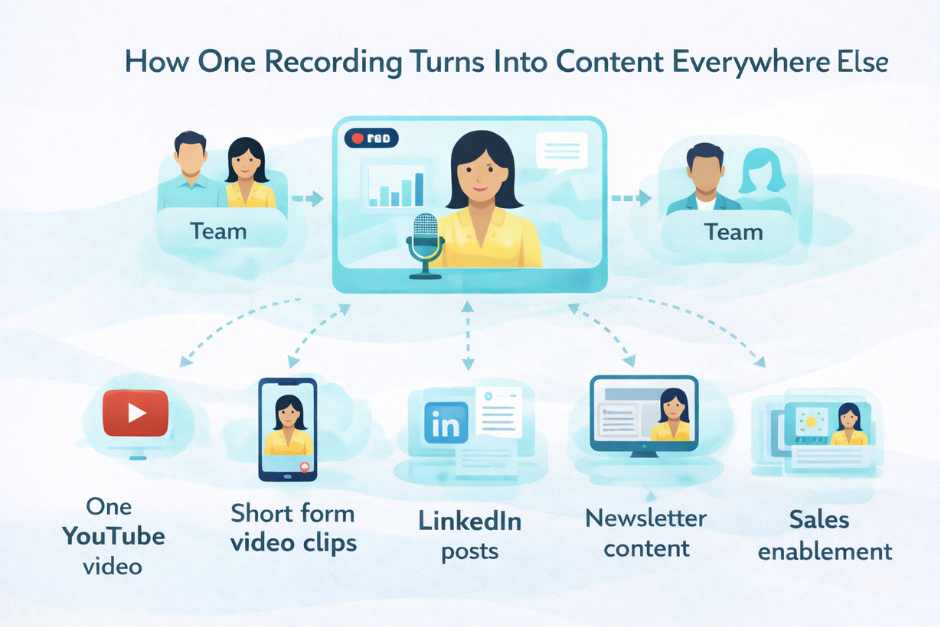
How one recording turns into content everywhere else
After recording, content goes to the team. One recording becomes one YouTube video, short-form video clips (Opus Clips or Riverside automatically creates them), LinkedIn posts (we use Publer to schedule), newsletter content (we use Beehiiv for newsletters), blog articles, and sales enablement. For AI video content, the best AI video generator tools can help turn scripts into polished content without a production team.
Founder content is repurposed, never rewritten from scratch. But each piece is optimized for the platform it’s being distributed on. SEO pulls insights into articles. LinkedIn pulls opinions and stories. Newsletters pull narrative and depth. Same voice. Different formats.
The no selling rule
This is non-negotiable. Founder content doesn’t pitch. No demos. No feature lists. No buy-now links. The product shows up through complaints, decisions, tradeoffs, and lessons learned. That is what builds trust.
How to measure founder content without killing it
Every 30 days, the team reviews founder content. Not likes. Not views. They look at quality of comments, DMs and replies, email signups, and sales conversations influenced. The only question that matters: did this attract the right people? Formats evolve. Depth increases. Identity stays fixed.
This isn’t a content system. It’s a trust system.
The founder supplies raw reality. The team turns it into leverage. The business compounds it across channels. When this runs properly, SEO converts better, YouTube grows faster, LinkedIn feels intentional, sales cycles shorten, and the founder stops being the bottleneck.
This is founder content at a B2B operator level, not a creator level. Content helps generate demand, but outreach is still important. Make sure to check out this post for an easy-to-use LinkedIn outbound tool.
And if you want a structured framework for building the full system around this content engine, the 6-Week B2B Growth Sprint is the place to start.