

A LinkedIn marketing strategy is a structured system that connects positioning, content, engagement, and outreach into one coordinated path from authority to pipeline. When that system is missing, activity feels busy but results stay inconsistent.
Teams post consistently.
They experiment with outbound.
They boost a few posts.
Sometimes it works. Mostly it doesn’t compound.
The issue isn’t effort. It’s the absence of an integrated LinkedIn marketing strategy that ties authority to audience and audience to revenue.
This is the 2026 version. Built for thought leaders that want a system they can actually follow to gerate pipeline.
Table of Contents
- LinkedIn Isn’t a Content Channel. It’s a Revenue Channel.
- Step 1. Positioning Is the Root of Your LinkedIn Marketing Strategy
- Step 2. Your Profile Is Conversion Infrastructure in Your LinkedIn Marketing Strategy
- Step 3. The Four Pillars of a High-Performing LinkedIn Marketing System
- Step 4. Content That Actually Performs in 2026
- Step 5. AI as Infrastructure, Not a Shortcut
- Step 6. Multi-Voice Authority Expands Reach
- Step 7. Connecting LinkedIn to Pipeline With Intent-Driven Outreach
- Step 8. Organic First. Paid Second.
- Step 9. Measure the Metrics That Matter
- The Entire LinkedIn Marketing Strategy
- FAQs About LinkedIn Marketing Strategy
LinkedIn Isn’t a Content Channel. It’s a Revenue Channel.
If you treat LinkedIn like a place to post thoughts, you’ll get engagement. If you treat it like a system designed to build trust and capture intent, you’ll get pipeline.
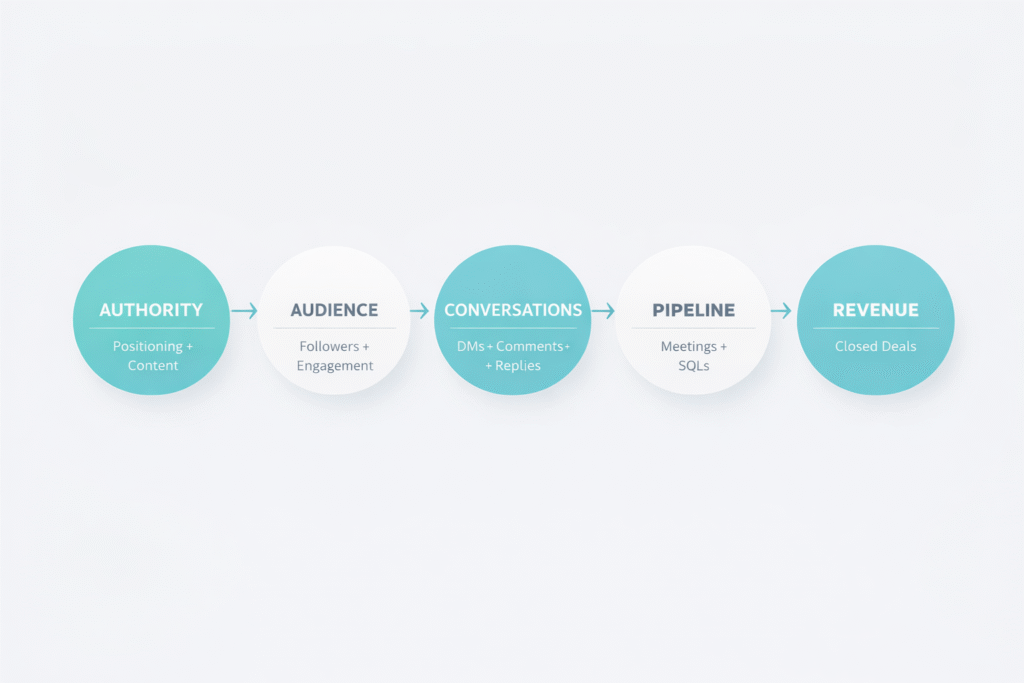
The sequence is simple.
Authority builds audience.
Audience builds conversations.
Conversations build revenue.
Most people skip the middle.
Step 1. Positioning Is the Root of Your LinkedIn Marketing Strategy
Before content. Before outreach. Before tools.
Answer one question.
Why should someone follow you?
If that’s unclear, nothing compounds.
You need one core category you own.
Not five. Not whatever you feel like posting about this week.
One.
Examples:
B2B marketing systems.
Cybersecurity leadership.
Scaling SaaS revenue.
Inside that category, you can explore subtopics.
Hiring.
Strategy.
Tools.
Case studies.
Lessons learned.
You become known for depth, not randomness.
Clarity drives algorithm alignment. And buyer recognition.
Step 2. Your Profile Is Conversion Infrastructure in Your LinkedIn Marketing Strategy
Your LinkedIn profile isn’t a résumé. It’s a landing page.
Your banner should communicate outcomes.
Your headline should clearly state who you help and how. Use keywords naturally.
Your About section needs four elements:
Your story.
Your belief.
Proof.
Who you help.
And your Featured section should not be empty.
Add:
A lead magnet.
A case study.
A clear next step.
Make “Follow” the primary action.
Every piece of content should reinforce the same narrative.
Alignment builds trust.
Step 3. The Four Pillars of a High-Performing LinkedIn Marketing System
You don’t need endless content types.
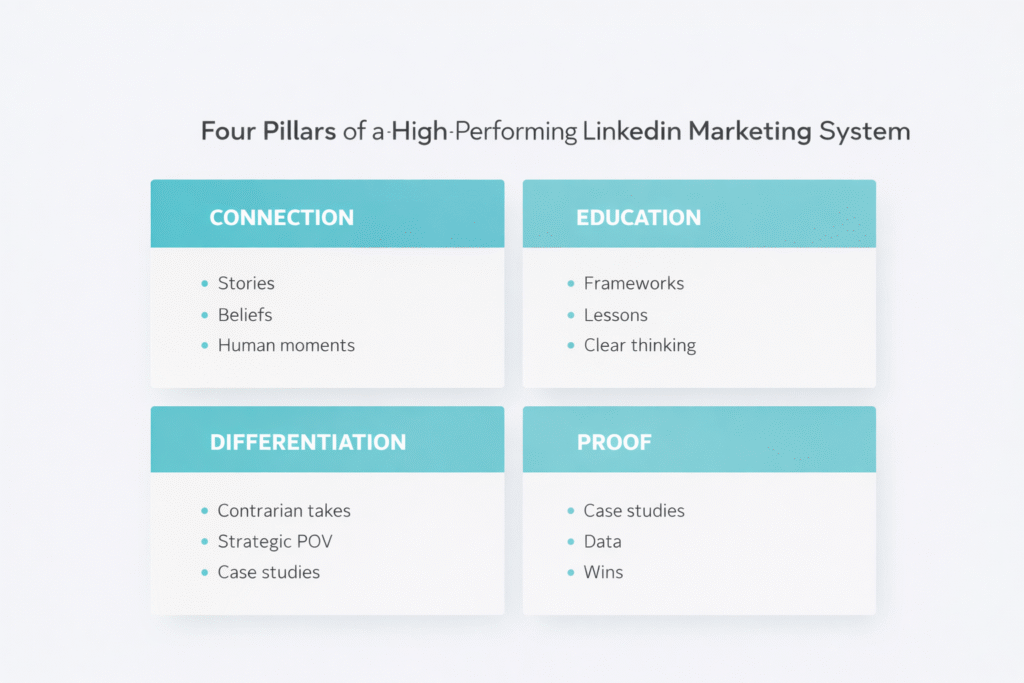
You need four pillars.
Connection
Stories. Beliefs. Human moments.
Education
Frameworks. Lessons. Clear thinking.
Differentiation
Contrarian takes. Strategic POV.
Proof
Case studies. Data. Wins. Outcomes.
If you stay inside these four, your LinkedIn lead generation strategy builds itself.
You naturally cover top, middle, and bottom of funnel.
Without forcing it.
Step 4. Content That Actually Performs in 2026
The highest-leverage skill on LinkedIn is writing strong hooks.
The first one to three lines decide reach.
People that get great results from their linkedin marketing strategy,
Keep a swipe file.
Save high-performing structures.
Reuse proven formats.
Iterate monthly.
Winning formats right now:
Text posts with sharp perspective.
Story to lesson breakdowns.
Case study posts.
Carousels that teach one clear framework.
Short native videos.
Visual infographics that simplify complexity.
Visuals amplify clarity.
They don’t replace it.
Step 5. AI as Infrastructure, Not a Shortcut
AI is now part of a modern LinkedIn marketing strategy.
But it doesn’t replace thinking.
It increases consistency.
High-performing founders and teams use AI to:
Draft posts faster.
Generate multiple hook variations.
Repurpose long-form content.
Outline carousels or infographics.
Draft personalized outreach.
Research and find prospects
Custom GPTs trained on your voice can support:
Post writing.
Hook testing.
Idea expansion.
Outbound personalization.
AI scales output. It doesn’t create authority.
Authority still comes from lived experience.
Step 6. Multi-Voice Authority Expands Reach
In 2026, growth isn’t driven by a single founder account.
The strongest brands show up through multiple aligned voices.
Founder
Vision and industry POV.
Operator
Execution lessons and frameworks.
Customer-facing expert
Objections, proof, real-world insight.
More surface area.
More trust.
More intent signals feeding outreach.
You don’t need everyone posting. You need alignment.

Step 7. Connecting LinkedIn to Pipeline With Intent-Driven Outreach
This is where most LinkedIn marketing strategies fall apart.
They create content.
They automate outreach.
But the two aren’t connected by signal.
And right now, there’s more noise than ever.
Automation is everywhere.
Connection limits are tighter.
Attention is thinner.
If you’re limited by how many connection requests you can send per day, precision becomes the advantage.
Intent is the leverage.
Here’s how the modern workflow actually works.
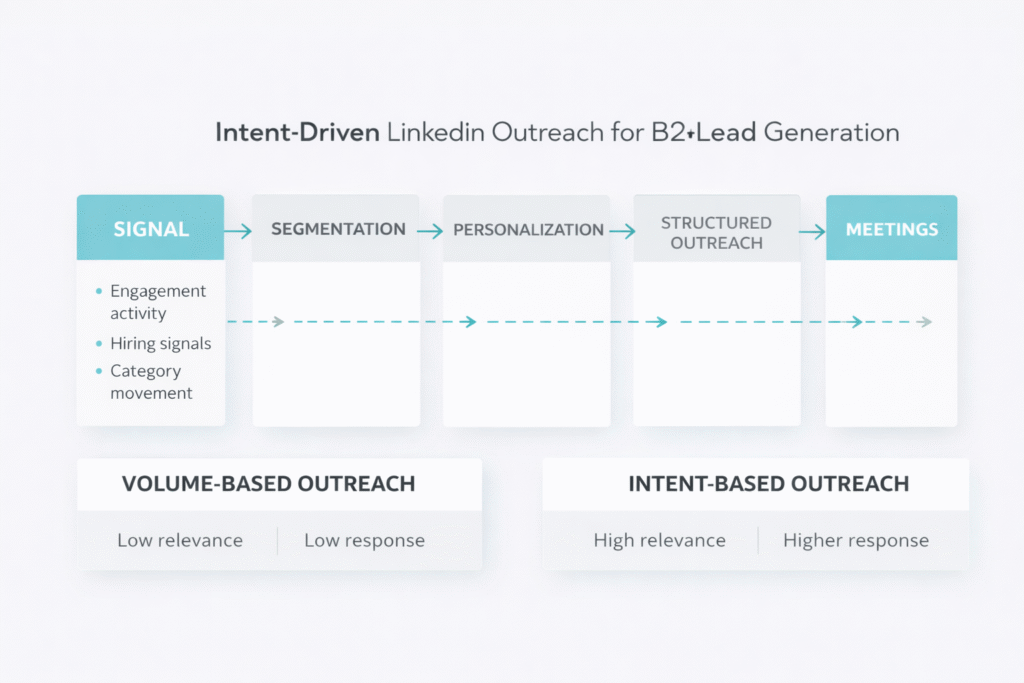
First, identify high-intent prospects with a tool like Gojiberry.
This finds signals like:
Engagement.
Hiring activity.
Category signals.
Gojiberry can now handle prospect identification, segmentation, and even generate personalized messaging for email or LinkedIn based on those signals.
You can also use the intent signal of website visitors. The best tool for this in my opinion is RB2B. This finds the personal level data of the people visiting your site.
There are many types of workflows for finding and enriching data for outbound reach. But these two are simple and can be added quickly.
That alone shifts outreach from cold to relevant.
Second, build prospect lists for outreach when needed.
You can layer in a Sales Navigator search link or use a targeted list from Apollo if you’re building around specific ICP criteria.
Intent data simply makes it warmer.
More relevant. More timely. And in a noisy environment, that difference matters.
Third, execute structured outreach. You can run outreach directly through platforms like Gojiberry.
Personally, I prefer using HeyReach for execution. It allows controlled, multi-account orchestration and keeps outbound structured and scalable.
But the key isn’t the tool. It’s the sequence.
Signal → segmentation → personalization → structured outreach.
When outreach is signal-based, response rates improve.
When it’s volume-based, noise increases.
If you want more replies and more leads, and you’re constrained by daily connection limits, intent data is what makes the difference.
Because relevance travels further than volume ever will.
Step 8. Organic First. Paid Second.
Boosting only works when you amplify what already performs.
Promote:
High-performing organic posts.
Lead magnets.
Webinars.
Case studies.
Paid should accelerate authority and conversations. Not compensate for weak positioning.
Step 9. Measure the Metrics That Matter
Ignore vanity reach.
Focus on:
Qualified followers.
Meaningful conversations.
Meetings created.
Pipeline influenced.
Revenue impact lives in relevance, trust, and timing.
Not impressions.
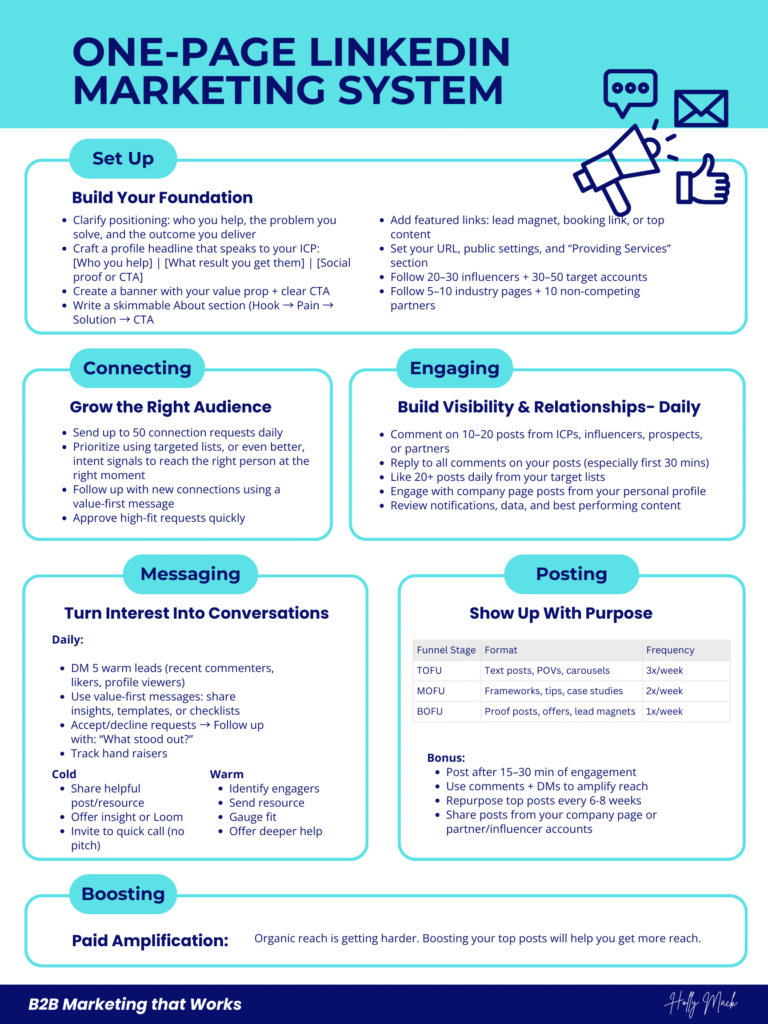
The Entire LinkedIn Marketing Strategy
Own one category.
Build authority through focused content.
Engage consistently.
Expand through aligned voices.
Capture intent signals with Rb2b and Gojiberry.
Execute precise outreach to targeted prospects with heyreach.
Amplify what works.
Optimize continuously.
LinkedIn isn’t about posting more. It’s about building a marketing system that turns authority into pipeline. When you treat it like a revenue channel, it behaves like one.
FAQs About LinkedIn Marketing Strategy
What is a LinkedIn marketing strategy?
A LinkedIn marketing strategy is a structured plan that connects positioning, content, engagement, and outreach to generate B2B pipeline. It aligns authority-building content with intent-driven conversations so activity on LinkedIn converts into qualified leads and revenue.
How does a LinkedIn marketing strategy generate pipeline?
A LinkedIn marketing strategy generates pipeline by building authority, attracting a relevant audience, identifying buying intent signals, and executing personalized outreach. When content and outreach are connected, conversations increase, leading to meetings, opportunities, and revenue.
Is LinkedIn marketing effective for B2B in 2026?
Yes. LinkedIn remains one of the most effective B2B marketing channels in 2026 when used as a revenue system. Companies that combine focused positioning, consistent content, intent data, and structured outreach see measurable pipeline impact.
What metrics matter in a LinkedIn marketing strategy?
The most important metrics are qualified followers, meaningful conversations, meetings booked, opportunities created, and pipeline influenced. A LinkedIn marketing strategy should be measured by revenue contribution rather than impressions or engagement alone.
How often should companies post on LinkedIn?
Most B2B companies should post 2 to 4 high-quality times per week. Consistency and clear positioning matter more than frequency. A focused LinkedIn marketing strategy compounds over time when content stays aligned with one core category.
What is the difference between LinkedIn content strategy and LinkedIn marketing strategy?
A LinkedIn content strategy focuses only on what is published. A LinkedIn marketing strategy includes positioning, profile optimization, content, engagement, intent-based outreach, paid amplification, and measurement to drive pipeline.