
Last updated: October 2026
TL;DR: Most wasted Claude tokens come from the same handful of habits: vague prompts, pasting whole documents when you need one section, starting a new task in an old thread, and hitting Regenerate instead of asking for a targeted edit. Fix those and you can cut usage dramatically without changing what you’re actually getting done, and without upgrading to a more expensive plan just to compensate for sloppy habits.
To save Claude tokens on marketing tasks, write specific prompts instead of vague ones, share only the relevant section of a document instead of the whole file, start a fresh conversation for each new task, and ask for a targeted edit instead of a full regeneration.
Nobody plans to waste tokens. It happens one small habit at a time. You paste the whole brand doc when you needed one paragraph. You hit Regenerate three times chasing a better intro instead of just asking Claude to fix the intro. You keep the same thread going for a week across six unrelated projects, and every message now drags the full history of all six along with it.
None of that is dramatic on its own. All of it together is why people hit usage caps faster than they expect, and why some teams conclude they need a more expensive plan when the real problem was never volume. It was waste.
I run a real content and marketing workflow through Claude, and the difference between a well-run setup and a sloppy one shows up directly in how often I hit limits versus how much I get done in a session.
Why Vague Prompts Cost More Than Clear Ones
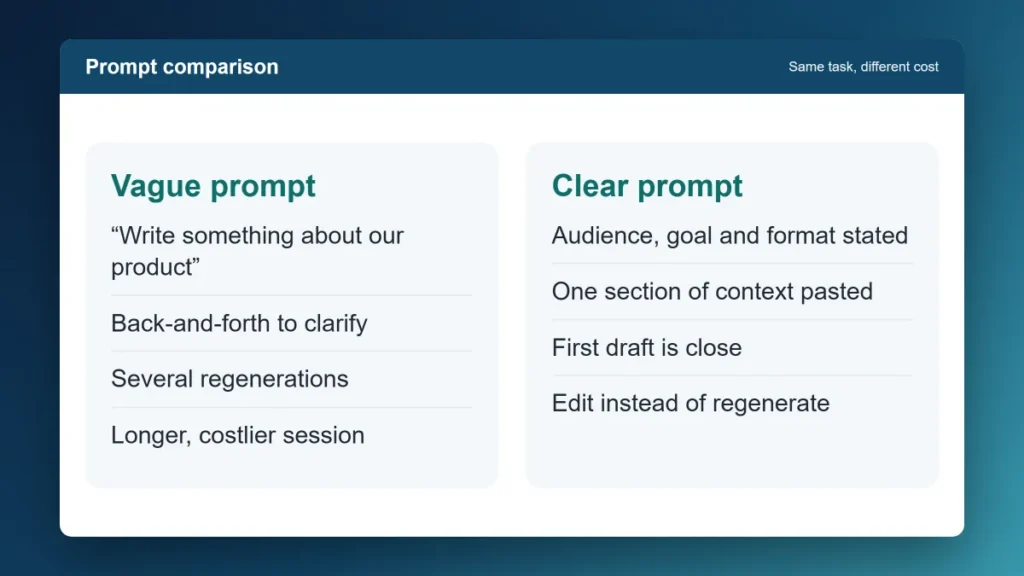
A vague prompt doesn’t just produce a worse answer. It costs more too, because Claude has to guess at what you actually want, and a guess that misses the mark means a second prompt, a clarifying question, or a full redo.
Compare “write about AI in customer support” to “write a 700-word guide about how AI helps customer support teams in software companies,” an example Analytics Insight uses in its breakdown of common Claude token mistakes. The second version gives length, audience, and focus up front. One pass. No back and forth.
This compounds across a whole content calendar. If every single piece needs one clarifying round trip because the original brief was vague, you’re not just spending extra tokens on that one exchange. You’re spending it across every post, every week, every month, and it adds up to a meaningful chunk of total usage that nobody tracks because it never shows up as one dramatic event.
Specificity isn’t extra typing for its own sake. It’s the fastest way to skip the round trip where Claude guesses wrong and you have to correct it. The habit of writing a tighter brief up front, length, audience, angle, format, pays for itself almost immediately.
Stop Pasting Whole Documents When You Need One Section
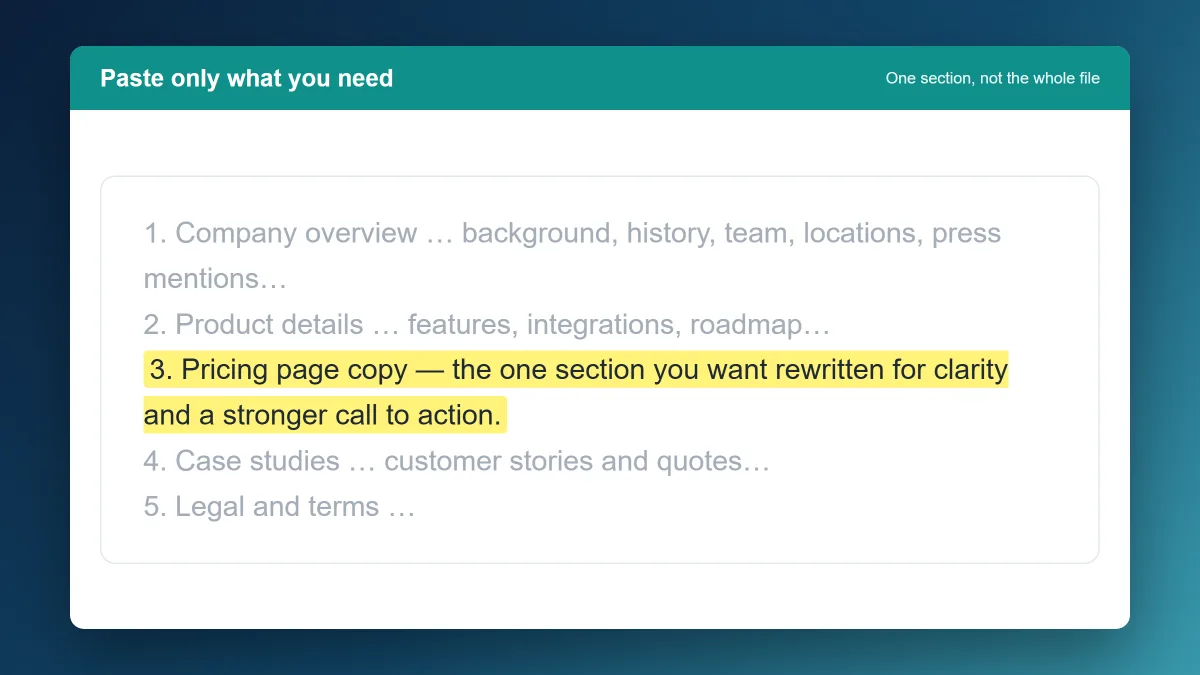
This is the single most common habit I see, including in my own early workflows. Someone uploads a 20,000-word document to get help with one paragraph in the middle of it. Every token in that document gets processed, every single time you send a follow-up message in that thread, whether you need it or not.
Pull the relevant section. Paste just that. If you need more context later, add it then. Analytics Insight’s piece on common token-wasting mistakes points to exactly this pattern as one of the biggest offenders, and separate 2026 benchmark reporting on code-specific tasks found limiting shared context cut token use by close to 70% in some workflows.
For marketing work specifically, this shows up with brand guides, past blog posts, and client briefs. You don’t need the entire 40-page brand guide in every message. You need the three paragraphs about tone and the banned word list. Build a trimmed reference version for daily use and keep the full document for when you genuinely need it.
The same logic applies to client files. If you’re managing multiple accounts, resist the temptation to paste an entire shared drive’s worth of context into one conversation just because it’s all technically relevant to the client. Pull what the specific task actually needs. The rest can wait until it’s actually asked for.
Projects Fix the Repetition Problem, Conversations Don’t
A Claude Project holds your standing context once. Brand voice, formatting rules, recurring instructions. A long conversation thread does not do this the same way. It just keeps growing, and every message in a long thread reprocesses everything that came before it.
Reported developer experiments from 2026 found that starting fresh, shorter threads instead of one long-running conversation cut token usage by almost 60% in some workflows, per the same Analytics Insight reporting. The mechanism is simple. A new thread starts clean. An old thread that’s been running for three weeks across five different projects is dragging all of that history behind it on every single turn.
This is the habit that’s hardest to break because it feels efficient in the moment. Why start a new chat when the old one already “knows” what I’m working on? But that knowing is exactly the problem. The old thread doesn’t selectively remember the useful parts. It carries everything, every tangent, every discarded draft, every half-finished thought, forward into every new message.
Start a new conversation per task. Keep the standing brand knowledge in the Project instead, so you’re not re-pasting it into every fresh thread anyway. I covered how to set that up properly here, and it’s the single biggest structural fix most people skip.
Combine Related Tasks, But Don’t Bundle Unrelated Ones
This one has a real nuance to it, and getting it backward wastes tokens either direction.
If you need Claude to summarize, rewrite, and restructure the same piece of content, do it in one well-written prompt instead of three separate round trips. That’s a related task bundle, and combining it saves tokens because you’re not re-sending the source material three separate times.
But writing a blog post, debugging a script, and researching a competitor are not related tasks just because you thought of them in the same five minutes. Bundling genuinely unrelated work into one prompt tends to produce a worse result on all three, because Claude is splitting attention across tasks that don’t share context. Split those into separate requests instead.
The rule isn’t “combine everything” or “split everything.” It’s whether the tasks actually share the same source material and context. If yes, bundle. If no, split. A quick test: if explaining the second task requires re-explaining the first task’s context from scratch, they’re not related enough to bundle.
Use the Right Model for the Task, Not the Biggest One by Default
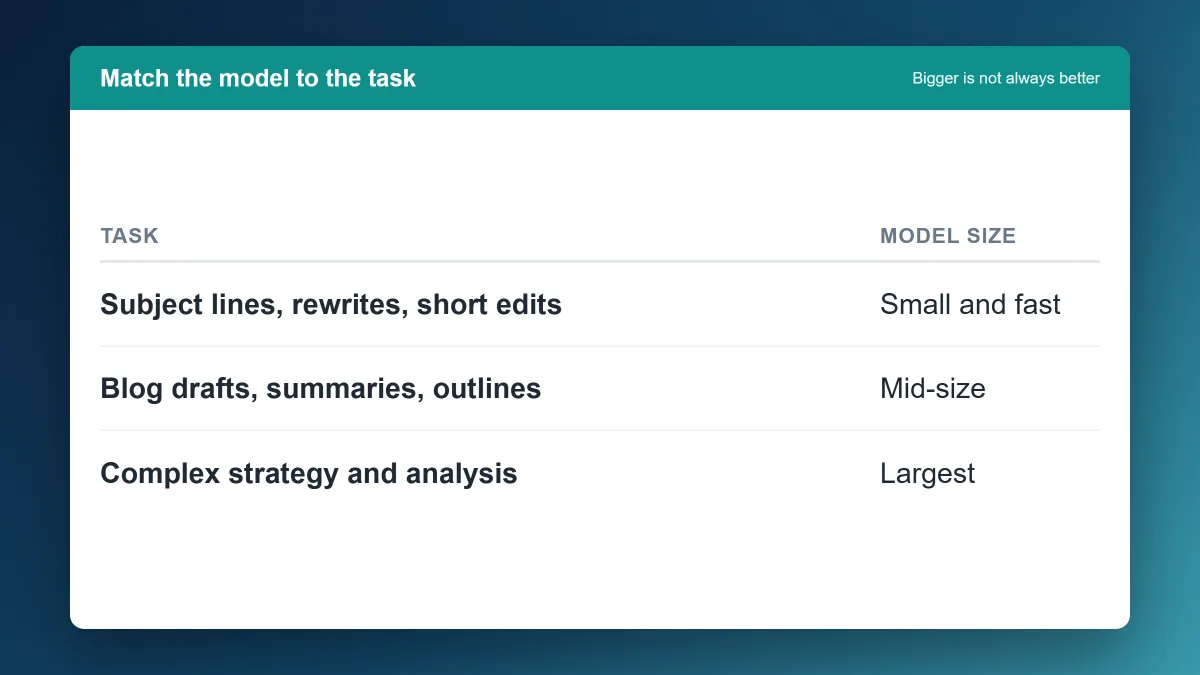
Not every marketing task needs your most capable model running at full capacity. A quick grammar pass, a short email draft, or a simple rewrite doesn’t need the same horsepower as a complex competitive analysis or a long-form strategic document.
Match the model to the actual difficulty of the task. Save the heavier lift for research synthesis, technical analysis, and anything genuinely complex. Route the quick, repeatable stuff to a lighter option. This single habit change is one of the tactics Analytics Insight flags most directly for cutting cost without cutting quality.
The default instinct is to always reach for the most powerful option because it feels safest. But a lighter model running a quick grammar check isn’t a compromise. It’s the right tool for a task that doesn’t require deep reasoning in the first place.
Stop Regenerating, Start Editing
Hitting Regenerate on a full response because the intro is weak means paying for the entire response again, including the 90% that was already fine.
Ask for the specific fix instead. “Rewrite just the intro” or “shorten the third paragraph” costs a fraction of what a full regeneration costs, and it gets you a more targeted result because Claude isn’t guessing what else you might want changed along with it.
This is a habit, not a tool setting, which means it’s also the easiest one on this list to fix starting with your very next message. There’s no setup required. No configuration. Just a different sentence the next time something needs a tweak.
The B2B Operator’s Take
None of this is about being cheap with tokens for its own sake. It’s about not hitting a usage cap in the middle of a client deadline because six unrelated habits quietly stacked up over a session.
The companies getting this wrong at scale are a real cautionary tale, not a hypothetical one. Legal AI firm Harvey reportedly scaled from roughly 1 trillion to almost 12 trillion tokens processed per month during 2026, and separate reporting describes one company burning through close to $500 million in a single month after rolling out unlimited AI access with no usage controls. That’s an extreme end of the spectrum, but the underlying lesson applies at any size. Usage without structure gets expensive fast, whether you’re a single operator or an enterprise rollout.
For a lean marketing team or a fractional CMO running multiple clients, the stakes are smaller in dollar terms but identical in kind. Sloppy habits mean you hit your cap on a Tuesday afternoon instead of getting through the week, and the fix usually isn’t a bigger plan. It’s the six habits above, applied consistently.
If you want help building a Claude setup that’s actually structured instead of improvised, book a call with Holly.
Quick Questions About Saving Claude Tokens
Does starting a new chat actually save tokens?
Yes. A long-running thread reprocesses its full history on every turn. Reported 2026 developer experiments found switching to shorter, fresh threads cut usage by almost 60% in some workflows. Keep standing brand knowledge in a Project instead of carrying it in conversation history, so a fresh thread never loses access to what it actually needs to know.
Is it better to use one long prompt or several short ones?
Depends on whether the tasks are actually related. Combine tasks that share the same source material into one prompt. Split tasks that don’t share context, like writing and coding and research, into separate requests. When in doubt, ask whether explaining task two requires re-explaining task one. If it does, they’re separate.
Should I always use Claude’s most capable model?
No. Save the heaviest model for genuinely complex work like research synthesis or technical analysis. Route quick, repeatable tasks like grammar passes or short drafts to a lighter option. This isn’t a compromise on quality. It’s matching effort to the actual difficulty of the task.
What’s the biggest token-wasting mistake marketing teams make?
Pasting entire documents when only one section is relevant. A brand guide or client brief gets re-processed in full on every message in that thread, whether the content is needed again or not. Building a trimmed reference version of your most-used documents fixes this permanently.
Does hitting Regenerate waste tokens?
Yes, more than most people realize. A full regeneration re-pays for the entire response, including the parts that were already good. Asking for a targeted edit to just the weak section costs a fraction of that, and it’s a habit you can change immediately with no setup.
Can reusing prompt templates actually help?
Yes. A fixed template for a recurring task, like a weekly report format or a standard content brief, cuts the repeated setup tokens you’d otherwise spend rebuilding the structure every time, and it keeps output more consistent as a side benefit. Templates pay off fastest on the tasks you run most often.