


This guide shows you how to get booked on podcasts systematically, starting with free tools, building judgment first, and then scaling with leverage only when it makes sense.
Podcast guesting is one of the most underutilized distribution systems in B2B and founder-led marketing.
Not because it doesn’t work —
but because most people approach it randomly, emotionally, or with the wrong incentives.
Here we break down the full playbook used.
Free First. Scalable when you’re ready.
(Disclosure: Some links are affiliate links. I only recommend tools I personally use, at no extra cost to you.)
Why Podcast Guesting Is Worth the Effort (The Strategic Case)
Podcast guesting works because it solves the hardest problem in marketing: distribution with trust.
Here’s why it matters strategically:
1. Trust Transfer Beats Cold Attention
You’re not interrupting strangers.
You’re introduced by someone the audience already trusts.
That means:
- Faster credibility
- Higher engagement
- Lower resistance than ads or cold outreach
2. Long-Form Attention Is Rare — and Valuable
Podcast listeners opt in and stay for 30–60 minutes.
Especially in B2B, that often means:
- Founders
- Operators
- Decision-makers
You’re not fighting for seconds.
You’re earning attention.
3. Podcast Appearances Compound
Unlike social posts or ads:
- Episodes live for years
- They get discovered via search
- They’re recommended algorithmically
One appearance can keep working long after you record it.
4. Guesting Multiplies Content Output
One conversation can become:
- Clips
- Quotes
- Blog references
- Sales enablement proof
- Google results
Podcast guesting isn’t just visibility — it’s content leverage.
Why Most Podcast Guesting Fails
Hosts Only Care About Audience Value
This is the rule that governs everything else in podcast guesting.
Podcast hosts don’t book guests because they’re impressive.
They don’t book guests because of titles, follower counts, or personal brands.
They book guests because the episode will help their listeners.
Every host is asking the same question. Will this conversation make my audience glad they pressed play?
If the answer is yes, you get booked. If the answer is unclear, you get ignored.
This is where most podcast guesting efforts break down.
People pitch:
- Their story instead of an episode
- Their credentials instead of a takeaway
- Their business instead of the listener’s problem
From the host’s perspective, that creates risk.
And hosts avoid risk.
When you stop asking, “Why should they have me on the show?” And start asking, “Why would this episode matter to their audience?”
Everything downstream becomes easier.
The Non-Negotiable Rule: Audience Fit First
Before you research a single podcast, define your target audience clearly.
You must know:
- Industry
- Role or title
- Company size
- Geography (if relevant)
If a podcast audience does not overlap with your ideal customer, skip it.
Right audience beats big numbers every time.
How to Get Booked on Podcasts- The Full Process
Step 1: Find Relevant Podcasts for Free
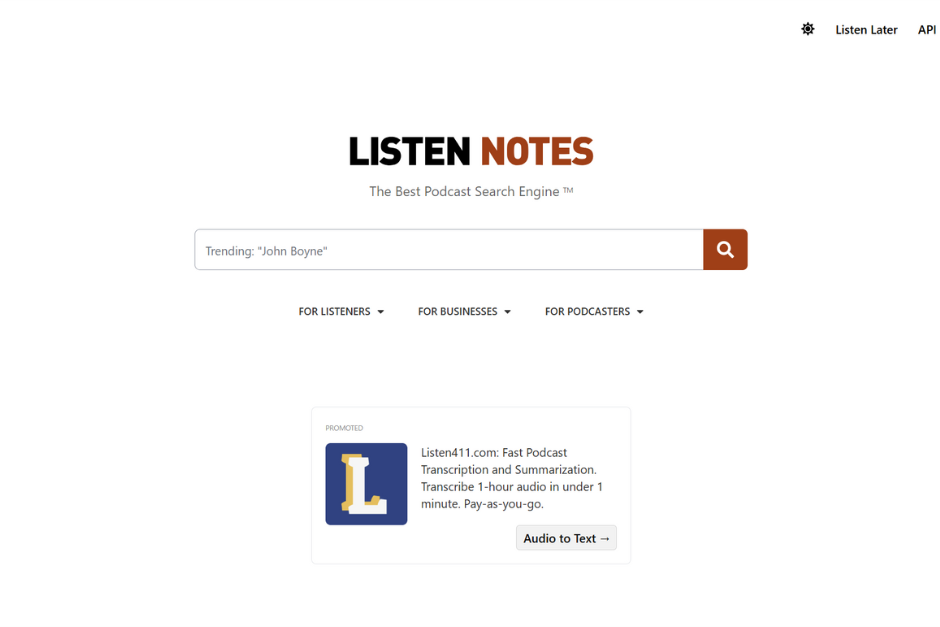
When learning how to get booked on podcasts, start here. Your primary free research tool is Listen Notes.
Think of it as Google for podcasts.
How to Search Correctly
Do not search only by industry.
Search by problems and themes your audience cares about.
Examples:
- “B2B growth”
- “MSP sales”
- “Founder burnout”
- “Scaling a SaaS”
- “IT leadership”
If you’re stuck, ask:
“What problems does my ideal customer actively search for in podcasts?”
What to Check in Listen Notes
For each podcast:
- Podcast description → who the show is actually for
- Recent episode titles → day-to-day problems matter
- Last publish date → active shows only
- Host name + website links → needed for outreach
Inactive podcasts are dead ends. Move on.
Secondary Free Discovery Channels
Use these to validate and expand your list:
- Spotify (categories + popularity signals)
- Apple Podcasts
- YouTube (video podcasts and clips)
- Google searches: “best podcasts for [audience]”
- Industry blogs, newsletters, and communities
Step 2: Vet Podcasts for Relevance and Quality
Audience Fit Check (Mandatory)
Ask:
- Is this show clearly speaking to my ideal customer?
- Are recent guests peers of my audience?
- Would my buyer realistically listen to this show?
If the answer isn’t clearly yes, skip it.
Quality Signals (Helpful, Not Required)
- Consistent publishing schedule
- Host is active or shares clips
- Episodes are conversations, not ads
Download counts are optional.
Relevance is mandatory.
Step 3: Build a Simple Tracking System
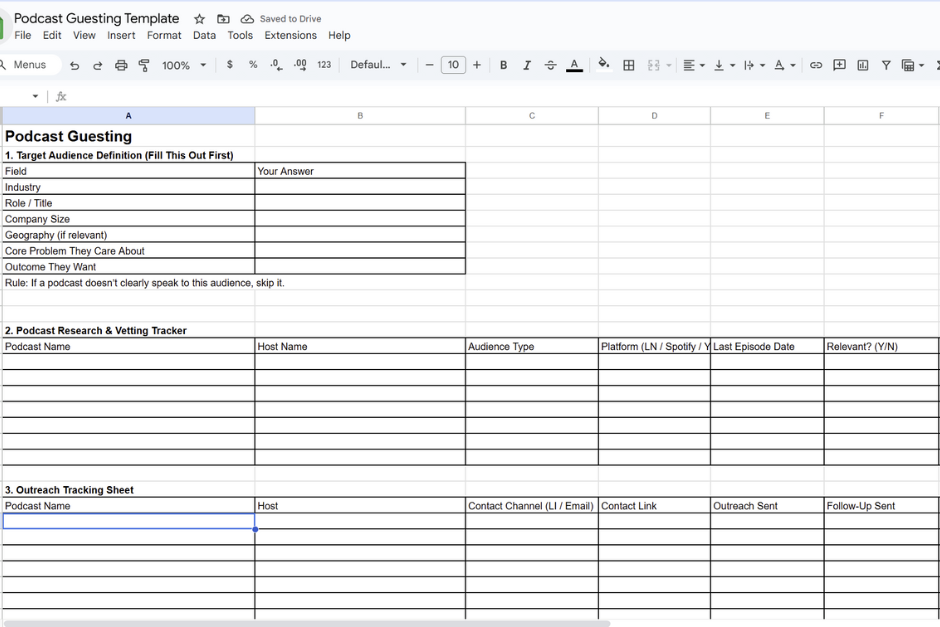
You can’t do this from memory. Track everything in one place:
- Podcast name
- Host name
- Audience type
- Platform links
- Contact email (if listed)
- LinkedIn profile
- Last episode date
- Outreach status
This prevents:
- Duplicate outreach
- Missed follow-ups
- Lost momentum
Since you’re probably just learning how to get booked on podcasts, I created this template to help you out.
Step 4: Identify Hosts and Outreach Channels
Where to Find Hosts
- Listen Notes profiles
- Episode descriptions
- Podcast websites
Channel Priority
- LinkedIn — fastest and most human
- Email — only if clearly listed for guest requests
- Contact forms — backup only
If there’s no email, default to LinkedIn. If you need to find contact information, I recommend
Step 5: The Pitch Framework That Gets Responses
Most pitches fail because they sound like PR.
Pitch Rules
- No bios
- No resumes
- No selling
If it sounds like marketing copy, rewrite it.
Every Pitch Must Include
- One line showing you know the show
- Clear relevance to their audience
- One or two episode ideas aligned with recent episodes
- A low-pressure, respectful tone
You are offering an episode, not asking for a favor.
Step 6: Outreach Execution
LinkedIn Outreach
- Send a connection request
- After acceptance, wait 1–2 days
- Send a short note referencing the podcast and idea
Email Outreach
- Only when email is clearly listed
- Personalize the first line using a recent episode
- Keep it under a few short paragraphs
Follow-Up Rules
- One follow-up max after 7–10 days
- No response = move on
When you’re learning how to get booked on podcasts, you might get discouraged if you don’t get a response. Silence is not rejection. It’s just a signal to keep going.
Tools that Can Help You Get Booked on Podcasts
Manual outreach works — but it requires time, consistency, and discipline. If you’re learning how to get booked on podcasts and your short on time, these two tools will help.
Tools exist to replace effort, not thinking.
There are three variables in podcast guesting:
- Time
- Volume
- Risk
No tool optimizes all three.
Inbound + SEO Layer: Talks.co
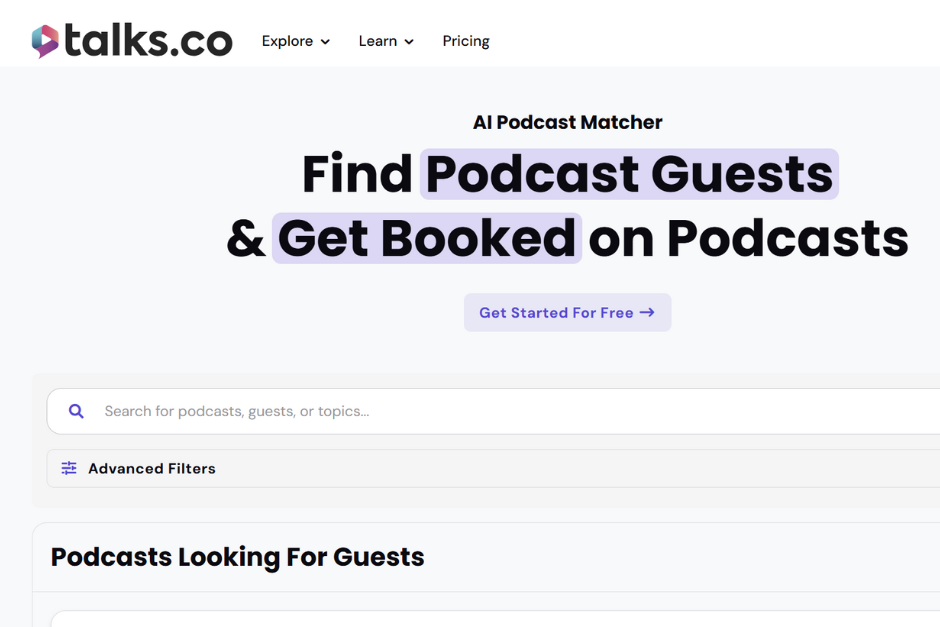
Talks.co is best for:
- People getting started
- Low-cost experimentation
- Inbound + credibility + SEO
What It Does Well
- Public profile hosts can discover
- Makes it easier for hosts to say yes
- Can rank in Google (real compounding value)
- Low monthly cost
What It Does Not Do
- Guarantee fast bookings
- Create immediate volume
Use Talks when you want momentum that builds over time.
Outbound + Volume Layer: PodPitch
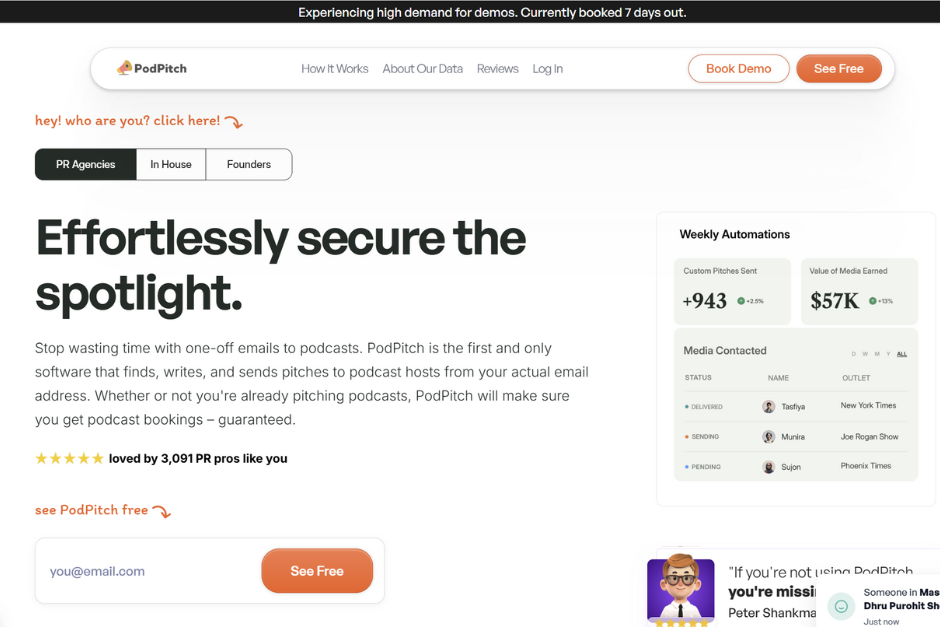
PodPitch is a volume and certainty engine.
What It Does Well
- Surfaces hosts actively looking for guests
- Reduces cold outreach
- Delivers faster reps
- Includes a booking guarantee (lower risk)
What It Does Not Do
- Build inbound
- Create SEO value
- Compound after you stop using it
PodPitch replaces manual outbound.
It does not replace strategy.
Can You Use Both? Yes — If You Use Them Correctly
Here’s the clean system:
- Manual outreach → builds judgment
- Talks.co → builds momentum + SEO
- PodPitch → creates velocity + volume
Talks builds momentum.
PodPitch creates velocity.
Manual outreach builds judgment.
Use them for different jobs, not the same one.
How to Choose the Right Path
Manual Only
- You’re clarifying your niche
- You’re testing podcast guesting
- You have more time than budget
Talks.co First
- You want inbound + SEO
- You’re early or rebuilding consistency
- You prefer low commitment (Plans start at less than $10 per month)
PodPitch
- You already know what converts
- You want bookings faster
- Time matters more than budget
The Takeaway for How to Get Booked on Podcasts
Podcast guesting isn’t hard.
It’s just honest, consistent work.
If you:
- Respect audience fit
- Offer real value
- Track your outreach
- Add leverage only when ready
You can turn podcast guesting into a repeatable marketing system, not a one-off tactic.
Start free.
Build judgment.
Then scale with intention.
FAQ 1: Is podcast guesting worth it?
Answer:
Yes. Podcast guesting works because it combines trust transfer, long-form attention, and evergreen distribution. You’re introduced to an audience that already trusts the host, which makes it especially effective for founders, consultants, and B2B operators.
FAQ 2: How do you get booked on podcasts without a PR agency?
Answer:
You can get booked by identifying podcasts your target audience already listens to, pitching episode ideas that deliver value to listeners, and reaching out directly to hosts via email or LinkedIn. PR agencies are not required for most podcast guesting.
FAQ 3: What is the best way to pitch yourself as a podcast guest?
Answer:
The best podcast pitches focus on the audience, not the guest. A strong pitch references the show, explains why the topic fits the audience, and proposes one or two clear episode ideas with specific takeaways.
FAQ 4: How do you find podcasts to be a guest on?
Answer:
You can find podcasts by using search tools like Listen Notes, browsing Spotify and Apple Podcasts categories, searching YouTube for video podcasts, and reviewing industry blogs or curated podcast lists related to your audience.
FAQ 5: Do podcast hosts care about follower count or audience size?
Answer:
Most podcast hosts care more about listener value than follower count. Relevance, expertise, and the ability to deliver a useful episode matter far more than the size of your personal audience.
FAQ 6: Are podcast guest booking tools worth it?
Answer:
Podcast guest booking tools can be worth it once you have clarity on your audience and message. Free manual outreach builds judgment, inbound tools help with visibility and SEO, and outbound tools help scale volume when time matters.
FAQ 7: What’s the difference between inbound and outbound podcast guesting?
Answer:
Inbound podcast guesting happens when hosts find and invite you, often through a public profile or search. Outbound podcast guesting involves actively pitching or responding to opportunities. Both approaches can work when used intentionally.
FAQ 8: How long does it take to get booked on podcasts?
Answer:
Timelines vary. Manual outreach may take weeks to build momentum, while outbound tools can accelerate bookings. Consistency, relevance, and clear episode ideas matter more than speed.
FAQ 9: Can podcast guesting generate leads?
Answer:
Yes, podcast guesting can generate qualified leads when the audience is aligned with your offer and you clearly articulate value during the episode. It works best as part of a broader distribution system, not a one-off tactic.
FAQ 10: Is podcast guesting good for SEO?
Answer:
Podcast guesting can support SEO through branded search, backlinks from show notes, and profile pages that rank in search results. While not a direct SEO tactic, it contributes to long-term visibility and authority.