

A marketing plan in 2026 shouldn’t be a document that lives in a folder somewhere.
It should be a system.
When you strip away the fluff, a marketing plan that actually works has seven parts, in this order:
- A clear goal or goals tied to revenue and business objectives
- A defined buyer or ideal customer profile
- An irresistible offer and message
- Primary channels to consistently capture leads
- A system to nurture and convert those leads
- A flywheel that turns customers into growth
- A way to track, measure, and adjust without chaos
Miss one, and the plan breaks.
Overcomplicate it, and it never gets used.
Let’s walk through it step by step.
Why Most Marketing Plans Don’t Work
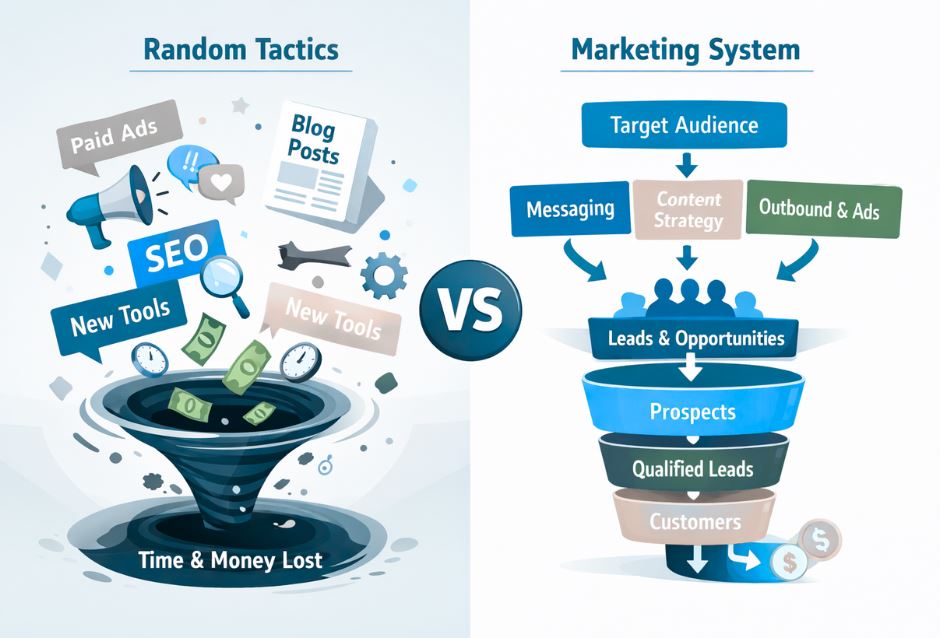
The simple reason. They start with tactics. A new channel. A new campaign. A new idea someone saw online. What they don’t start with is a decision.
A real marketing plan doesn’t describe everything you could do. It tells you what matters, what doesn’t, and what to stop doing.
Start with What’s Already Working
Most marketing plans start in the wrong place. They start with ideas. New channels. New campaigns. New bets.
But growth rarely comes from something brand new. It usually comes from something that’s already working that just hasn’t been fully expanded yet.
Before you add anything, look at what’s already producing results. Not opinions. Not assumptions. Actual pipeline.
That might be:
- A channel that consistently drives leads
- A campaign with higher-than-average conversion
- A sales motion that closes faster than others
- Customers who are already expanding or referring
This is where your plan should start. Not with brainstorming. With evidence.
A simple way to do this:
- Look at your last 20–30 closed deals
- Identify where they came from
- Find the patterns, not the outliers
If something is already working, your first job isn’t to replace it. It’s to expand it.
Step 1: Set a Clear Goal Tied to Business Objectives
Every marketing plan needs a goal. A real marketing goal answers one question: What does the business need marketing to do right now?
Bad goal: “Grow pipeline.” Better goal: “Generate 25 qualified sales conversations per month from mid-market manufacturing companies within 90 days.” That single sentence will shape everything else in the plan.

Growth Doesn’t Come from One Motion
Most marketing plans over-index on acquisition. More leads. More traffic. More top-of-funnel.
But real growth usually comes from three distinct motions:
- Acquisition — Net new pipeline: SEO, paid, outbound, content
- Expansion — Revenue from existing customers: upsells, cross-sells, increased usage
- Referral and Partner — Pipeline from trust, not targeting: customer referrals, partners, integrations
Here’s the part most plans miss:
- Acquisition is the most visible
- Expansion is often the easiest
- Referrals are usually the cheapest
If your plan only focuses on acquisition, you’re ignoring two of the highest leverage growth paths available.
Step 2: Define Who You’re Targeting.
Once the goal is clear, the next question is obvious. Who is this for? Your marketing plan should be built around the buyers most likely to help you hit the goal you just set.
Look at your last 12 months of customers and ask: which industries show up repeatedly, which buyers close faster, and which customers are profitable and low friction?
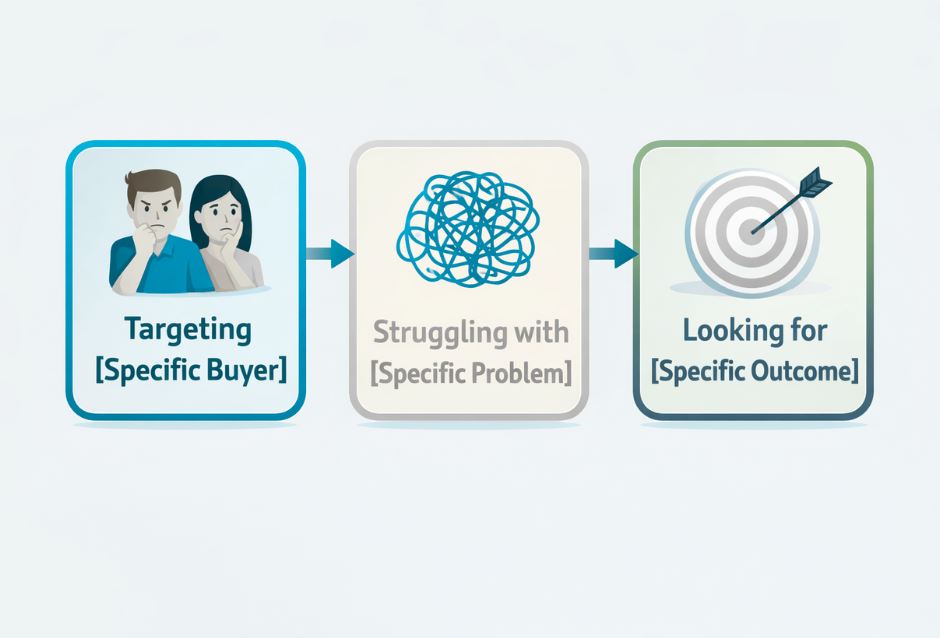
Before moving on, you should be able to say: We are targeting [specific buyer] who are struggling with [specific problem] and actively looking for [specific outcome].
Step 3: Create an Offer and Message They Can’t Ignore
A strong offer does three things: solves a real, urgent problem; promises a clear outcome; and reduces perceived risk.
A simple structure that works: We help [specific buyer] achieve [specific result] without [specific pain or risk]. Lock this before choosing channels. Otherwise, you’ll just amplify noise.
Step 4: Choose Your Primary Channels to Capture Leads
A strong marketing plan defines primary channels based on team size and capacity. Ask two questions: where does this buyer already spend attention, and can we show up here consistently every week? If the answer to either is no, it’s not a primary channel. Consistency beats novelty every time.
Every new channel you add takes time and attention away from something else. More ideas usually lead to less execution. Focus isn’t limiting — it’s what makes growth possible.
Once you chooose your primary channels, find ways to repurpose that content across other channels.
Sequence Your Growth — Don’t Stack It
One of the fastest ways to stall growth is trying to do too much at once.
More channels doesn’t mean more growth. It usually means less focus.
Instead of stacking, sequence your growth:
- Start by expanding what already works
- Improve conversion before adding volume
- Double down on one channel before introducing another
- Layer in referrals and partners once your core motion is stable
A simple progression looks like:
- Step 1: Focus on your strongest channel
- Step 2: Fix bottlenecks in conversion
- Step 3: Increase output in that channel
- Step 4: Add a second channel
- Step 5: Build referral and partner loops
Growth compounds when it’s layered. Not when it’s scattered.
Step 5: Build a Simple Nurture and Conversion System
Most people aren’t ready to buy the first time they hear about you. Nurture usually includes email follow-ups, a newsletter, retargeting ads, sales sequences, and proof content that reinforces trust. The exact mix matters less than having a system that runs without manual chasing.
For lean teams, this is why I recommend using a single CRM system like GoHighLevel to handle lead capture, tagging and segmentation, automated follow-ups, and pipeline tracking.
Step 6: Turn Customers Into a Growth Flywheel
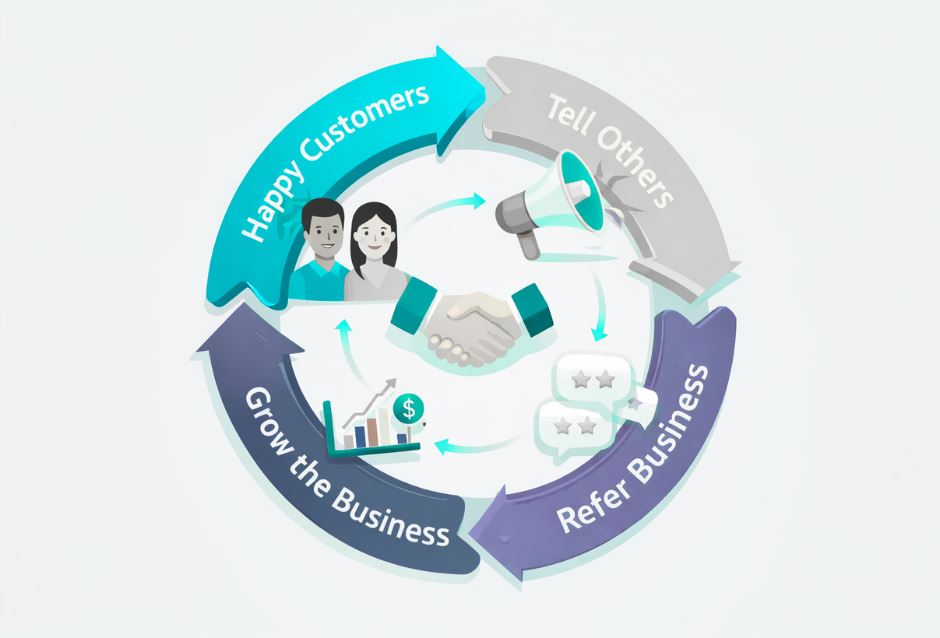
Your happiest customers are one of your most powerful growth channels. Referrals don’t happen by accident. They need a clear ask, a simple system, consistent timing, and follow-up. Right after a customer sees success is the best time to ask for feedback, capture testimonials, introduce the next offer, and invite referrals.
Expansion Is the Most Underutilized Growth Lever
Most teams treat growth like it only comes from new customers.
But in practice, a large percentage of revenue is already sitting inside your existing customer base. It’s just not being actively worked.
Expansion doesn’t happen automatically. It’s driven.
Where expansion actually comes from:
- Customers who never fully onboarded
- Features that were never adopted
- Accounts that outgrew their current plan
- Contracts that haven’t been revisited in 12+ months
Why it gets ignored:
- It sits between marketing, sales, and CS
- It’s not always clearly owned
- Dashboards prioritize new pipeline, not expansion revenue
What to do instead:
- Treat your customer base like a second audience
- Build campaigns specifically for existing customers
- Track expansion revenue as a core KPI, not a bonus
- Work closely with CS to identify expansion signals early
If you’re not actively planning for expansion, you’re leaving one of your highest ROI growth levers untouched.
Referrals and Partners Aren’t Passive Channels
Most teams say they want more referrals. Very few build a system to generate them.
Referrals and partner channels work because they’re built on trust. That’s why they convert faster and close at higher rates.
But they don’t work without structure.
Why referrals and partners matter:
- Higher trust from the first touch
- Shorter sales cycles
- Lower cost to acquire
Why they fail:
- No consistent ask
- No defined process
- No tracking or attribution
What a simple system looks like:
- Identify your most successful customers (top 20%)
- Ask for referrals at specific moments (after results, not randomly)
- Create lightweight partner relationships where incentives are clear
- Track referral sources consistently, even if it’s manual at first
This doesn’t need to be complex. It just needs to be intentional.
Step 7: Decide How You’ll Track and Measure What Matters
Pick 3 to 5 metrics tied to your goal. No more. Set a simple review cadence: weekly to fix small leaks, monthly to decide what to double down on or stop, and quarterly to adjust the plan based on reality.
If everything is a priority, nothing actually gets done. The plan is only as good as the number of things you’re willing to stop doing.
The Focused Growth Stack
A simple way to think about your marketing plan:
- Core channel — The primary driver of pipeline today
- Expansion layer — Revenue from existing customers
- Referral and partner layer — Trust-driven pipeline
- Experimental layer — New channels being tested, not relied on
Most teams over-invest in the experimental layer and under-invest in the core and expansion layers. That’s why growth feels inconsistent.
Make Sure the Plan Is Financially Sound
Before you finalize the plan, run one last reality check. You should know what a customer is worth over time, what you can afford to spend to acquire one, and how long it takes to earn that back.
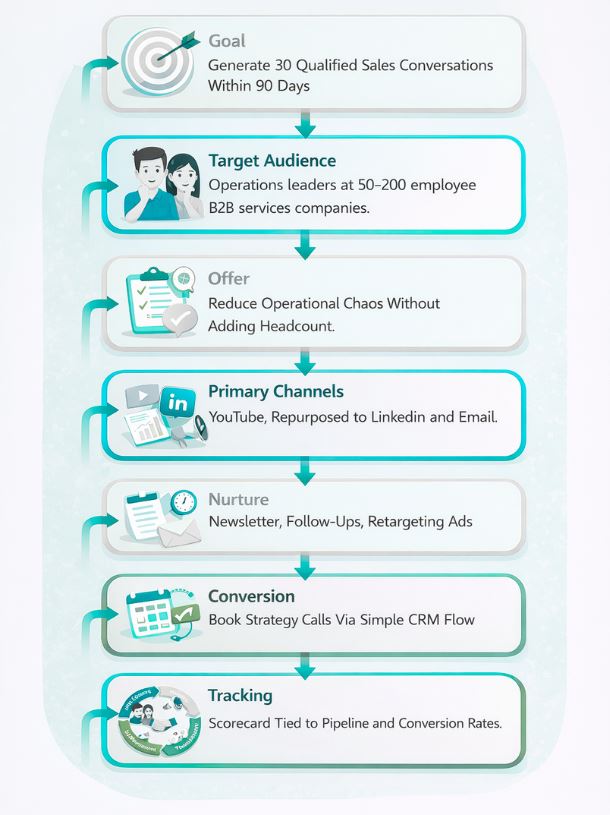
A Simple Marketing Plan Example
Goal: Generate 30 qualified sales conversations per month within 90 days.
Who: Operations leaders at 50–200 employee B2B services companies.
Offer: A clear promise to reduce operational chaos without adding headcount.
Primary channels: YouTube as the main engine, repurposed to LinkedIn and email.
Nurture: Weekly newsletter, automated follow-ups, retargeting ads.
Conversion: Book a strategy call through a simple CRM flow.
Flywheel: Post-project reviews, referral asks, and expansion offers.
Tracking: Weekly scorecard tied to pipeline and conversion rates.
Frequently Asked Questions
What should a B2B marketing plan include?
A B2B marketing plan should include a clear revenue-tied goal, a defined ideal customer profile, a compelling offer and message, primary lead capture channels, a nurture and conversion system, a customer flywheel for referrals and expansion, and a measurement framework with 3 to 5 KPIs.
How long does it take to build a B2B marketing plan?
A focused B2B marketing plan can be built in a few hours if you already have clarity on your goal, ICP, and offer. Most teams get stuck because they try to plan everything at once. Starting with one clear goal and two primary channels is faster and more effective than building a comprehensive document that never gets used.
What is the most important part of a marketing plan?
The goal. Everything else in the plan flows from a clear, revenue-tied objective. Without a specific goal, channels scatter, messaging weakens, and measurement becomes meaningless.
How often should you update your marketing plan?
Review your marketing plan weekly at a tactical level, monthly to decide what to double down on or stop, and quarterly to adjust strategy based on what the data is actually showing. A plan that isn’t reviewed regularly stops being real.
What is the difference between a marketing plan and a marketing strategy?
A marketing strategy defines your positioning, target audience, and competitive differentiation. A marketing plan is the operational document that translates that strategy into specific goals, channels, systems, and metrics. Strategy sets direction. The plan governs execution.
What should a marketing plan include?
A clear revenue target, defined growth channels, an expansion strategy, a referral motion, and an execution timeline.
What’s the difference between a marketing strategy and a marketing plan?
Strategy defines the direction. The plan defines what actually gets done and when.
Want Help Turning This Into a Real Plan?
Reading about a marketing plan is easy. Actually building one, with clarity and follow-through, is where most teams get stuck.
That’s why I created the Free 6-Week Growth Sprint. Each week, we take one part of this system and make it real: your goal and message, your best channels, your nurture and conversion flow, your CRM and tracking, your outbound and referral engines, and a plan that scales without chaos.