
Last updated: November 4, 2026
The Short Version: llms.txt is a plain-text file you place in your site’s root directory to tell AI systems what your site covers and where to find your best content. It’s voluntary, not enforced by any platform, and an Ahrefs study of 137K sites found 97% of these files never get read by AI crawlers. So why bother? Because the 3% that do get read are also the sites doing everything else right for AI visibility. This is one piece of a broader AEO and GEO strategy, not a standalone fix.
llms.txt is a plain-text file at yoursite.com/llms.txt that describes your site for AI systems. It’s voluntary, unenforced, and 97% of files get zero AI requests. Add it as part of a broader AEO strategy, not instead of one.
If you’ve been following how AI search actually works and what drives citation in tools like ChatGPT, Perplexity, and Google AI Overviews, you’ve probably seen llms.txt come up. It sounds more technical than it is. And the data on whether AI systems actually read these files is, frankly, sobering.
But there’s a case for adding one anyway. Here’s the honest version.
What Is llms.txt?
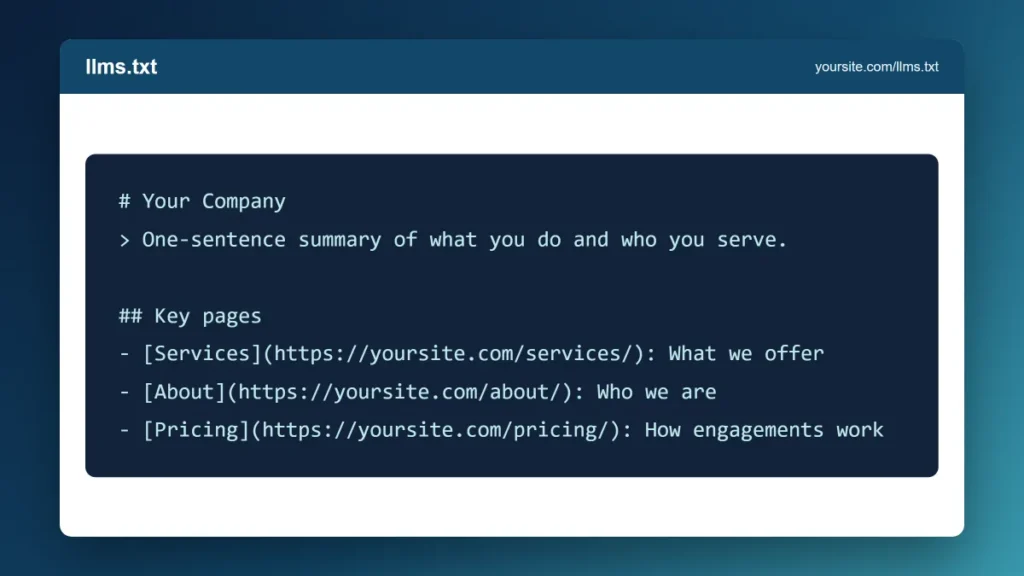
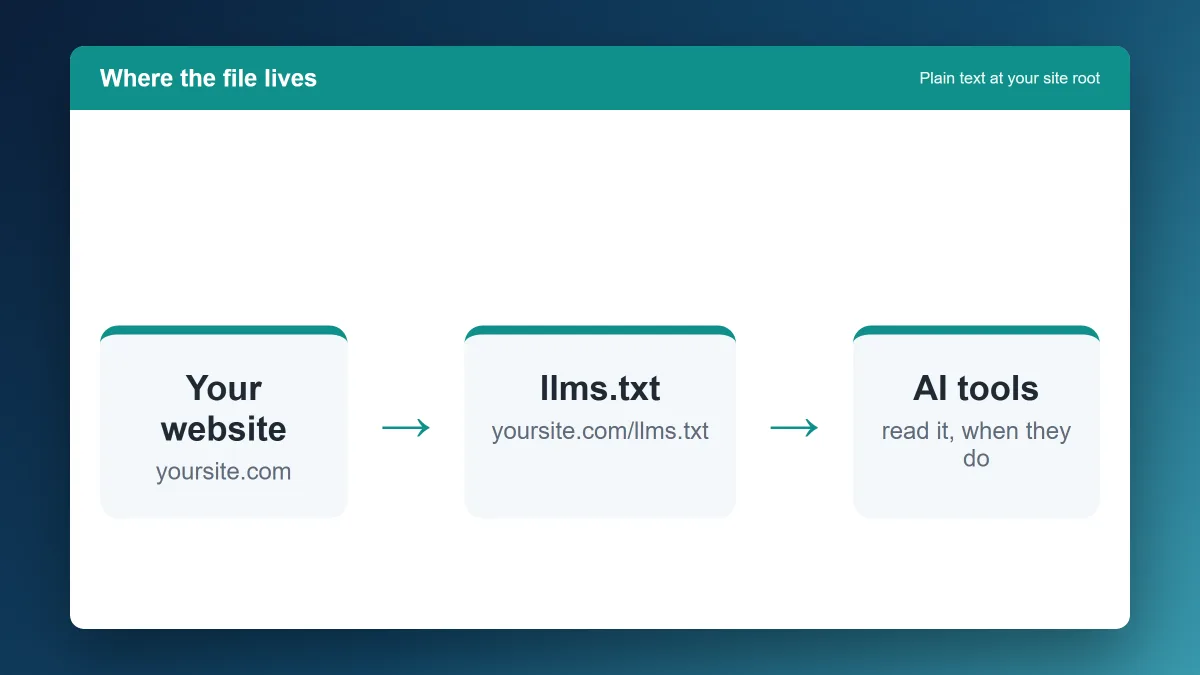
A plain-text file placed at the root of your website (yoursite.com/llms.txt) that provides structured information about your site specifically for large language models.
Jeremy Howard, founder of Answer.AI, proposed the format in late 2024 as an informal standard. Since then, adoption has grown across tech, publishing, and B2B marketing. The file typically includes:
- A plain-language description of what the site covers and who it’s for
- Links to key pages organized by topic or function
- Usage guidance on what content the site owner does and doesn’t want used by AI systems
- Optional links to documentation, APIs, or structured data sources
There’s also a companion format, llms-full.txt, which includes full page content rather than just links. Think of it as giving AI systems a curated dump of your best content in one readable file.
How Is llms.txt Different From robots.txt?
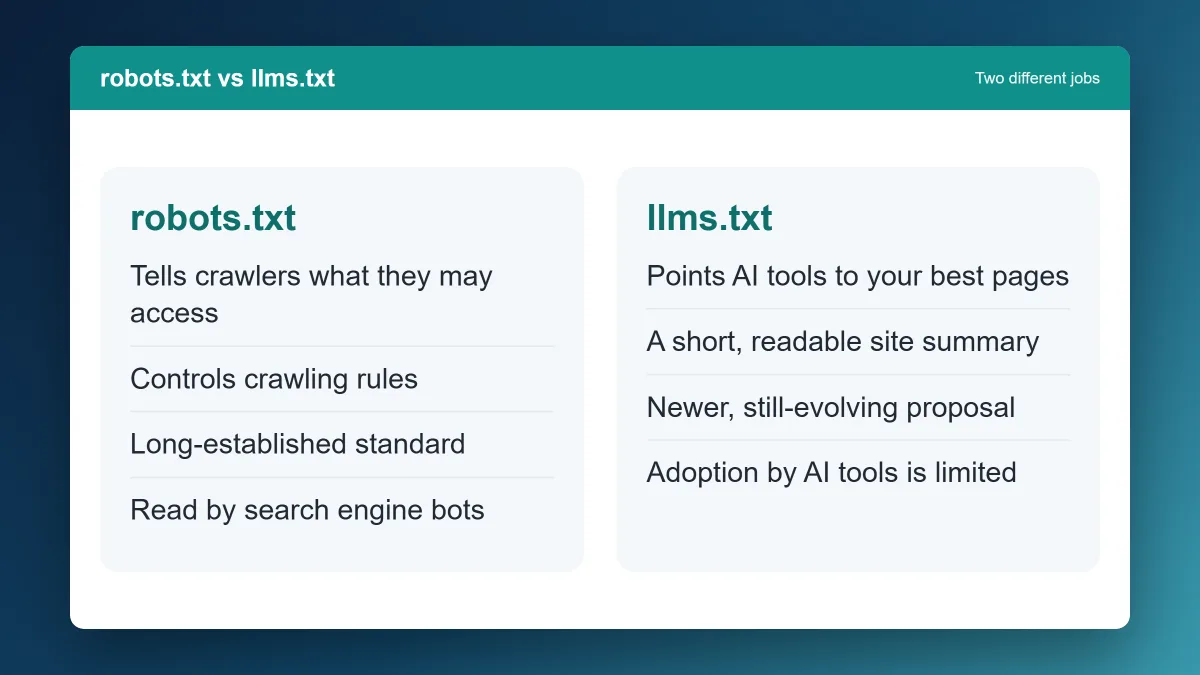
robots.txt tells search engine crawlers what they can and can’t access. It’s been standard since 1994 and is actively enforced by major crawlers. A properly configured robots.txt that blocks Googlebot actually keeps Google from indexing those pages.
llms.txt works differently.
It’s descriptive, not restrictive. Where robots.txt says “don’t crawl this,” llms.txt says “here’s what we are and what we cover.” Welcome mat with context, not a fence.
And it’s unenforceable. AI systems aren’t required to read or respect llms.txt. Some look for it. None are obligated to follow it.
| robots.txt | llms.txt | |
|---|---|---|
| Purpose | Controls crawler access | Describes site to AI systems |
| Enforced? | Yes (major search engines) | No, voluntary |
| Blocks content? | Yes | No, descriptive only |
| Affects AI citation? | Potentially (if blocking AI bots) | Potentially (if AI reads it) |
| Standard body | Robots Exclusion Standard | Informal community proposal |
| Age | 1994 | 2024 |
The Adoption Problem: What the Data Actually Shows
Here’s where it gets uncomfortable.
Ahrefs analyzed 137,210 domains with traffic in May 2026. About 28% had an llms.txt file published. That’s roughly 38,000 sites.
97% of those files received zero requests from AI crawlers that month.
Zero.
Only about 1,100 domains saw any fetches at all. The files that were fetched drew roughly 22,000 requests total, with bots making up 96% of them. GPTBot was the top AI crawler at 4.51% of requests. ClaudeBot sat at 0.8%. AI agents and agentic infrastructure accounted for 10.5% combined, with Claude-Code actually out-fetching every retrieval bot and assistant other than GPTBot.
PPC Land reported adoption had grown 8.8x. But adoption without reads is just a file sitting on a server.
So why am I still recommending it?
Two reasons. First, the 3% of files that did get read belonged to sites that were also doing everything else right, strong content, clean structure, active AEO strategy. The file is a signal that compounds with other signals. On its own, it does nothing.
Second, the cost is 30-60 minutes. If you’re already investing in getting recommended by Perplexity and Claude, adding llms.txt is rounding out the effort, not starting a new one.
llms.txt v2: What Changed
The original spec was loose. Write a text file, use Markdown, organize however you want.
Search Engine Journal reported that llms.txt v2 introduces formal markdown linking specifically designed for AI agents. The update creates a clearer structure for how pages should be referenced so agentic AI systems, not just chatbots, can navigate your site programmatically.
What that means in practice: if you wrote your llms.txt as a wall of text with some links scattered in, v2 gives you a reason to restructure it with proper markdown headings and organized link sections. AI agents parsing your file now have a better shot at understanding what points where.
The llmstxt.org changelog tracks all spec updates. Worth bookmarking if you’re maintaining one of these files.
How Do LLMs Actually Use llms.txt (When They Do)?
When an AI system with web access crawls your site, llms.txt can serve as a starting point for understanding what the site is and what’s worth reading. Instead of crawling dozens of pages to piece together what you cover, the model gets a structured summary immediately.
For sites with a lot of content, this matters. A B2B blog with 100+ posts, or a documentation-heavy SaaS site, can use llms.txt to direct AI systems toward the most authoritative content rather than letting them land on an old post that doesn’t represent current positioning.
There’s also a practical angle for accuracy. If your brand name is ambiguous, your content spans a niche topic, or your site has gone through a rebrand, llms.txt gives you a space to state explicitly what you do and who you serve. That matters for AI Output Integrity, making sure AI systems describe you correctly when your brand comes up in generated answers.
Should Your B2B Site Have One?
Yes. With caveats.
A mediocre llms.txt pointing to thin content won’t help. The file should direct AI systems to your genuinely strongest, most substantive pages. If those pages don’t exist yet, building them is a better use of time than writing the file that points to nothing.
It’s worth prioritizing if any of these apply:
- Your brand name is easy to confuse with something else
- You have 20+ posts or pages and want AI to find the right ones
- You’ve recently rebranded or shifted positioning and want AI systems to reflect the current version
- Your site covers a niche topic where you have genuine authority
- You’re actively investing in AEO or GEO and want to cover all available surfaces
It’s lower priority if your site is new with minimal content, or if AI systems are already citing you accurately.
What Goes in a B2B llms.txt File
The format isn’t rigid. No schema to follow. A practical B2B llms.txt typically includes four things.
A brief site description. Two to three sentences on what the site covers, who it’s for, and the author or organization behind it. Plain language. Write it the way you’d describe your site to someone who just asked “what’s this about?”
Key page links, organized by topic. A structured list of your cornerstone posts, service pages, comparison content, and high-authority guides. Grouped so the site’s structure is readable at a glance. Markdown-formatted links work well since many AI systems parse Markdown natively.
Optional usage permissions. Whether you want AI systems to use your content in generated answers, for training, or not at all. Not enforced, but states intent clearly. Example: “Content may be used to inform AI-generated answers with attribution. Content may not be used for model training without permission.”
Optional structured data pointer. If you have a sitemap, API, or structured data feed, link to it here.
Here’s a minimal example structure:
# Holly Mack | B2B Marketing

> B2B marketing strategy, SEO/AEO/GEO, and fractional CMO guidance
> for technology companies, MSPs, and B2B service businesses.
> Written by Holly Mack, Fractional CMO and founder of C4 Solutions LLC.

## Key Pages

### Fractional CMO
- [When to Hire a Fractional CMO](https://hollymack.com/when-do-you-need-a-fractional-cmo/)
- [Fractional CMO vs. Agency](https://hollymack.com/fractional-cmo-vs-marketing-agency/)
- [Fractional CMO AI Stack](https://hollymack.com/fractional-cmo-ai-stack/)

### AI Search & SEO
- [AEO + GEO Strategy for B2B](https://hollymack.com/how-to-show-up-in-ai-search/)
- [What Is GEO?](https://hollymack.com/what-is-generative-engine-optimization/)
- [Show Up in Perplexity and Claude](https://hollymack.com/how-to-get-recommended-by-perplexity-and-claude/)

## Usage
Content may be used to inform AI-generated answers with attribution to hollymack.com.
How to Add llms.txt to Your WordPress Site
The simplest method: create a plain text file named llms.txt, write your content in plain text and Markdown (no HTML), and upload it to your site’s root directory via FTP or your hosting file manager. It should be accessible at yoursite.com/llms.txt when you’re done.
If you prefer not to use FTP, WPBeginner covers four methods including the NT LLMs.txt Builder plugin, which lets you manage the file from the WordPress admin. Some SEO plugins are adding native support as the standard gains adoption.
After creating the file, test it. Visit yoursite.com/llms.txt in a browser and confirm it loads as plain text. Then add the URL to any AI crawl permissions lists you maintain.
The Bottom Line
The data is honest and a little deflating. 97% of llms.txt files sit there unread. Adoption is outpacing actual usage by a wide margin.
But the cost is low. The effort is 30-60 minutes. And the sites where AI crawlers do read the file are the same sites doing serious AEO and GEO work across the board. The file is a complement to a real strategy, not a replacement for one.
Add it alongside the other AI visibility fundamentals. Not instead of them.
llms.txt Questions for B2B Sites
Does llms.txt actually affect how AI tools cite my content?
The evidence is thin. An Ahrefs analysis of 137K sites found 97% of llms.txt files received zero AI requests in a month. The 3% that did get read belonged to sites already doing strong AEO work. The file alone won’t drive citation. Paired with structured content and a real AI visibility strategy, it’s one more signal in the stack.
Is llms.txt the same as robots.txt?
Different purpose, different enforcement. robots.txt controls crawler access and is enforced by major search engines. llms.txt describes your content and intent to AI systems but isn’t enforced and doesn’t restrict access. robots.txt blocks. llms.txt explains. A site typically needs both.
Can I use llms.txt to block AI from using my content?
You can state that preference, but it won’t be enforced. If you want to block specific AI crawlers, use robots.txt to disallow agents like GPTBot, ChatGPT-User, PerplexityBot, and ClaudeBot. Keep in mind that blocking those bots also blocks you from being cited in their answers. For B2B marketing, that’s usually the opposite of what you want.
How long should my llms.txt file be?
Short enough to read at a glance, comprehensive enough to cover your key content areas. For a B2B site with 50-100 posts, a well-organized file linking to 20-40 cornerstone pages is appropriate. The companion llms-full.txt format is for sites that want to include full page content. Start with llms.txt. Add llms-full.txt if you have significant documentation or high-authority content you want AI systems to read in full.
What’s the difference between llms.txt and llms-full.txt?
llms.txt is a summary file with links and descriptions. llms-full.txt includes the full content of your key pages in one readable file. Useful for AI systems that can process long documents and want complete context rather than following individual links. Start with the summary version. Add the full version when you have the content to justify it.