
Last updated: October 2026
TL;DR: An AI marketing system wires three layers together: Claude for research, content, and reporting, a CRM like GoHighLevel for pipeline and automation, and a lean set of specialized tools underneath both. This is the full architecture, the rough costs, a 90-day roadmap for building it instead of piecing it together as you go, and where most builds actually stall out.
An AI marketing system for B2B combines Claude for research, content production, and reporting with a CRM like GoHighLevel for pipeline, automation, and lead nurture, connected through a small set of specialized tools, run by one operator or a lean team instead of a full department.
Most of the AI marketing conversation stops at “use ChatGPT to write blog posts faster.” That’s a tactic, not a system. A system is the whole thing wired together: where leads come from, who or what writes to them, who tracks whether any of it worked, and what happens when something breaks at 11pm on a Tuesday when nobody’s watching.
I run a real version of this system for my own agency and for clients. This is the architecture, not the pitch deck version of it.
What Actually Makes This a System, Not Just a Tool List
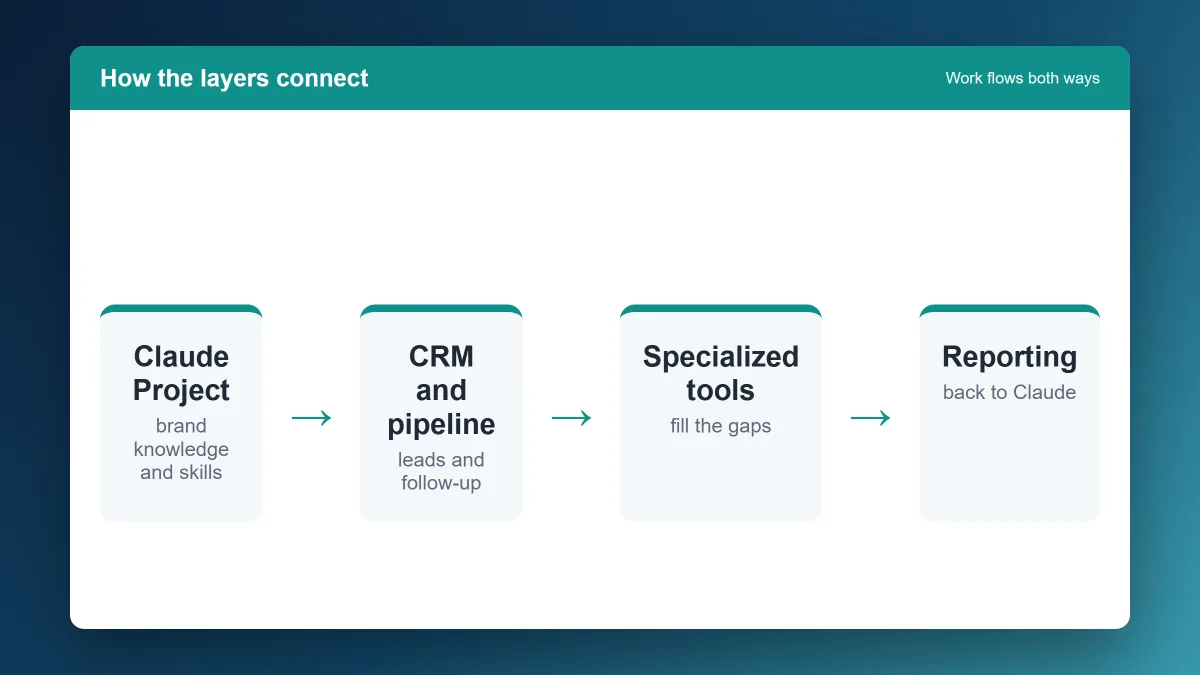
A tool list is five apps you pay for separately that don’t talk to each other. A system is the same tools, wired so a lead moving through one stage automatically triggers the next step, without a human manually copying data between tabs.
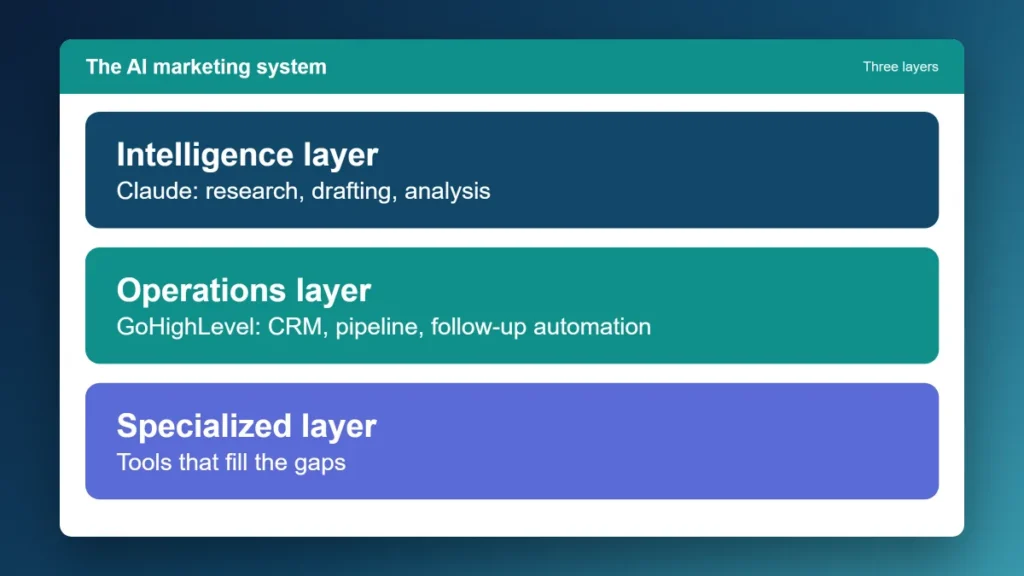
Three layers make up a working version of this for B2B.
- The intelligence layer. Claude, handling research, content drafting, SEO work, and reporting synthesis. This is where thinking happens.
- The operations layer. A CRM like GoHighLevel, handling pipeline, automation, email and SMS sequences, and lead nurture. This is where the leads actually live and move.
- The specialized layer. A handful of single-purpose tools underneath both, for things like scheduling, review generation, or outbound sending, that neither the intelligence layer nor the CRM does well on its own.
Most small B2B teams build the specialized layer first because that’s where the obvious gaps show up. Someone notices they need a scheduling tool, or a review generation tool, and bolts it on. The real unlock is building the intelligence layer properly first, because that’s what makes the specialized layer worth having instead of a pile of disconnected subscriptions that each do one thing in isolation.
The Intelligence Layer: What Claude Actually Does Here
If you’ve set up a real Claude marketing engine with Projects and Skills, this is the layer that’s already built. The system guide is about wiring it to everything else.
Claude’s job in this architecture is specific. Research for content and competitive positioning. Drafting content that follows your actual voice instead of generic AI output. Synthesizing performance data into something a human can act on instead of a spreadsheet nobody reads. What it is not doing is running the pipeline itself or sending the emails. That’s the next layer’s job, and conflating the two is one of the more common setup mistakes.
The intelligence layer is also where your actual differentiation lives. Two companies can run the exact same CRM and the exact same specialized tools and produce completely different marketing results, because the quality of the thinking feeding into both of those layers is what separates them.
The Operations Layer: Where GoHighLevel Fits
GoHighLevel runs three tiers as of 2026: Starter at $97 a month, the unlimited Pro tier at $297 a month, and an Agency SaaS tier at $497 a month, with email, SMS, phone, and metered AI usage billed separately on top of the plan price. For a single B2B company running its own marketing, the $297 tier is usually the realistic starting point, since the $97 tier caps you at three sub-accounts, which matters more if you’re an agency managing multiple clients than if you’re running one brand.
What GoHighLevel actually does in this system: holds the pipeline, runs the automated follow-up sequences, tracks where every lead sits in the funnel, and triggers the next action when a lead moves stages. It’s the layer that keeps running at 2am when nobody’s awake to manually send a follow-up email.
This isn’t the only option. HubSpot and Keap both compete in this space, and each has a different strength profile. GoHighLevel tends to win on flat-rate pricing and breadth of built-in channels for a lean team. The right pick depends on your specific funnel complexity and whether you’re running one brand or managing several as an agency.
Setup here takes longer than people expect. Building out the actual pipeline stages, the automated sequences, and the triggers that connect them is real work, not a weekend project. Budget for it accordingly rather than assuming a CRM configures itself once you’ve paid for it.
The Specialized Layer: Filling the Gaps
Underneath both of those sit the single-purpose tools that handle what the intelligence and operations layers don’t do natively. Review generation campaigns. Outbound email infrastructure and warmup. LinkedIn automation. Podcast booking. Distribution scheduling across social platforms.
None of these need to be elaborate. The mistake is either skipping this layer entirely and doing it manually, or buying ten overlapping tools that all claim to do the same three things. Pick one tool per genuine gap, not one tool per feature you saw in a demo.
A useful filter here: before adding a specialized tool, ask whether the gap is actually frequent enough to automate, or rare enough that doing it manually once a month is fine. Automating something you do twice a year isn’t efficiency. It’s a subscription you’ll forget to cancel.
What This Actually Costs
Rough monthly numbers for a lean B2B team running this full system: Claude at the Pro tier runs $20 per person per month, with Team pricing varying by seat count. [VERIFY: current Team/Enterprise Claude pricing before publishing]. GoHighLevel’s Pro Unlimited tier runs $297 a month flat, plus metered usage for email, SMS, and AI features on top. Specialized tools vary widely depending on what gaps you’re filling, but a lean stack typically adds another few hundred dollars a month across two or three tools.
All in, a realistic range for a single-operator or small-team setup lands somewhere between $500 and $1,000 a month once everything is wired together, well under the cost of a single additional full-time marketing hire, which is the actual comparison that matters. This isn’t replacing a strategist. It’s replacing the hours a strategist would otherwise spend on production and manual follow-up.
Compare that monthly cost to what those same hours would cost at an agency retainer or an additional salaried hire, and the math tends to favor building the system, provided someone actually does the setup work properly instead of half-configuring it and letting it rot.
Your 90-Day Implementation Roadmap
Trying to build all three layers simultaneously is how most of these builds stall out. Sequence it instead.
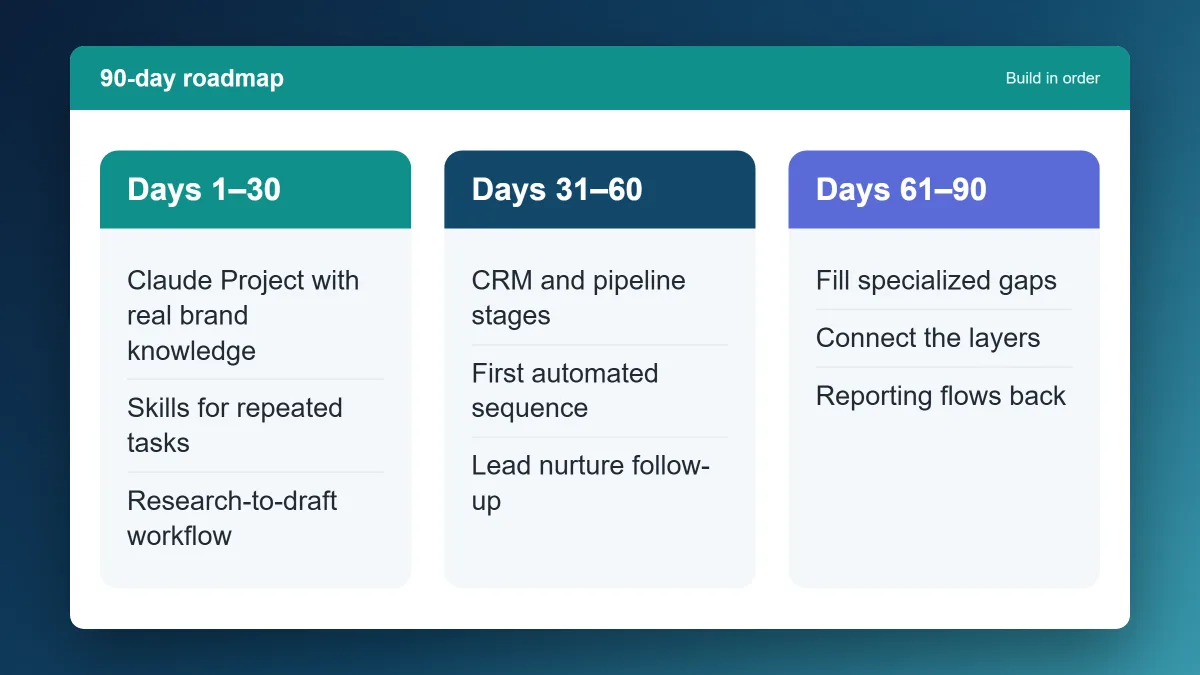
Days 1-30: Build the intelligence layer. Set up your Claude Project with real brand knowledge. Build or adopt Skills for your two or three most repeated content tasks. Get comfortable with the research-to-draft workflow before adding any automation on top of it.
Days 31-60: Build the operations layer. Set up your CRM, build your actual pipeline stages, and wire up the first automated sequence, usually a lead nurture or follow-up sequence, since that’s the highest-leverage automation for most B2B funnels.
Days 61-90: Fill the specialized gaps and connect the layers. Identify where the intelligence and operations layers still require manual handoff, and decide whether a specialized tool closes that gap or whether it’s rare enough to just do manually. Connect reporting so performance data flows back into something Claude can synthesize into a regular update, instead of living in four different dashboards nobody checks.
Build in that order and each layer is actually useful on its own before you add the next one. Build them simultaneously and you end up with three half-finished systems instead of one working one. The teams that rush this timeline usually end up re-doing the intelligence layer setup six months later once they realize the CRM automation they built was feeding off a content engine that was never properly configured in the first place.
The B2B Operator’s Take
The honest version of this is that most of the AI marketing hype skips straight to the content layer and ignores that content without a pipeline underneath it just sits there looking nice. A blog post that ranks well and converts nobody because there’s no nurture sequence behind it isn’t a marketing system. It’s a hobby.
The system only works when all three layers are actually wired together, and that wiring is the part that takes the real time, not the prompt engineering. Anyone can get a good-looking draft out of Claude in five minutes. Building a pipeline that automatically moves that draft’s readers into a nurture sequence, tracks whether they convert, and feeds that performance data back into the next round of content decisions takes considerably longer, and that’s where the actual value sits.
If you’re trying to figure out whether to build this yourself or have someone build it for you, that’s exactly the kind of system I put together for clients, Claude setup, GoHighLevel configuration, and the connective tissue between them.
Book a call with Holly to talk through what this looks like for your specific team.
Common Questions About Building an AI Marketing System
Do I need both Claude and a CRM, or is one enough?
Both, for a real system. Claude handles the thinking and content work. A CRM like GoHighLevel handles the pipeline and automated follow-up. Running only one leaves a genuine gap, either great content with no pipeline behind it, or a pipeline with no content engine feeding it.
How much does this cost to run every month?
Roughly $500 to $1,000 a month for a lean team once all three layers are wired together, depending on your CRM tier and how many specialized tools you need. That’s well under the cost of hiring one additional full-time marketer, which is the comparison that actually matters when weighing whether to build this.
Can one person actually run this whole system?
Yes, that’s the point of building it this way. A single operator with the right setup can run research, content, pipeline automation, and reporting without a full department, as long as the three layers are actually connected instead of operated as separate disconnected tools.
Is GoHighLevel the only CRM option for this?
No. HubSpot and Keap are both real competitors in this space. GoHighLevel tends to win on flat-rate pricing and built-in channel breadth for a lean team, but the right choice depends on your funnel complexity and whether you’re managing one brand or several as an agency.
What should I build first if I’m starting from nothing?
The intelligence layer. Get your Claude Project and core content workflow working before you add CRM automation on top of it. Building the pipeline before the content engine means automating the delivery of nothing in particular.
How long does it actually take to get this running?
Budget 90 days for a real build done in sequence rather than all at once. Thirty days for the intelligence layer, thirty for operations, thirty to fill gaps and connect reporting. Rushing all three simultaneously is the most common reason these builds stall out and need to be partially rebuilt later.