Last updated: October 2026
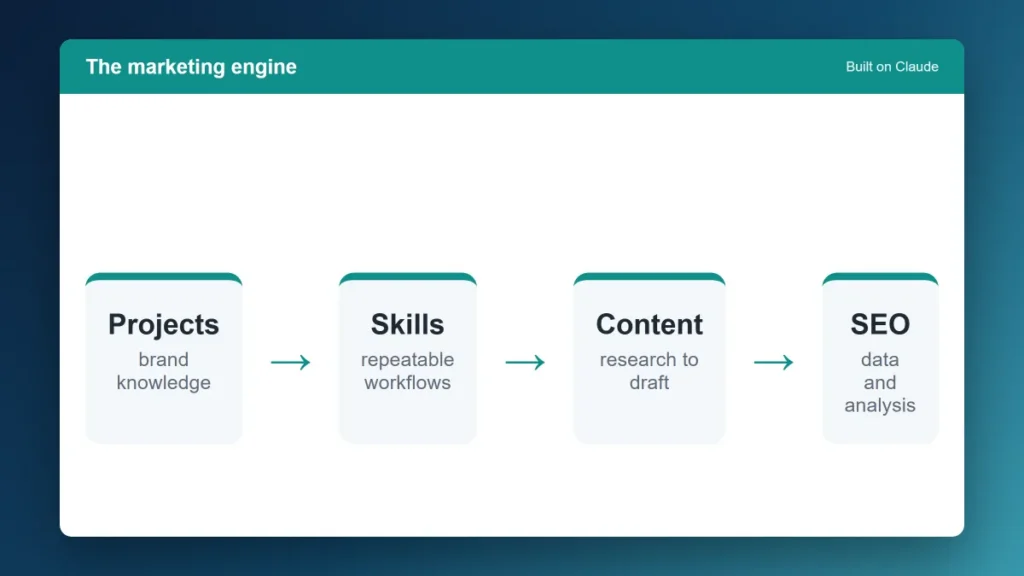
TL;DR: Claude works as a real marketing system when you set it up like one. Projects hold your brand knowledge so you stop re-explaining it every chat. Skills turn your repeatable workflows into something you run instead of rebuild. This covers the actual setup, what it’s good for, where it still needs a human watching, and what the real cost-benefit looks like for a lean team.
To build a marketing engine with Claude, set up a Project with your brand knowledge and voice guidelines, build Skills for repeatable workflows like content drafting and SEO research, and keep Claude on tasks where judgment and brand voice matter more than raw speed.
Most people use Claude the way they used ChatGPT in 2023. Open a chat, type a prompt, copy the output, close the tab. Start over tomorrow.
That’s not a marketing engine. It’s a word processor with extra steps.
If you’re building a real AI marketing workflow, the difference between those two things is the whole point. One is a tool you poke at. The other remembers your brand, runs your repeatable work, and gets better the longer you use it instead of starting from zero every morning.
I run my own agency work through a setup like this. Content research, drafting, SEO audits, reporting. Not a theory. This is the actual system, built out piece by piece, the same one that’s drafting the post you’re reading right now.
Why Claude Is More Than Just Another AI Tool for B2B Marketing
Any AI tool can write a paragraph. The question that matters for a marketing operation is which one holds up across a full workday of real work, not just a clever prompt.
Claude’s context window runs up to 200,000 tokens, with a practical sweet spot closer to 100,000 for consistent quality, according to HubSpot’s comparison of Claude and ChatGPT for marketers. That number matters more than it sounds like it should. It means you can hand Claude an entire brand voice guide, a style document, and three past blog posts in the same conversation, and it holds onto all of it instead of forgetting your tone by paragraph four.
HubSpot’s own framing is blunt about where each tool wins. Claude for long-form editing, brand voice consistency, and handling dense source material. ChatGPT for speed, volume, and quick ideation. Neither one replaces a strategist. But for the actual production work, the editing, the drafting, the staying-on-brand-for-3,000-words work, Claude is built for exactly that job.
Here’s where that distinction actually shows up in practice. Ask a model to write a single LinkedIn caption and almost any tool will do fine. Ask it to draft a 2,500-word comparison post that references your brand’s past three articles, follows a specific banned-word list, and matches a voice guide you wrote eight months ago, and the gap between tools widens fast. One holds the thread. One starts drifting by section three.
If you’re deciding what belongs in your AI stack as a fractional CMO or lean marketing team, this is the distinction that should drive the decision. Not which tool is smarter in the abstract. Which one does the kind of work you actually need done, over and over, without drifting.
Set Up Projects So Claude Actually Knows Your Brand
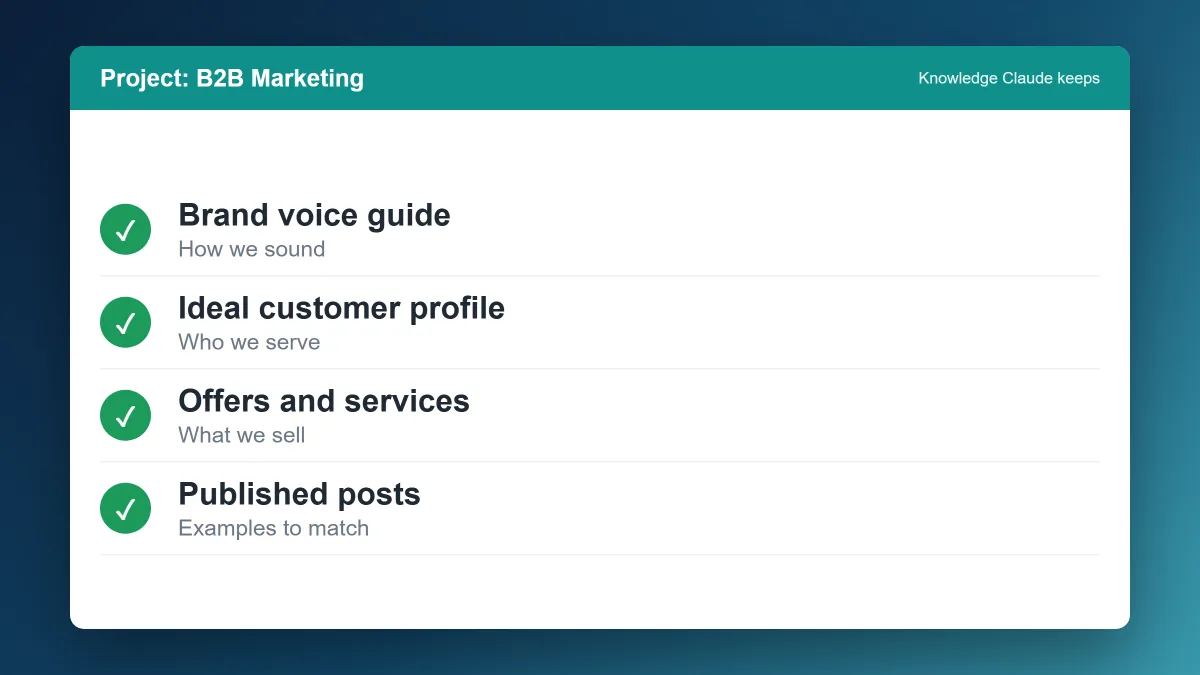
A Claude Project is a persistent container for everything Claude should know about your brand before you ever type a prompt. Voice guide, banned word lists, past content, client details, whatever context would otherwise get retyped into every single chat.
Without one, every conversation starts cold. You paste the same brand guidelines in March that you pasted in January. You re-explain who your audience is for the fortieth time. The project structure exists specifically to kill that repetition.
Here’s what actually goes into a working marketing Project.
- Voice and tone documentation. Not a vague adjective list. Actual rules. Banned words, sentence structure preferences, what “sounds like us” and what doesn’t.
- Brand facts that don’t change often. Services offered, audience, positioning, what you do and don’t claim.
- Custom instructions. The standing rules Claude should apply to every single output without being told again. Output format. What to flag instead of guess. How aggressively to push back versus just comply.
- A handful of past examples. Three or four pieces that represent your actual voice, not your best-case theoretical voice.
- Any client-specific knowledge, kept separate per client rather than mixed into one general pile. Cross-contaminating two clients’ banned word lists or positioning is an easy, embarrassing mistake to make once everything lives in a single undifferentiated document.
This exact project, the one running this website, is built that way. Voice guide, a document of words I never want written, a human-writing standard that governs sentence rhythm, affiliate link lists, all loaded once. Every post I draft pulls from the same foundation instead of me rebuilding the brief from scratch each time.
The setup cost is real but one-time. Expect to spend an afternoon pulling together the documents, writing the custom instructions, and testing with a few sample prompts to see whether the output actually sounds like you. After that afternoon, every future session starts already knowing what would’ve taken fifteen minutes to re-explain.
That’s the actual unlock. Not that Claude is smart. That it’s consistently smart in your specific voice, without you doing the explaining every single time.
Build Skills for Repeatable Marketing Workflows
A Skill is a packaged set of instructions for doing one specific kind of task well, every time, the same way. Think of it as the difference between explaining a process verbally each time versus having it written down as a procedure someone, or something, just follows.
Marketing work is full of tasks that repeat with small variations. Draft a blog post. Audit a page for SEO. Build a content calendar. Write a comparison post against a competitor. Each of those has a shape. A skill captures that shape once, so you’re not re-explaining the structure, the gates, the formatting rules, every single time you need that kind of output.
Where this actually earns its keep is in the gates. A skill can force a pause before drafting until research is actually done. It can require an outline approval before a single word of body copy gets written. It can run a self-audit checklist before anything ships, catching banned words, checking sentence rhythm, verifying internal links land where they should.
None of that happens reliably from a fresh prompt every time. It happens when the process is written down once, as a skill, and followed the same way on post one and post one hundred.
Think about the categories of marketing work that actually repeat often enough to justify this. Content drafting is the obvious one. SEO audits are another, where you’re running the same checklist against a new page each time. Reporting is a third, where the inputs change weekly but the format and the questions stay constant. Each of those is a candidate for a skill, and each one saves more time the more often you run it.
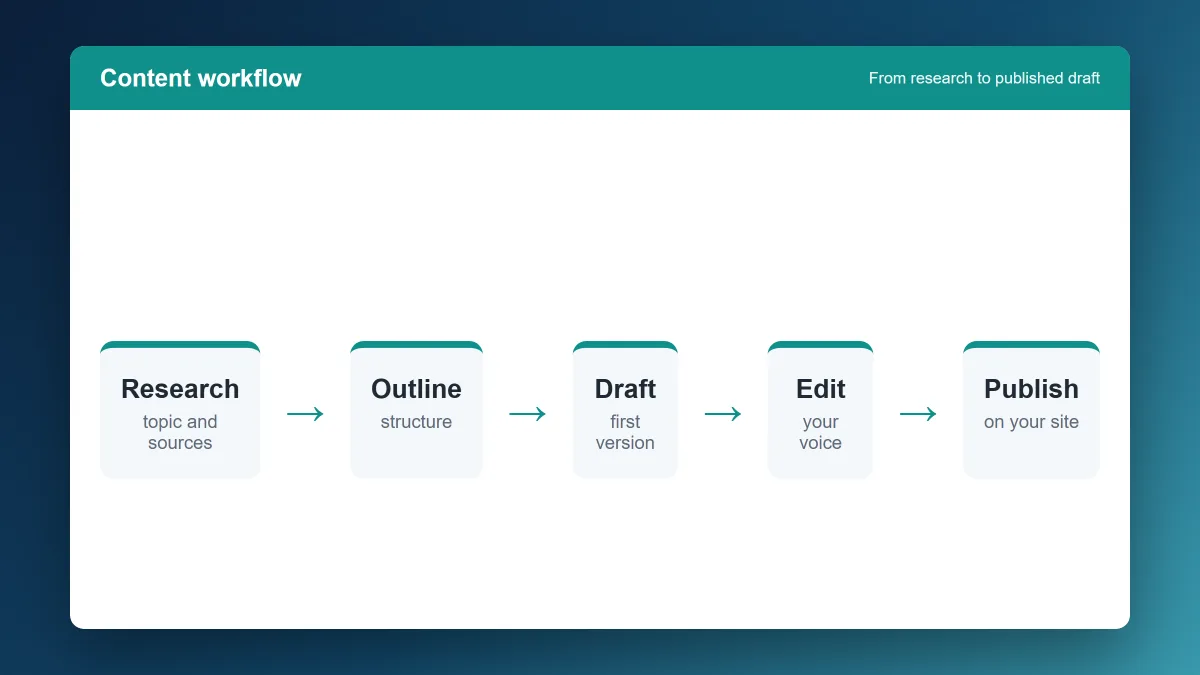
Content Workflow: From Research to Published Draft
Here’s roughly what a real content pipeline looks like once Projects and Skills are both in place.
Research first. Real searches, real sources, not recalled-from-memory facts dressed up as current. Then an outline, built from that research, presented before a single paragraph gets written. Then drafting, with the voice rules from the Project already baked in. Then a humanization pass, because a first draft from any AI tool reads a little too smooth, a little too even, and needs roughing up to sound like an actual person wrote it. Then SEO metadata, schema, and a self-audit before anything goes anywhere near a CMS.
That’s six distinct stages, and the gates between them matter as much as any single step. Skip the outline approval and you end up with 2,000 words that need a full rewrite because the structure was wrong from paragraph one. Skip the humanization pass and the content reads like it was written by something that’s never had a bad day.
The reason this matters more for marketing than for other use cases is that marketing content gets read by actual prospects deciding whether to trust you. A technically correct but flavorless draft doesn’t just underperform on engagement. It actively undersells the expertise behind it, which is the opposite of what a content program is supposed to do.
If you’re thinking about how AI fits into marketing more broadly, this is the part that actually determines whether it helps or just adds noise. A pipeline with real gates produces work you can publish. A single prompt produces a draft that needs as much editing as if you’d written it yourself, except now you’ve also lost the thinking that happens during drafting.
SEO Research and Data Analysis Without a Full Analyst Team
Claude in Chrome, the browser extension version, reads pages, clicks through sites, fills out forms, and works across multiple tabs, according to Anthropic’s own setup documentation. For SEO and competitive research specifically, that means Claude can actually look at a competitor’s page structure, pull data from a live dashboard, or check how a page renders, instead of working purely from what you paste in.
That’s a meaningfully different capability than a chat window. A chat window only knows what you tell it. A browser-connected Claude can go look.
Reporting automation is the other side of this. Marketing teams building workflows that pull platform data and have Claude synthesize it into a readable report, instead of someone manually copying numbers into a slide deck every Monday, are a documented pattern now, not a hypothetical one. The actual time savings compound weekly. A report that used to eat an hour of copying and formatting becomes fifteen minutes of review on something already assembled.
If you’re trying to run marketing with a team of one, or close to it, this is where the hours actually come back. Running a marketing function as a single operator only works if the repetitive research and reporting work stops eating the hours you need for strategy and client relationships.
What Claude Can’t Do (So You Don’t Build Your Engine on a Bad Assumption)
Every one of these matters more than the capabilities, because building a system on top of a wrong assumption wastes more time than building no system at all.
No native image generation inside a Claude chat. If your workflow needs visuals generated as part of the content pipeline, that’s a separate tool, not a Claude feature.
Usage caps exist on heavy daily use, per HubSpot’s comparison. If you’re running dozens of long sessions every day across a whole team, you’ll hit limits that a lighter user never notices.
Claude in Chrome is Chrome-only. Not Safari, not Firefox, not mobile. And Anthropic’s own documentation calls the feature “still risky” despite the safety measures built in, which is Anthropic telling you directly that a human needs to be watching what it does, not walking away and trusting it blind.
It doesn’t browse the live web by default inside a plain chat the way some other tools do. Browser-connected research is a specific, separate setup, not the baseline behavior.
And the biggest one. It doesn’t know your business is making a mistake unless you’ve told it what a mistake looks like. A Project with real brand guardrails catches drift. A Project with nothing but a logo and a tagline catches nothing. The quality of what comes out is a direct function of what went into the setup, which is exactly why the setup work earlier in this post isn’t optional scaffolding. It’s the actual product.
The B2B Operator’s Take: Where This Actually Pays Off
This isn’t a headcount replacement. Say that part clearly, because the hype cycle around AI replacing marketing teams is loud and mostly wrong for anyone doing real client-facing or brand-building work.
What it replaces is hours. The hour spent re-explaining brand voice. The hour spent manually pulling last week’s numbers into a report. The hour spent drafting a first pass that then gets thrown away because nobody checked the structure first.
Those hours add up to something close to a part-time hire over a quarter, for a team that sets this up properly. That’s the actual return. Not magic. Time back, pointed at the work that still needs a real person doing it.
The teams that get the most out of this aren’t the ones with the cleverest prompts. They’re the ones who did the unglamorous setup work first, the voice guide, the banned word list, the custom instructions, before ever asking for a draft. Skipping that step and going straight to “write me a blog post” is how people end up disappointed and conclude the tool doesn’t work, when really the groundwork never got laid.
If you’re trying to figure out whether this is worth building for your own team, or whether you’d rather have someone build it for you, that’s exactly the kind of system I put together for clients.
Book a call with Holly if you want help building this out instead of piecing it together solo.
What Marketing Teams Keep Asking About Using Claude
Is Claude better than ChatGPT for marketing?
Depends on the task. For long-form content, brand voice consistency, and handling large amounts of source material in one conversation, Claude tends to hold up better. For fast, high-volume output like social captions or quick ideation, ChatGPT’s speed is the bigger advantage. Most lean teams end up using both for different jobs rather than picking one, routing long-form brand content to Claude and quick social copy to whichever tool is fastest in the moment.
How much does Claude cost for a marketing team?
The Pro plan runs $20 a month per person. Team and Enterprise pricing varies by seat count and features, so [VERIFY: current Team/Enterprise pricing before publishing] rather than quoting a number I can’t confirm against Anthropic’s live pricing page. For a single operator or a two-person team, the Pro tier alone usually covers real usage.
Can Claude replace a marketing employee?
No, not for anything requiring judgment, client relationships, or strategic decisions. What it replaces is the repetitive production work underneath those decisions. Treat it as removing hours from your week, not removing a person from your team. The teams that try to use it as a literal replacement for strategic thinking tend to end up with technically fine, strategically empty content.
What’s the difference between a Claude Project and a Skill?
A Project is where you store what Claude should always know, your brand voice, your facts, your standing rules. A Skill is a packaged process for doing one specific task the same way every time. Projects hold the knowledge. Skills run the workflow. Most working setups use both together, with a Skill pulling from the Project’s knowledge every time it runs.
Does Claude browse the web like ChatGPT does?
Not by default in a plain chat. Browser-connected research through Claude in Chrome is a specific extension you set up separately, and Anthropic’s own documentation describes it as still carrying real risk, meaning a person should be reviewing what it does rather than letting it run unsupervised.
Is Claude safe to use with client or company data?
Anthropic positions Claude around governance and compliance as a differentiator, which is part of why some enterprise and agency teams choose it over alternatives. That said, any AI tool handling client data should go through your own data-handling review, not just a vendor’s marketing claim. [NEEDS SOURCE: specific compliance certifications if you want to cite them by name]
How long does it take to set up a working Claude marketing system?
A basic Project with brand voice and core documents loaded takes an afternoon. Building out actual Skills for your repeatable workflows, content drafting, SEO audits, reporting, takes longer and usually gets refined over a few weeks as you see where the gaps are. Start with the Project. Add Skills once you know which tasks you’re repeating often enough to justify one.