

You need a fractional CMO when marketing has motion but lacks direction — typically when revenue is between $1M and $8M and marketing spend exists without a clear system connecting it to pipeline.
At some point, marketing starts to feel heavier than it should.
You’re spending money.
You’re trying things.
You might even have a team.
But it still feels… loose.
Campaigns run. Leads come in. Sales shrugs. Revenue moves, but not predictably. And every quarter you’re having the same conversation.
“Maybe we just need better execution.”
Maybe… but most of the time, that’s not the problem.
The real question is this: when do you need a fractional CMO? Not when is it trendy. Not when someone on LinkedIn says it’s time. When is it structurally necessary? Let’s break that down.
What a Fractional CMO Actually Is
A fractional CMO is senior marketing leadership, part time. Not a contractor writing copy. Not an agency running ads. Not a junior marketing manager with a bigger title.
A fractional CMO owns direction, prioritization, revenue alignment, and systems. They are there to decide what not to do as much as what to do. That distinction matters.
Because most B2B companies don’t suffer from lack of activity. They suffer from lack of coherent leadership across activity. A fractional CMO increases leadership capacity without committing to a full-time executive hire. That’s the function. Not the title.
Why B2B Marketing Breaks Before Leadership Shows Up
Here’s the pattern I see across SaaS, IT services, growth-stage tech firms, and B2B companies. Paid ads get tested. SEO starts and stops. Someone suggests webinars. LinkedIn becomes a “focus.” Sales asks for better leads.
Each tactic makes sense individually. Together, they create noise. What’s missing isn’t effort. It’s integration. The marketing manager is buried in execution. The founder is still approving copy at night. Agencies are running channels, but no one owns the system. Marketing becomes reactive. And when marketing is reactive, revenue is unpredictable.
That’s the leadership gap. It’s not a skills gap, but a capacity gap. The right marketing automation system can help close the execution gap, but it still needs strategic direction to work.
When a Fractional CMO Actually Makes Sense
This is where most advice gets vague. From my experience, this is what makes sense. A fractional CMO works when you already have motion. You have a defined ICP, a real product or service with traction, some pipeline even if it’s inconsistent, budget allocated to marketing, and people or partners who can execute.
And most importantly — leadership wants systems. Not hacks. Not quick wins. Not another experiment. Systems. In this environment, a fractional CMO becomes a force multiplier. They align marketing to revenue, stop wasted spend, tighten positioning, and simplify channel focus. Growth becomes calmer. More deliberate. That’s when it works.
When You Should Wait
A fractional CMO isn’t a substitute for clarity. You should probably wait if you’re still validating your offer, can’t clearly define your target market, have no marketing budget, or expect one person to “do marketing.”
A fractional CMO works when you want leadership. It fails when you want labor. If what you need is someone to build landing pages and post on LinkedIn, hire a marketing specialist. If what you need is someone to architect growth and decide where capital goes, that’s leadership.
A Revenue Stage Framework for B2B Companies
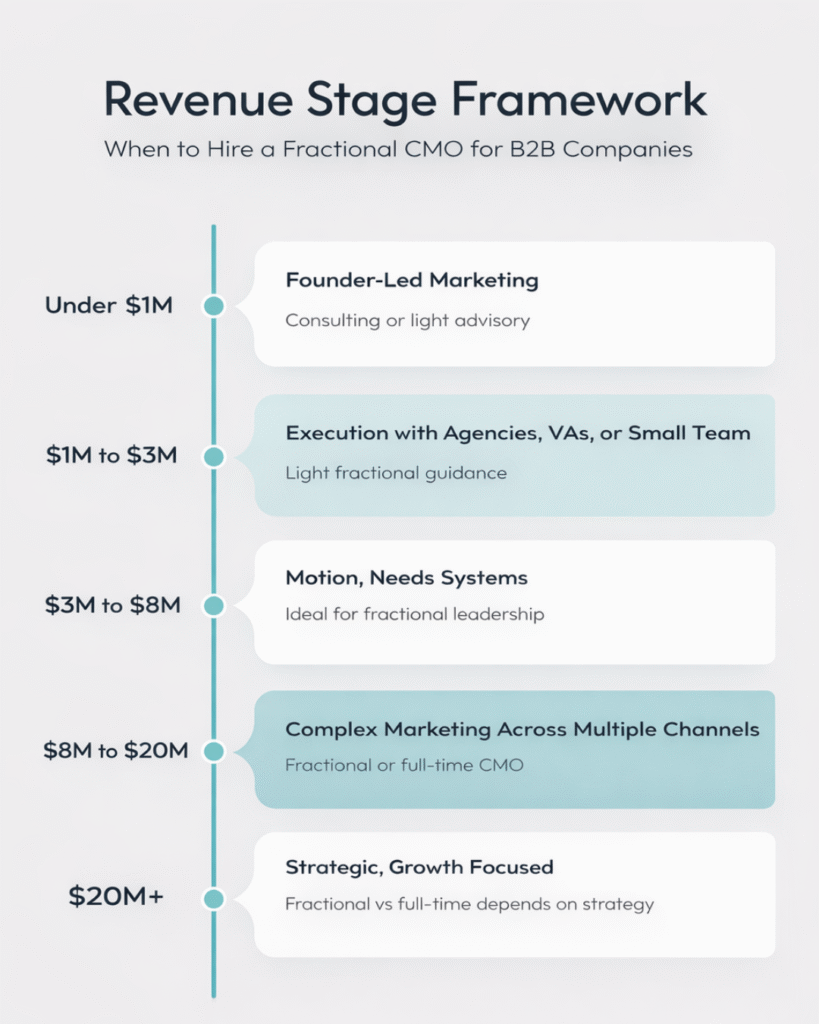
Hiring based on title is a mistake. Hiring based on stage makes more sense.
| Revenue Stage | Marketing State | Recommendation | Key Signal |
|---|---|---|---|
| Under $1M | Founder-led, early traction | Not yet — focus on one or two channels and build consistency | No consistent pipeline yet |
| $1M–$3M | Inconsistency creeping in | Light fractional guidance can help if execution resources exist | Marketing feels unpredictable quarter to quarter |
| $3M–$8M | Motion without a cohesive system | Sweet spot — fractional leadership adds real leverage here | Spend exists but ROI is unclear; sales and marketing misaligned |
| $8M–$20M | Complexity increasing across channels | Fractional CMO paired with specialists scales effectively | Multiple channels running with no single owner of the system |
| $20M+ | Strategic inflection point | Fractional vs. full-time depends on growth ambition and internal capability | Ready to evaluate permanent C-suite marketing leadership |
Fractional CMO vs Agency vs Full-Time CMO
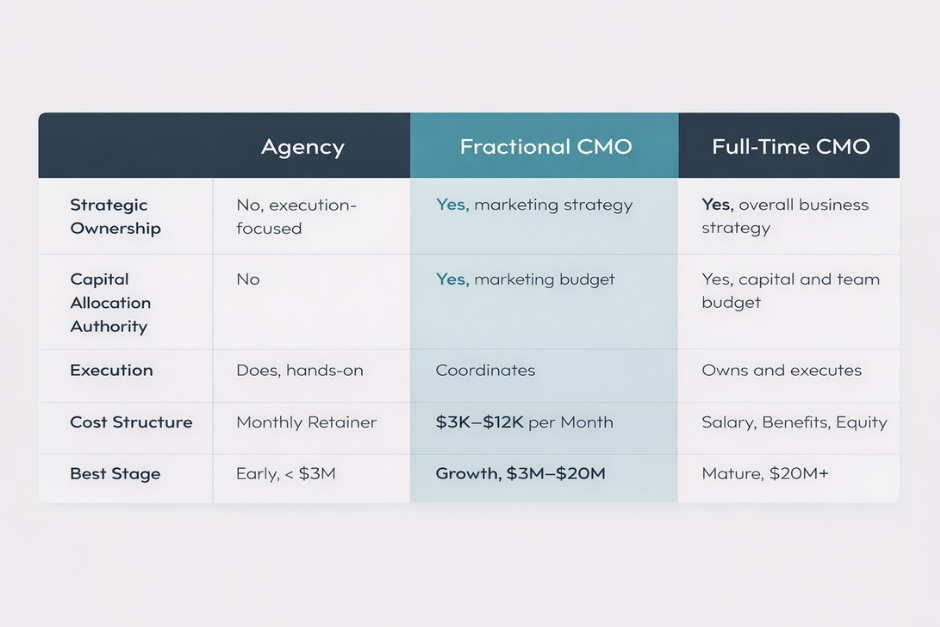
| Fractional CMO | Agency | Full-Time CMO | |
|---|---|---|---|
| Function | Owns strategy, direction, and revenue alignment | Executes specific marketing channels or tactics | Owns full marketing strategy and team |
| Cost Range | $3k–$12k/month depending on scope | Varies by retainer and channel | $150k–$300k+ salary plus benefits and equity |
| Owns Strategy? | Yes | No — executes within defined scope | Yes |
| Execution | Coordinates internal teams, agencies, and contractors | Direct execution within their channel | Manages internal team and vendor relationships |
| Best For | $3M–$8M growth-stage companies needing system and direction | Companies with clear strategy needing channel execution | Companies at $20M+ ready for permanent marketing leadership |
What Happens in the First 90 Days
Most founders assume the first move is launching new campaigns. It usually isn’t. The first 90 days are about grounding: aligning marketing goals to revenue targets, auditing what has already been tried, tightening ICP and messaging, clarifying channel priorities, identifying fast wins, and stopping low-ROI activity.
Often, we reduce activity before we increase it. Because growth is constrained more by lack of focus than lack of effort. When marketing becomes clear, execution becomes easier. A solid marketing plan is usually the first real deliverable.
How Much Does a Fractional CMO Cost?
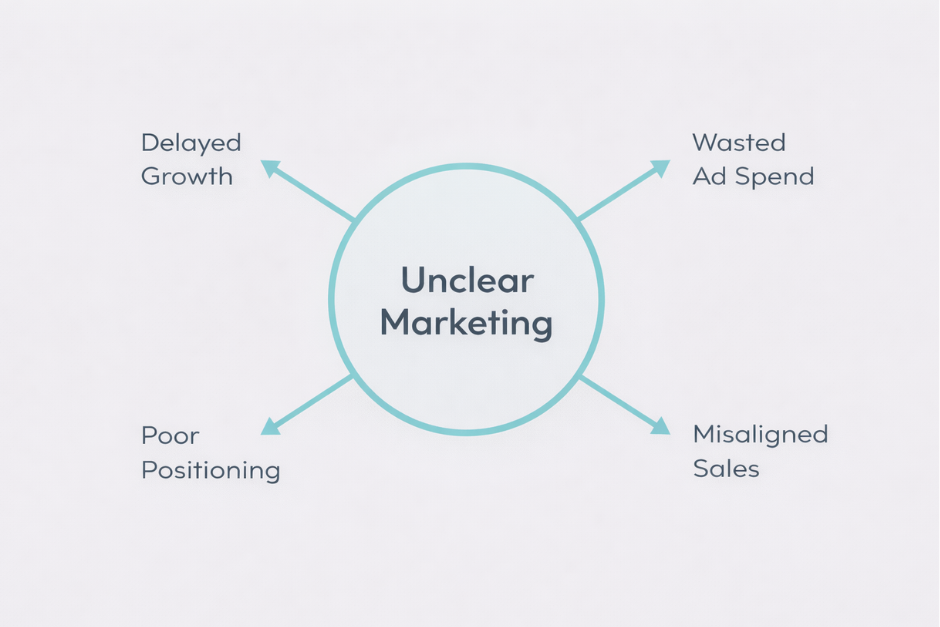
Most fractional CMOs work one to two days per week. In small B2B companies, that typically ranges from $3k to $12k per month depending on scope and complexity. But cost is the wrong primary lens. The better question is opportunity cost. What is unclear marketing currently costing you in wasted ad spend, misaligned sales effort, poor positioning, and delayed growth?
A fractional CMO should increase capital efficiency, not just add overhead. If they don’t, the structure is wrong.
Signs You’re Ready
You might be ready if you have motion but no focus, marketing spend exists but ROI is unclear, sales and marketing are misaligned, marketing feels reactive, and you want a system, not more tactics. You don’t need perfection. You need momentum and willingness.
The Real Question
Hiring a fractional CMO isn’t about marketing sophistication, but leadership capacity. At certain stages, the business outgrows founder-led marketing but can’t yet justify a full-time executive. That gap is real.
The companies that handle it intentionally tend to scale with less chaos. The ones that ignore it tend to oscillate between over-hiring and under-structuring. Growth doesn’t require more activity. It requires better decisions. And sometimes, that requires a new level of leadership.
If you think you might be ready for fractional leadership, learn more about working with me or reach out directly.
If you’re not quite there yet, try my free 6-week growth sprint — it’s a good place to build the foundation first.
FAQs
When should you hire a fractional CMO?
You should hire a fractional CMO when marketing has activity but lacks direction. If revenue is inconsistent, ROI is unclear, and sales and marketing are misaligned, the issue is usually leadership capacity. A fractional CMO provides strategic oversight without the cost of a full-time executive.
What revenue stage is best for a fractional CMO?
Most B2B companies benefit from a fractional CMO between $3M and $8M in annual revenue. At this stage, marketing spend increases but systems are not fully integrated. Fractional leadership helps align marketing to revenue without committing to a permanent C-suite hire.
How much does a fractional CMO cost?
A fractional CMO typically costs between $3k and $12k per month depending on scope and time commitment. Most work one to two days per week. The real consideration is opportunity cost, including wasted ad spend and unclear marketing priorities.
What is the difference between a fractional CMO and an agency?
An agency executes marketing tactics. A fractional CMO owns strategy and direction. Agencies run channels like ads or SEO, while a fractional CMO decides what gets funded, what gets cut, and how marketing aligns with revenue goals.
What happens in the first 90 days with a fractional CMO?
In the first 90 days, a fractional CMO audits current performance, aligns marketing goals to revenue targets, clarifies ICP and positioning, and prioritizes channels. Often, low-return activity is reduced before new campaigns are launched.
Is a fractional CMO worth it for a growing B2B company?
For growth-stage B2B companies with existing revenue and marketing spend, a fractional CMO can significantly improve capital efficiency. By aligning strategy, positioning, and sales integration, they reduce wasted spend and create more predictable growth.
Can a fractional CMO work with our existing marketing team or agency?
Yes. A fractional CMO typically coordinates internal marketers, agencies, contractors, or offshore teams. They do not replace execution resources. They provide direction, prioritization, and accountability across all channels.