
Last updated: October 2026
TL;DR: GoHighLevel wins for most small B2B teams. It’s flat-rate, includes unlimited contacts, and covers funnels, SMS, and multi-channel automation that Keap simply doesn’t touch. Keap wins for service businesses whose entire operation runs on sales pipeline, quoting, and invoicing, where its Campaign Builder and payment tools are genuinely more mature. The gap between them is bigger than most comparison pages let on.
GoHighLevel is the better CRM for most small B2B teams in 2026. It’s flat-rate from $97/month with unlimited contacts, versus Keap’s $249-299/month for just 1,500. Keap wins only for service businesses built around invoicing and pipeline, not funnels or multi-channel outreach.
Keap used to be Infusionsoft. If you’ve been running a small B2B company for more than a few years, you probably remember that name, and maybe the bill that came with it.
That history matters here, because a lot of the businesses comparing GoHighLevel and Keap right now aren’t starting from scratch. They’re already on Keap, the contract renewal just landed, and the price tag finally made them look around. I’ve helped B2B service companies migrate off Keap onto GoHighLevel more than once, and I’ve also talked a couple of them out of switching. (For the full picture on GHL by itself, here’s my complete GoHighLevel review.) The honest version of this comparison isn’t “GHL wins, obviously.” It’s closer to: GHL wins for most people, Keap wins for a specific kind of business, and the difference is worth knowing before you sign another annual contract.
I get a commission if you sign up for GoHighLevel through my link. Worth knowing upfront. It doesn’t change the math below.
What Do These Two Platforms Actually Do?
GoHighLevel is a CRM that absorbed everything around it: funnels, SMS, email, calling, calendars, and workflow automation, all under one flat price. Keap is a CRM and automation engine built specifically around sales pipeline, quoting, and invoicing for small service businesses.
GHL’s bet is breadth. One login replaces 5-6 separate tools. Keap’s bet is depth in a narrower lane: get the sales and billing side of a small business running cleanly, and don’t try to be a funnel builder or a website platform on top of it.
Neither platform is trying to be the other one. That’s actually the useful part of this comparison, because it means the right answer depends less on “which is better” and more on which lane your business actually lives in.
How Does 2026 Pricing Actually Compare?
This is where the gap gets uncomfortable fast.
| Plan | Monthly | Contacts | Notes |
|---|---|---|---|
| GHL Starter | $97 | Unlimited | CRM, funnels, SMS, email, calling, calendars, 3 sub-accounts |
| GHL Unlimited | $297 | Unlimited | Unlimited sub-accounts, white-labeling, API |
| GHL Agency Pro | $497 | Unlimited | SaaS resale mode, custom domains, Stripe connect |
| Keap Base | $299 ($249 annual) | 1,500 | 2 users, invoicing, quoting, landing pages |
Keap sells one plan, not a tier ladder. $299/month gets 2 users and 1,500 contacts. Go past that and pricing climbs fast. One cost breakdown put 5,000 contacts around $449/month and 25,000 around $719/month, plus $39/month for every extra user beyond the first two. There’s also a required implementation package, commonly quoted around $500, and a $299 fee if you break an annual contract early.
GHL’s unlimited-contacts model means the sticker price doesn’t move as your list grows. A B2B service company with 5,000 contacts pays the same $97 or $297 they’d pay with 500. That’s the single biggest structural difference between these two platforms, and it’s the one most comparison pages bury under a feature list instead of leading with.

Where Does GoHighLevel Win?
GHL wins anywhere a business needs more than a sales pipeline. Which, for most B2B service companies, is most of the time.
- Unlimited contacts at every price point. No per-contact math to do before you sign up.
- A real funnel and website builder. Keap offers basic landing pages. GHL covers full funnels, order bumps, and upsells natively.
- Multi-channel automation. SMS, voicemail drops, WhatsApp, social DMs, and live chat all run through the same workflow builder. Keap’s SMS is an add-on with no WhatsApp or social DM equivalent.
- Agency and white-label features. Sub-accounts, white-labeling, and SaaS resale mode at the $497 tier. Keap has none of this. If you ever plan to resell access to clients, that’s not a Keap conversation at all.
- Review data that actually backs it up. On G2’s head-to-head comparison, GHL holds a 4.6/5 rating across 651 reviews. Keap sits at 3.8/5 across just 30.
None of this makes GHL simple. Reviewers flag a real learning curve (140 mentions on G2) and missing features (91 mentions) as genuine complaints. It’s not that GHL does everything perfectly. It’s that it does enough things, at a flat price, to beat paying separately for a funnel builder, a texting tool, and a CRM.
Where Does Keap Still Win?
Credit where it’s due, because Keap isn’t a weak product. It’s a narrow one.
- Invoicing and quoting, done properly. Native quotes, invoicing, and payment collection built for service businesses that bill by project or by job. GHL’s invoicing tools are more basic by comparison.
- Lead scoring and segmentation depth. Keap’s tagging and segmentation are more mature than GHL’s, which matters if your sales process depends on precisely scoring and routing leads.
- Campaign Builder. One third-party review called it “one of the most powerful automation engines in the small business market.” That’s a real strength for businesses running complex, multi-branch nurture sequences.
- Phone support on every plan. GHL leans on chat and community. Keap gives you a human on the phone, even if hands-on onboarding costs extra on top.
If your business is a solo service provider or small team whose whole operation is quote, invoice, follow up, repeat, and you don’t need funnels, SMS at scale, or multi-channel outreach, Keap’s narrower focus isn’t a weakness. It’s the point.
What Do the Reviews Actually Say?
Worth looking at honestly, not just citing the headline number.
| Metric | GoHighLevel | Keap |
|---|---|---|
| G2 Overall Rating | 4.6/5 (651 reviews) | 3.8/5 (30 reviews) |
| Ease of Use | 7.8/10 | 8.2/10 |
| Ease of Setup | 7.3/10 | 7.8/10 |
| Product Direction (% positive) | 88% | 5.5% |
| Top Reviewer Complaint | Learning curve (140 mentions) | High cost, complexity (3 mentions each, small sample) |
That Product Direction number for Keap is striking, 5.5% positive versus GHL’s 88%. But Keap’s review sample is tiny, just 30, so treat that gap as a signal worth noting, not gospel. What’s consistent across GHL’s reviews on G2, Capterra, and Trustpilot is that the ratings hold steady. Keap’s Trustpilot score runs notably lower than its G2 and Capterra scores, and that gap tracks with billing and cancellation complaints, including that early termination fee on annual contracts.

What’s the Feature Matrix for Small B2B Teams?
Less talking. More table.
| Feature | GoHighLevel | Keap |
|---|---|---|
| Contacts | Unlimited, every plan | 1,500 base, scales with cost |
| CRM/Pipeline | Multiple pipelines, basic lead scoring | Single pipeline on base, advanced lead scoring |
| Funnel/Website Builder | Full builder included | Basic landing pages only |
| SMS/Texting | Included | Add-on, 500 messages included |
| WhatsApp/Social DM | Included | Not available |
| Invoicing/Quoting | Basic | Mature, built for service billing |
| Agency/White-Label | Yes, at $497 tier | Not available |
| AI Features | AI Employee suite (voice agent, conversation AI) | AI Automation Assistant (campaign copy + builds) |
| Support | Chat + community | Phone on all plans |
Look at where the actual gap sits. It’s not that one platform is simply better. It’s that GHL covers the whole marketing and sales stack, and Keap covers one lane of it more deeply. For a side-by-side against the enterprise option, there’s also my GHL vs HubSpot breakdown, and for a broader roundup of CRM options, the best CRM for small business guide.
What Does Migrating From Keap to GoHighLevel Actually Look Like?
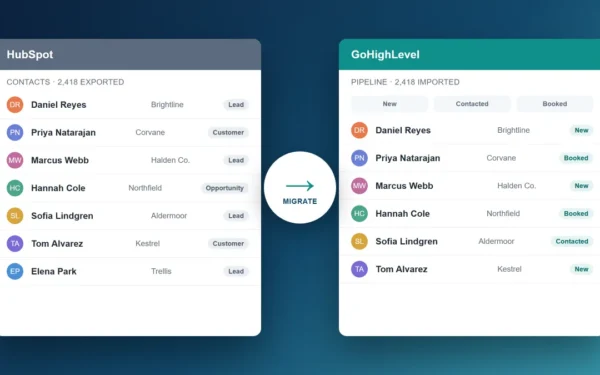
Contacts, tags, and basic automations transfer with migration help. The hard part is anything built in Keap’s Campaign Builder.
Complex Infusionsoft-era campaigns don’t export cleanly. They need to be rebuilt as GHL workflows from scratch. If you’ve got years of built-out sequences on Keap, that’s a real project, not a weekend task. One agency’s migration estimate put it plainly: Keap users with years of built automations may find the switching cost outweighs the benefit, at least in the short term.
For a company with a handful of straightforward sequences, expect 1-2 weeks to get the core automations rebuilt and running. For a company with years of accumulated Campaign Builder logic, budget closer to a month, and bring in help if you don’t have someone who can map the old logic to GHL’s workflow builder cleanly.
Which Platform Fits Which Business?
Here’s the actual call, not the “it depends” dodge.
| Business Type | Recommendation | Why |
|---|---|---|
| B2B service company needing funnels + CRM + SMS | GoHighLevel | One flat price covers the whole stack. Unlimited contacts removes the growth tax. |
| Agency or consultant managing multiple clients | GoHighLevel | White-labeling and sub-accounts don’t exist on Keap at all. |
| Solo service provider focused on quoting and invoicing | Keap | Native quoting, invoicing, and payment collection beat GHL’s more basic tools. |
| Business with complex, branching nurture sequences already built in Keap | Stay on Keap | Rebuilding years of Campaign Builder logic in GHL may cost more than it saves. |
| Coach or consultant under 1,500 contacts, simple needs | Either, lean GHL | Keap works fine at this size, but GHL’s price stays flat as the list grows. |
The B2B Operator’s Take
Here’s the pattern I keep seeing. A company signs up for Keap when they’re small, the pricing feels fine at 1,500 contacts, and three years later they’ve got 6,000 contacts, a tool that costs more than it used to, and sales and marketing automations that still live in separate corners of the business because Keap was never built to run funnels or multi-channel outreach.
That’s not a Keap failure exactly. It’s a mismatch that grows slowly until the renewal invoice makes it obvious. Is your business still the same shape it was when you signed up? For most B2B service companies past their first year or two, the answer is no, and that’s usually when GHL starts making more sense.
Where I’d push back on the easy GHL recommendation: if your business runs on complex sales sequences you’ve spent years building in Keap’s Campaign Builder, don’t switch just because the sticker price looks better. Price out the actual rebuild time against what you’re saving monthly. Sometimes the math still favors staying put, at least until those sequences need a rework anyway.
If you’re ready to see whether GoHighLevel fits your business, grab the free trial here (plus $8,273 in bonuses) and build one pipeline before committing to anything. Don’t try to migrate everything on day one. Get one workflow live, confirm it feels right, then expand.
What Small B2B Teams Keep Asking
Is GoHighLevel actually cheaper than Keap, or just cheaper upfront?
Cheaper both ways, for most businesses. GHL’s $97-297/month doesn’t change with contact count, while Keap’s $299 base covers only 1,500 contacts before costs climb fast. At 5,000+ contacts, the gap gets significant. Keap only pulls ahead on raw sticker price for very small lists under roughly 1,500 contacts, where its base plan and GHL’s Starter land close together.
Can Keap do SMS marketing like GoHighLevel?
To a point. Keap includes 500 texts and sells paid tiers from $24-279/month, but it has no WhatsApp, social DM, or voicemail drop equivalent. GHL bundles all of that into its workflow builder without a separate texting subscription.
Why is Keap’s G2 rating so much lower than GoHighLevel’s?
Partly real, partly sample size. Keap has 3.8/5 across only 30 reviews versus GHL’s 4.6/5 across 651. That’s not a lot of data for Keap. What’s consistent, though, is that Keap’s Trustpilot score runs lower than its other review scores, often tied to billing and cancellation complaints like the early termination fee on annual plans.
How hard is it to migrate from Keap to GoHighLevel?
Contacts and tags move over cleanly with migration help. The real work is rebuilding Campaign Builder sequences as GHL workflows, since they don’t export directly. Budget 1-2 weeks for a simple setup, closer to a month if you’ve got years of complex automations to recreate.
Does Keap have any AI features comparable to GoHighLevel’s?
Some, but they’re different in scope and not as recent. Keap’s AI Automation Assistant generates campaign copy and builds matching automations from a questionnaire. GHL’s AI Employee suite includes a voice agent and conversation AI across channels, which is a broader, more current build.
Is there a point where staying on Keap makes more sense than switching?
Yes, if your business is small, under 1,500 contacts, runs on invoicing and quoting rather than funnels, and you’ve already got years of working automations built in Keap’s Campaign Builder. The switching cost in that case often outweighs the savings, at least until those sequences need rebuilding anyway.